
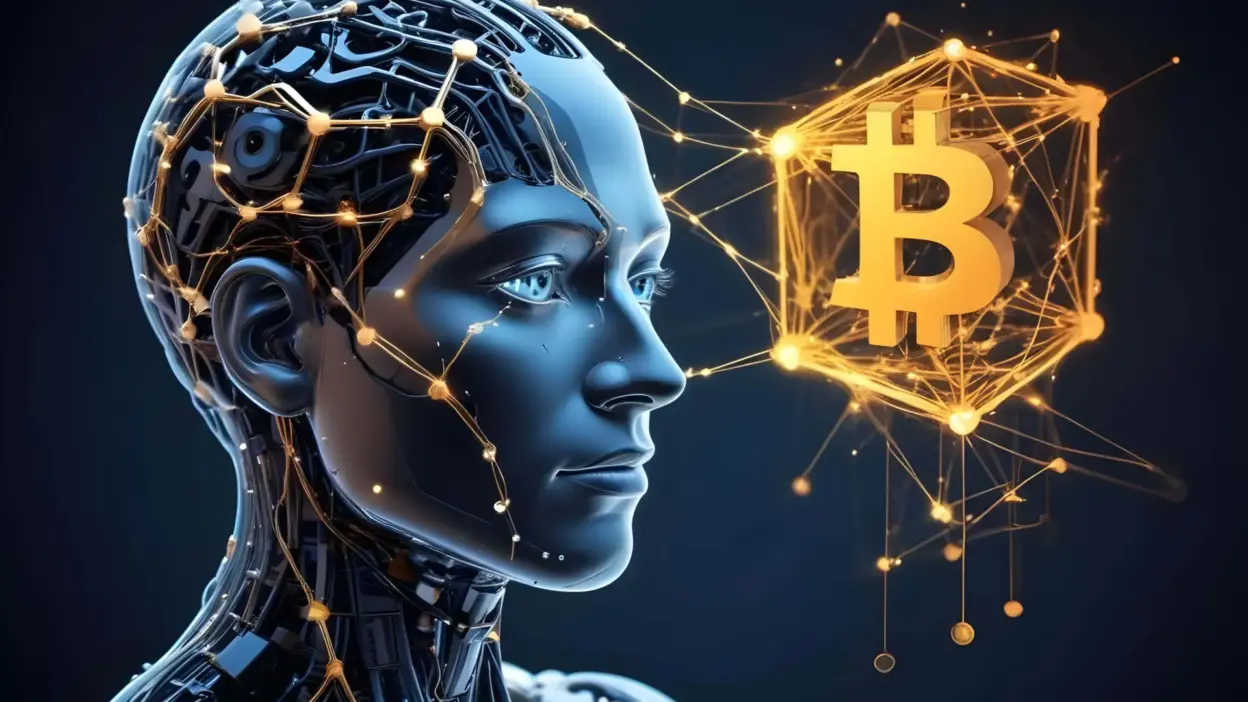
Imagine a world where machines not only learn but predict market movements, detect fraud before it occurs, and optimize transactions in milliseconds—this is how artificial intelligence is reshaping crypto networks in today’s world
How artificial intelligence is reshaping crypto networks is more than a trend—it’s a technological evolution. AI’s capacity to analyze massive datasets in real time is enhancing the security, efficiency, and scalability of decentralized systems. As of 2025, blockchain analytics powered by AI are expected to reduce crypto fraud losses by over 40%, according to industry projections.
In this article, we dive deep into how artificial intelligence is reshaping crypto networks—a convergence that’s redefining what’s possible in decentralized finance (DeFi), token economies, and even governance.
- 1 Decoding the Synergy: AI Meets Blockchain
- 2 Pioneering Projects: AI and Blockchain in Action
- 3 Smart Contracts Get Smarter
- 4 Fortifying Security: AI’s Shield in Crypto Networks
- 5 Optimizing Performance: AI’s Role in Network Scalability
- 6 Revolutionizing User Experience: Personalized Crypto Interactions
- 7 Conclusion
Decoding the Synergy: AI Meets Blockchain
The fusion of artificial intelligence and blockchain is not merely complementary—it’s revolutionary.
Each technology on its own is powerful, but together, they unlock a new paradigm in secure, intelligent, and decentralized systems.
To understand how artificial intelligence is reshaping crypto networks, we must first break down the core strengths of both technologies.
AI’s Superpower: Data Mastery and Intelligent Automation
AI thrives on data. With capabilities in predictive modeling, machine learning, and deep neural networks, AI systems can identify complex patterns, forecast market behavior, and make autonomous decisions faster and more accurately than any human analyst.
In the context of cryptocurrency, this translates to smarter trading algorithms, real-time risk assessments, and automated fraud detection.
For instance, machine learning models are now being used by exchanges to spot wash trading and pump-and-dump schemes within seconds.
This application illustrates how artificial intelligence is reshaping crypto networks by introducing adaptive, learning-driven responses to ever-changing market conditions.
The result is enhanced accuracy, speed, and decision-making across decentralized platforms.
Blockchain’s Core Strengths: Trust, Transparency, and Security
While AI brings intelligence, blockchain contributes integrity. Known for its decentralization, immutability, and transparency, blockchain offers an unalterable ledger of records—ideal for creating trust in trustless environments.
Whether it’s tracking token movements or recording smart contract executions, blockchain ensures that every action is verifiable and secure.
This combination—AI’s learning ability with blockchain’s incorruptibility—is how artificial intelligence is reshaping crypto networks in ways previously unimaginable.
Consider decentralized finance (DeFi), where AI-driven bots now manage liquidity pools, predict user behavior, and adjust interest rates dynamically while blockchain ensures all actions are transparently recorded and tamper-proof.
The Combined Power: Smart, Scalable, and Secure Networks
When AI meets blockchain, the synergy enables far more than just technical enhancement—it redefines network intelligence.
AI models can monitor blockchain networks for anomalies in real-time, optimizing energy usage in consensus mechanisms like Proof-of-Work or identifying vulnerabilities in smart contracts before they’re exploited.
An example is VeChain, which combines blockchain with AI and IoT to ensure supply chain integrity. Meanwhile, projects like Ocean Protocol are giving AI secure access to decentralized data without compromising privacy.
These innovations demonstrate how artificial intelligence is reshaping crypto networks to become more scalable, efficient, and self-governing.
Pioneering Projects: AI and Blockchain in Action
The synergy between AI and blockchain isn’t theoretical anymore—it’s unfolding in real time across multiple pioneering projects.
These initiatives showcase the tangible impact of artificial intelligence in driving blockchain innovation, usability, and trust.
From identity verification to intelligent automation, understanding how artificial intelligence is reshaping crypto networks means looking closely at the platforms leading this convergence.
Worldcoin: Biometric Identity Meets Decentralized Infrastructure

Spearheaded by OpenAI’s CEO Sam Altman, Worldcoin is one of the most ambitious attempts to merge AI with blockchain.
At its core, Worldcoin aims to provide every human on Earth with a verified digital identity through biometric iris scanning, facilitated by an orb-like device.

This identity, stored securely on the blockchain, enables users to prove their uniqueness while maintaining privacy.
AI plays a key role in identity validation, pattern recognition, and fraud prevention. By leveraging both blockchain’s immutability and AI’s precision in biometric analysis, Worldcoin exemplifies how artificial intelligence is reshaping crypto networks through scalable, secure identity systems with potential applications in universal basic income, voting, and decentralized governance.
ChainGPT: AI Tools for Web3 Development

ChainGPT is another standout platform transforming blockchain interactions through artificial intelligence.
Tailored specifically for the crypto ecosystem, ChainGPT offers AI-powered services like smart contract generation, code audits, market analysis, and legal document interpretation—all in real-time.
Its large language model is trained on crypto-specific data, making it an invaluable resource for both developers and traders.
Whether you’re automating DeFi protocols or evaluating airdrop strategies, ChainGPT shows how artificial intelligence is reshaping crypto networks by embedding intelligent tooling directly into blockchain workflows.
Other Notable Projects Pushing the AI-Blockchain Frontier
Several other groundbreaking platforms are blending AI with blockchain technology:
- Ocean Protocol: Empowers users to share and monetize data using blockchain, with AI models accessing datasets in a privacy-preserving manner.
- Fetch.ai: Utilizes autonomous AI agents to perform tasks like decentralized data exchange, smart parking, and energy grid optimization on blockchain.
- Numerai: Combines blockchain incentives with AI-based stock market prediction models built collaboratively by data scientists worldwide.
Each of these platforms reinforces how artificial intelligence is reshaping crypto networks, ushering in new use cases that go beyond finance into identity, data, infrastructure, and machine autonomy.
Smart Contracts Get Smarter
Smart contracts—self-executing agreements encoded on the blockchain—have long been hailed as a breakthrough in automation and decentralization.
But their initial limitations are becoming more apparent in an increasingly data-driven world. Enter artificial intelligence, the catalyst making these contracts more adaptive, responsive, and intelligent. This evolution is central to understanding how artificial intelligence is reshaping crypto networks.
AI-Enhanced Contracts: From Static Logic to Dynamic Intelligence
Traditional smart contracts operate on predefined conditions. Once deployed, they can’t adjust to unforeseen events or real-time inputs.
That’s where AI steps in. With machine learning algorithms, natural language processing, and decision-making capabilities, AI can feed smart contracts with real-time data—be it weather patterns, stock prices, or geopolitical news—and enable them to adjust terms or trigger events dynamically.
This transformation is at the heart of how artificial intelligence is reshaping crypto networks, turning rigid code into flexible, intelligent agreements that can interpret context and act accordingly.
For example, an AI-enhanced DeFi lending contract could automatically adjust interest rates based on borrower behavior or macroeconomic indicators, rather than relying solely on static collateral ratios.
Use Cases: DeFi and Supply Chains Go Autonomous
In decentralized finance, platforms like Aave and Compound are beginning to explore AI integration for smarter asset management.
AI models can predict liquidity needs, forecast market volatility, and dynamically adjust yield farming strategies—all while blockchain secures every transaction transparently.
Another powerful use case is supply chain management. Projects like Ambrosus and OriginTrail are incorporating AI to enhance blockchain tracking systems.
Imagine a smart contract that not only records the movement of goods but also responds to delays, spoilage, or customs issues in real time, rerouting shipments automatically or adjusting payments accordingly.
These examples clearly illustrate how artificial intelligence is reshaping crypto networks, enabling smart contracts to become truly autonomous agents that don’t just execute but think, learn, and adapt.
Benefits: Automation, Accuracy, and Trust Amplified
The integration of AI significantly reduces human intervention, which in turn minimizes errors and fraud. Automated contract execution means fewer disputes, while adaptive logic ensures fairness even in complex, evolving scenarios.
This drives higher confidence among users and institutions alike, especially in high-stakes sectors like finance and global trade.
Ultimately, how artificial intelligence is reshaping crypto networks through smarter contracts is about more than just efficiency—it’s about creating systems that are self-sustaining, predictive, and trustworthy by design.
Fortifying Security: AI’s Shield in Crypto Networks
In the decentralized world of cryptocurrency, security isn’t just a feature—it’s a necessity. From wallet hacks to phishing scams and smart contract exploits, crypto platforms face a growing wave of sophisticated threats.
Fortunately, artificial intelligence is emerging as a powerful defense mechanism, offering real-time protection against malicious activity.
Understanding how artificial intelligence is reshaping crypto networks in terms of security is vital for the next phase of blockchain evolution.
Threat Detection: AI’s Vigilance Against Fraud and Anomalies
AI algorithms excel in anomaly detection by analyzing massive volumes of blockchain data at speeds no human team could match.
Machine learning models are trained to recognize patterns of legitimate transactions and flag deviations instantly.
This includes identifying wash trading, unusual transaction volumes, wallet behavior shifts, and even insider threats long before they escalate.
For example, AI-based systems can detect sudden spikes in gas fees or transaction batching that often precede a front-running attack.
These insights power automated alerts or initiate smart contract failsafes, demonstrating how artificial intelligence is reshaping crypto networks with proactive, adaptive security frameworks.
Case Studies: Real-World Success in Crypto Security
A prominent case is Binance, one of the world’s largest crypto exchanges, which uses AI and big data to monitor for irregular trading patterns, phishing attempts, and KYC fraud.

Their AI-driven security protocols helped mitigate a large-scale phishing attack in 2022 by detecting unusual access patterns and blocking malicious transactions in real time.
Another case is Elliptic, a blockchain analytics firm that leverages AI to track illicit crypto flows. Their platform has been instrumental in identifying wallets tied to darknet markets, ransomware campaigns, and terrorist financing.

These examples reinforce how artificial intelligence is reshaping crypto networks into safer environments, building institutional and user trust.
Future Outlook: AI as the Cybersecurity Backbone of Web3
Looking ahead, AI will become the default guardian of crypto ecosystems. Future AI tools may predict zero-day vulnerabilities in smart contracts before they’re deployed, simulate attack scenarios in DeFi protocols, or even enforce decentralized insurance policies through real-time loss assessments.
As quantum computing looms, the arms race between security and exploitation will intensify, placing AI firmly at the core of blockchain defense strategy.
That’s how artificial intelligence is reshaping crypto networks for long-term resilience: not just reacting to threats but outsmarting them.
Optimizing Performance: AI’s Role in Network Scalability
One of the most persistent challenges in blockchain technology is scalability—the ability to process thousands of transactions per second without compromising security or decentralization.
While traditional approaches like sharding and Layer-2 solutions offer incremental improvements, artificial intelligence introduces a paradigm shift.
Understanding how artificial intelligence is reshaping crypto networks includes recognizing its pivotal role in optimizing performance and scaling blockchain infrastructures.
Efficiency Gains: Smarter Transaction Processing and Resource Allocation
AI excels at real-time optimization. In blockchain networks, it can dynamically manage node activity, bandwidth usage, and energy consumption, ensuring that resources are utilized with maximum efficiency.
For instance, AI-driven consensus models can reduce latency by predicting peak usage times and pre-scheduling transaction validation accordingly.
Furthermore, machine learning can streamline transaction ordering and block propagation, improving processing times without sacrificing decentralization.
These efficiency gains are central to how artificial intelligence is reshaping crypto networks, transforming previously slow and congested blockchains into fast, adaptive ecosystems.
Scalability Solutions: Pushing Throughput Boundaries
AI not only enhances existing infrastructure, it also introduces novel solutions to blockchain’s scalability bottlenecks.
Reinforcement learning, for example, can train blockchain systems to adaptively reconfigure their architecture under load.
AI can also optimize routing in multi-chain ecosystems, ensuring transactions are automatically processed through the most efficient pathways.
Take Algorand and Fetch.ai, for instance. Algorand uses AI-driven cryptographic sortition to maintain a high-performance consensus algorithm, while Fetch.ai implements autonomous AI agents to manage data and service transactions efficiently.
These platforms exemplify how artificial intelligence is reshaping crypto networks to handle mass adoption without breaking under pressure.
Real-World Implementations: AI + Blockchain at Scale
Several trailblazing projects are already showcasing the synergy of AI and blockchain for performance optimization:
- Numerai utilizes decentralized AI models to drive predictive data trading while maintaining blockchain integrity and privacy.
- SingularityNET combines AI with blockchain to create a decentralized marketplace for AI services, optimizing task allocation across its network using smart algorithms.
- DeepBrain Chain uses AI to distribute computing resources for neural network training on the blockchain, cutting costs while improving performance.
These implementations reflect the real and growing momentum behind how artificial intelligence is reshaping crypto networks, especially in terms of scaling operations to meet global demand.
Revolutionizing User Experience: Personalized Crypto Interactions
As blockchain networks mature, user experience has become a defining factor in adoption. While decentralization and security remain foundational, modern users demand intuitive, responsive platforms tailored to their needs.
Artificial intelligence plays a crucial role here, transforming rigid crypto interfaces into dynamic, user-friendly environments.
A key part of understanding how artificial intelligence is reshaping crypto networks lies in its ability to make blockchain interactions feel seamless, personalized, and accessible.
AI-Driven Interfaces: Personalization in Wallets and Trading Platforms
AI-powered interfaces adapt in real-time to user behavior. Whether it’s suggesting token swaps based on trading habits or offering risk-adjusted portfolio advice, AI enables crypto platforms to provide experiences tailored to individual preferences.
For example, AI in platforms like Robinhood Crypto and Binance helps analyze user transactions and provide personalized insights or warnings, like alerting users to risky trading behaviors or suggesting less volatile alternatives.

This reflects how artificial intelligence is reshaping crypto networks by elevating functionality beyond static interfaces.
AI chatbots also streamline support, answering technical questions and guiding users through complex operations like staking, bridging, or swapping tokens.
This kind of intelligent assistance bridges the gap between new users and blockchain’s intricate mechanics.
Accessibility Improvements: Making Blockchain User-Friendly
Many users are still daunted by the cryptic interfaces of Web3 apps. AI steps in by simplifying this complexity.
Natural Language Processing (NLP) enables voice and text-based interactions, allowing users to ask questions like “What’s the cheapest way to transfer ETH?” or “How do I bridge to Polygon?” and receive contextual answers.
Projects like Argent and MetaMask Snaps are beginning to experiment with AI-based UX enhancements that help users set up wallets, manage assets, and interact with dApps—without writing a line of code or understanding gas fees.

Such developments highlight how Artificial Intelligence is reshaping crypto networks for inclusivity and broader appeal.
Engagement Strategies: Tailored Content and Community Recommendations
Crypto communities thrive on timely, relevant information—and AI is instrumental in curating it. AI algorithms analyze user sentiment, engagement patterns, and token preferences to serve up custom dashboards, market news, and social updates. This boosts user retention and deepens community trust.
For instance, platforms like CoinGecko and CoinMarketCap integrate AI-based personalization in their mobile apps, offering customized alerts and watchlists.

These features show how Artificial Intelligence is reshaping crypto networks to become more user-centric and experience-driven.
Conclusion
As we’ve explored throughout this article, how Artificial Intelligence is reshaping crypto networks is evident across multiple dimensions: fortifying security, scaling performance, personalizing user experience, and powering intelligent automation through smart contracts.
AI’s predictive models and real-time analytics are helping blockchain platforms detect fraud faster, reduce latency, and adapt dynamically to user behavior.
From platforms like Worldcoin’s identity verification to ChainGPT’s developer tools, we are witnessing the formation of a new digital frontier—one where trustless systems become smarter, more secure, and more accessible.
This transformation is not only optimizing existing blockchain infrastructure but is also redefining what’s possible in decentralized finance, governance, and digital identity.
As the technology matures, how Artificial Intelligence is reshaping crypto networks will become even more evident, unlocking powerful new use cases in sectors far beyond finance.