
Bitcoin Price Forecast Q2 2025: Can Bitcoin break $120,000 this quarter? Let’s explore key technical signals, macro trends, ETF momentum, and expert insights shaping BTC’s price forecast in Q2 2025.
- 1 Bitcoin’s Q1 2025 Recap: The Road to Now
- 2 Macro Factors Influencing Bitcoin Price in Q2 2025
- 3 On-Chain & Technical Analysis: Patterns and Signals for Bitcoin Price Forecast Q2 2025
- 4 Analyst Predictions and Market Sentiment: Bitcoin Price Forecast Q2 2025
- 5 Can Bitcoin Break the $120,000 Barrier in Q2 2025?
- 6 Altcoin Correlation and Impact on Bitcoin Dominance
- 7 Historical Q2 Bitcoin Trends: What the Past Tells Us
- 8 Investor Strategies for Q2 2025
- 9 Conclusion
Bitcoin’s Q1 2025 Recap: The Road to Now
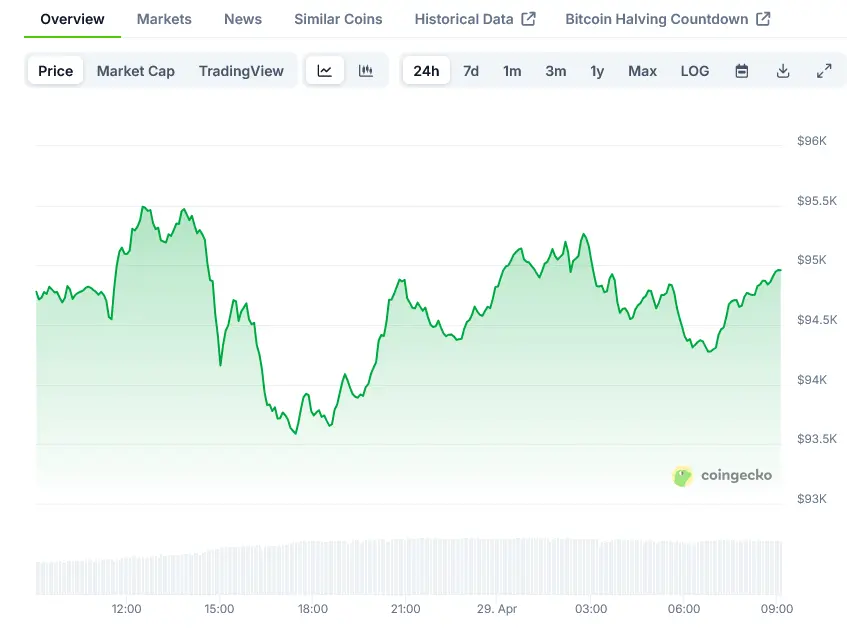
As we enter Q2, the Bitcoin price forecast for Q2 2025 is mainly based on the trends and events that occurred in Q1.
The first quarter of 2025 was nothing short of momentous for Bitcoin, with wild price swings, record ETF inflows, and growing institutional acceptance all laying the foundation for what’s to come.
Q1 2025 Market Summary: Highs, Lows, and Volume
Bitcoin entered 2025 with strong bullish momentum, reaching a new all-time high of $109,225 in early January. This rally was fueled by optimism about the macroeconomic rebound, favorable regulatory changes, and the continued adoption of spot Bitcoin ETFs.
However, the price fell sharply by April, dropping below $80,000, before rising to more than $100,000 in May.
Despite the volatility, trade volumes remained consistently high, showing sustained investor interest and liquidity. This active trading environment emphasizes Bitcoin’s growing role in global financial markets.
ETF Inflows, Regulatory Momentum & Institutional Growth
One of the most significant events in Q1 2025 was the large capital inflow into US-listed spot Bitcoin ETFs, which recorded a whopping $4.4 billion in net inflows between mid-January and early February.
This marked a 175% year-over-year increase over Q1 2024, confirming increased institutional demand for Bitcoin as a hedge against inflation and fiat volatility.
In March 2025, President Trump signed an executive order creating a Strategic Bitcoin Reserve, thus establishing Bitcoin as a national reserve asset.
This political backing boosted market confidence and indicated a greater integration of digital assets into the mainstream financial system.
Institutional players also acted aggressively. MicroStrategy, for example, increased its holdings to more than 447,000 BTC, demonstrating corporate treasuries’ confidence in Bitcoin’s long-term value.
Year-on-Year Performance: Q1 2024 vs. Q1 2025
In comparison to Q1 2024, when Bitcoin reached $73,000 backed by $12.1 billion in ETF inflows, Q1 2025 saw a stronger price ceiling, increased capital inflows, and more pronounced institutional activity.
What’s the difference? A maturing market environment with stronger infrastructure, increased liquidity, and growing global interest.
Why Q1 is Important for the Bitcoin Price Forecast in Q2 2025
Price trends, ETF dynamics, and regulatory developments from Q1 form the foundation of any Bitcoin Price Forecast for Q2 2025.
Bitcoin appears to be in a good position to test higher resistance levels, thanks to solid market infrastructure, supportive regulations, and growing institutional demand.
However, the volatility witnessed serves as a reminder to investors of the asset’s unpredictable nature, necessitating close monitoring of Q2 macroeconomic shifts for informed projections.
Macro Factors Influencing Bitcoin Price in Q2 2025
The Bitcoin price forecast for Q2 2025 is closely linked to evolving macroeconomic dynamics. Key global forces, ranging from monetary policy moves and geopolitical uncertainties, are actively impacting market conditions and influencing Bitcoin’s price trajectory.
1. Federal Reserve Monetary Policy and Inflation Data
In response to a cooling labor market and sticky inflation, the US Federal Reserve has decided to maintain interest rates at 4.25%-4.50% in Q2 2025. However, softer-than-expected inflation data in April fueled investor optimism about potential rate cuts, facilitating a Bitcoin surge over $103,000.
Because Bitcoin thrives in low-interest environments due to its risk-taking nature, any dovish pivot by the Fed could bolster upward momentum. Conversely, sustained high rates may cap price growth by minimizing excess liquidity in the market.
2. Geopolitical Tensions and Bitcoin as a Safe Haven Asset
Global geopolitical volatility, such as trade tensions and currency wars, continues to influence risk sentiment. Notably, Bitcoin rallied 15% in April 2025 while equities weakened, highlighting its emerging role as a macro hedge against political and economic instability.
Investors are increasingly turning to Bitcoin as a decentralized asset that is less vulnerable to state-level manipulation or cross-border restrictions.
3. Fiat Currency Devaluation Trends
With global central banks printing money to address economic imbalances, fiat currency devaluation is again in the spotlight. Bitcoin, with its limited supply of 21 million, is viewed by many as a hedge against the erosion of purchasing power.
This trend continues to fuel capital flows into crypto markets, particularly among investors looking for protection against inflation and currency volatility.
4. Global Crypto Regulation and Evolution of Tax Policy
In Q2 2025, regulatory clarity has improved, but it is still a double-edged sword. In the US, new IRS crypto tax rules now compel brokers to report digital asset transactions through Form 1099-DA, which enhances transparency while increasing compliance complexity.
Meanwhile, states such as Arizona and New Hampshire have adopted pro-crypto legislation, whilst countries such as Australia have chosen not to enact new crypto tax laws, so maintaining the status quo under general tax principles.
These regulatory shifts are crucial in shaping investor behavior and institutional participation. A consistent, clear regulatory environment attracts long-term investments, but uncertainty frequently fuels volatility.
In analyzing the Bitcoin Price Forecast for Q2 2025, it’s important to consider macroeconomic factors, both positive and negative.
The convergence of monetary easing prospects, geopolitical stress, fiat dilution, and regulatory clarity creates a complex but potentially bullish setup for Bitcoin in the months ahead.
On-Chain & Technical Analysis: Patterns and Signals for Bitcoin Price Forecast Q2 2025
As Bitcoin continues its excellent performance into Q2 2025, technical charts and on-chain metrics provide a better picture of what could lie ahead. For traders and long-term investors alike, studying these factors is critical to developing a solid Bitcoin price forecast for Q2 2025.
Key Technical Indicators: RSI, MACD, and Moving Averages
Bitcoin’s current price structure is bullish, supported by strong momentum across technical charts.
- RSI (Relative Strength Index): Remains above 70, indicating overbought conditions signaling a likely short-term correction or consolidation. However, persistent strength can also validate bullish momentum.
- MACD (Moving Average Convergence Divergence): The MACD line is currently higher than the signal line, indicating upward price pressure. The histogram remains positive, indicating that buyers are still in control.
- 50-Day and 200-Day Moving Averages: A bullish “golden cross” remains in place, with the 50-Day MA trading above the 200-Day MA, which is historically an indicator of medium-to-long-term upward trends. This formation continues to boost market confidence.
Fibonacci Retracement Levels from All-Time Highs
With Bitcoin recently regaining the $100K level, Fibonacci retracement levels from past highs provide insight into major areas of price reaction:
- Support: The 23.6% retracement zone at $88,000 provides strong support, with further cushion near $78,000 if the market falls further.
- Resistance: Immediate resistance is observed at around $106,000. A confirmed breakout above this level could trigger a sharp move toward the much-anticipated psychological target of $120,000.
On-Chain Data Trends: Whale Activity and Exchange Flows
Understanding what the “smart money” is doing behind the scenes requires analyzing on-chain activity:
- Whale Accumulation: Wallets with 10-10,000 BTC have accumulated more than 83,000 BTC in the last month. The number of new whale wallets continues to grow, indicating renewed institutional and high-net-worth interest.
- Exchange Flows: A significant increase in exchange outflows suggests that investors are transferring Bitcoin to cold storage, which is often a bullish sign of long-term holding intent. Simultaneously, ETF inflows have exceeded $5 billion, indicating institutional conviction in Bitcoin’s upward trajectory.
MVRV Ratio and Realized Cap Metrics
- MVRV Ratio: Sitting around 2.0, the Market Value to Realized Value ratio suggests Bitcoin is not in bubble territory. Historically, this ratio signals a top only when it exceeds 3.7, indicating more upside potential.
- Realized Cap: The rising realized cap confirms that newer capital is entering the market at higher prices. This metric underlies price stability, as it demonstrates long-term investors are boosting their cost basis, reducing selling pressure.
Support and Resistance Zones Heading Deeper into Q2
- Support Levels: Strong demand zones are apparent at about $92,000, with firmer support around $77,500, the zone where whales have exhibited recurring accumulation.
- Resistance Zones: Beyond $106,000, the next key resistance zone is between $115,000 and $120,000, where significant profit-taking is expected unless bullish momentum picks up.
Technical and on-chain data in Q2 2025 support a cautiously bullish Bitcoin price forecast. If macroeconomic conditions remain favorable and whale/institutional behavior trends positively, Bitcoin could realistically challenge and potentially break the $120,000 barrier.
However, RSI overbought indications and major resistance zones suggest traders should remain prepared for short-term volatility.
Analyst Predictions and Market Sentiment: Bitcoin Price Forecast Q2 2025
As Bitcoin trades above $103,000 in mid-May 2025, market analysts and sentiment indicators shed light on its possible direction for the remainder of Q2.
Expert Forecasts: Bloomberg, Glassnode, and Messari
Bloomberg Intelligence has historically forecast that Bitcoin will hit $100,000 in 2025, based on historical growth trends.
According to Glassnode, Bitcoin’s Realized Cap increased by 117%, from $402 billion to $870 billion, showing considerable capital inflow and great investor confidence.
Messari notes that corporations have become the main Bitcoin buyers in 2025, acquiring over 157,000 BTC (about $16 billion) thus far, exceeding new Bitcoin supply by 3.3 times.
This institutional demand indicates that major firms are increasingly using Bitcoin as a treasury reserve asset and a store of value.
AI and Algorithmic Model Projections
AI models have been employed to predict Bitcoin price movements. For example, an AI model predicted a potential trading range of $108,000 to $118,000 for June 1, 2025, if the current upswing persists.
Key bullish factors include Bitcoin’s breakout above the psychologically significant $100,000 level, increasing whale accumulation, consistent inflows into spot ETFs, and the post-halving effect.
CryptoMamba, a novel Mamba-based State Space Model (SSM) architecture, has shown improved accuracy in capturing long-range dependencies in financial time-series data, resulting in more accurate predictions and greater generalizability across different market conditions.
Sentiment Analysis: Social Media, News, and Derivatives Markets
- Social Media and News: Market sentiment about Bitcoin in May 2025 is notably positive, thanks to the successful launch of spot Bitcoin ETFs and growing mainstream adoption. Social media buzz and Google Trends for Bitcoin have picked up again as the public takes notice of the approach toward $100K mark.
- Derivatives Markets: Coinbase’s acquisition of Deribit, the world’s largest trading platform for Bitcoin and Ether options, for $2.9 billion represents a strategic move into the lucrative crypto derivatives market, with the goal of accelerating its global expansion.
Bullish vs Bearish Scenarios
- Bullish Case: Analysts predict a mid-2025 price range of $120,000 to $210,000, based on ETF inflows and institutional traction. Bitcoin’s rise to $95,000 is consistent with several predictions forecasting $130,000 to $200,000 by Q4 2025.
- Bearish Case: Some analysts caution that Bitcoin’s price remains below its January peak and still indicates correlation with broader markets, especially the S&P 500. Experts believe that when U.S. asset trust wanes, Bitcoin could achieve new highs, but caution that Bitcoin’s independence from macroeconomic trends is still incomplete, and its correlation with risk assets may grow again.
The Bitcoin price forecast for Q2 2025 is influenced by institutional adoption, AI-driven predictions, and market sentiment.
While bullish scenarios indicate potential highs of $120,000 or more, bearish outlooks highlight the importance of caution due to macroeconomic factors and market correlations.
Can Bitcoin Break the $120,000 Barrier in Q2 2025?
As Bitcoin hovers at $103,000 in mid-May 2025, the question arises: Will it break the $120,000 mark in the remaining months of Q2? Several basic variables support a potential breakout, but certain risks could hinder progress.
Key Drivers Supporting a Breakout
Post-Halving Supply Constraints
The April 2024 Bitcoin halving cut mining rewards from 6.25 to 3.125 BTC per block, essentially half the rate at which new Bitcoins enter circulation. Historically, such incidents have resulted in considerable price hikes in the following 12 to 18 months due to supply restrictions.
Institutional Investment Momentum
Bitcoin’s institutional adoption accelerated in 2025. Notably, BlackRock’s Bitcoin ETF has seen a 19-day stretch of inflows, with more than $1 billion in the last week alone.
Furthermore, partnerships such as FalconX’s with Standard Chartered show the growing institutional interest and infrastructure backing Bitcoin investments.
Expansion of Spot Bitcoin ETFs
The approval and launch of spot Bitcoin ETFs in 2024 gave investors regulated avenues to obtain exposure to Bitcoin. These ETFs have seen huge capital inflows, with BlackRock’s ETF accounting for a large percentage.
The continued growth and adoption of such financial products strengthen Bitcoin’s legitimacy and accessibility.
Potential Risks and Headwinds
Regulatory Uncertainties
While the regulatory environment has improved under the current US government, uncertainties persist. The SEC is currently working on establishing new rules for crypto tokens with the goal of providing clearer guidelines.
However, the evolving nature of these regulations may pose unexpected challenges for the market.
Market Manipulation by Large Holders
The influence of large Bitcoin holders, or “whales,” is a cause of concern. Their ability to drastically influence market prices through big transactions can result in increased volatility and potential price distortions.
Global Economic Slowdown
The global economy is expected to increase by only 3.3% in 2025, which is below the historical average.
Persistent inflation and geopolitical tensions are contributing factors to this slowdown, which could affect investor sentiment and risk appetite, potentially influencing Bitcoin’s price trajectory.
Probabilistic Price Scenarios for Q2 2025
- Conservative Scenario: Bitcoin remains in the $95,000 to $105,000 range, facing resistance due to regulatory uncertainties and economic headwinds.
- Moderate Scenario: Bitcoin surpasses $110,000, driven by continued institutional inflows and favorable market sentiment.
- Aggressive Scenario: Bitcoin hits $120,000, driven by post-halving supply restrictions, strong institutional adoption, and favorable regulatory developments.
While challenges remain, the combination of lower supply post-halving, increasing institutional investment, and the expansion of regulated investment vehicles sets Bitcoin favorably for a potential breakout beyond $120,000 in Q2 2025.
Investors should exercise caution in this volatile market environment, taking into account both the opportunities and risks.
Altcoin Correlation and Impact on Bitcoin Dominance
As we progress through Q2 2025, the dynamics between Bitcoin and altcoins will play an important role in shaping the crypto environment.
Understanding the relationship between altcoin movements and Bitcoin’s market dominance is crucial for predicting Bitcoin’s price trajectory.
How Altcoin Movements Affect Bitcoin’s Price
Historically, altcoins often follow Bitcoin’s lead, with BTC price swings setting the tone for the wider crypto market. However, recent trends indicate a shift.
In May 2025, altcoins like as Ethereum (ETH), XRP, and Solana (SOL) beat Bitcoin, indicating a decoupling in price movements. This divergence can lead to capital rotation, where investors reallocate funds from Bitcoin to altcoins, thus potentially putting downward pressure on BTC’s price.
Bitcoin Dominance Index Trends in Early 2025
The Bitcoin Dominance Index (BTC.D), which measures Bitcoin’s market capitalization in relation to the overall crypto market, has fluctuated significantly in early 2025.
After peaking at 64.98% in early May, the highest since 2021, BTC.D has since dropped to about 62%, showing a resurgence in altcoin investments.
This decline in dominance shows that investors are diversifying their portfolios, favoring altcoins over Bitcoin, which may have an influence on BTC’s price stability and growth potential.
Implications for Forecasting Bitcoin’s Price Trajectory
The connection between altcoin performance and Bitcoin dominance has substantial implications for BTC’s price outlook:
- Capital Diversion: As investors turn their focus to altcoins, reduced demand for Bitcoin could halt its price increase.
- Market Sentiment: A declining BTC dominance frequently indicates increased risk appetite among investors, who choose more volatile assets like altcoins, which may result in short-term BTC price corrections.
- Potential for Altseason: Sustained altcoin rallies and decreasing BTC dominance could signal an “altseason,” where altcoins significantly outperform Bitcoin, impacting BTC’s market position and price dynamics.
Monitoring altcoin trends and Bitcoin’s market dominance is critical for anticipating BTC price movements in Q2 2025. A balanced view of the crypto ecosystem will provide more insight into prospective market movements and investment opportunities.
Historical Q2 Bitcoin Trends: What the Past Tells Us
Understanding Bitcoin’s past performance in the second quarter (Q2) provides useful insights into its price trajectory. Analyzing data from 2020 to 2024 shows trends influenced by market cycles, investor sentiment, and macroeconomic variables.
Bitcoin’s Q2 Performance (2020–2024)
- 2020: Bitcoin began the year around $8,000 and fell to approximately $5,550 in March as a result of pandemic-induced market turmoil. However, at the end of Q2, it had returned to around $9,000, marking a recovery phase.
- 2021: In Q2, Bitcoin hit an all-time high of about $65,000 in April, fueled by institutional adoption and the “digital gold” concept. However, by June, it had dropped to roughly $30,000, due to regulatory concerns and environmental criticisms.
- 2022: The second quarter was characterized by high volatility. Bitcoin’s price plunged from around $47,300 in January to less than $20,000 by June, due to macroeconomic tightening and the collapse of major crypto projects.
- 2023: Bitcoin began the year at roughly $16,800 and progressively increased to over $42,000 by December, with Q2 contributing to this gradual rise amid renewed investor confidence.
- 2024: In Q2, Bitcoin reached new highs, hitting $93,000, propelled by the introduction of spot Bitcoin ETFs and greater institutional investment.
Seasonal Market Behavior Patterns
Bitcoin’s performance frequently reflects seasonal trends:
- Post-Halving Rallies: Historically, Bitcoin’s price tends to surge in the months following a halving event, as lower supply meets sustained or increasing demand.
- Mid-Year Volatility: Q2 is highly volatile, with significant price swings influenced by macroeconomic developments and shifts in market sentiment.
Lessons from Previous Bull and Bear Cycles
- Bull Markets: Characterized by rapid price increases, often following halving events, and fueled by institutional adoption and favorable regulatory developments.
- Bear Markets: Characterized by significant price drops, often caused by regulatory crackdowns, macroeconomic tightening, or serious market disruption.
Understanding these cycles helps in anticipating potential market swings and making smart investment decisions.
By analyzing historical Q2 trends and identifying recurring patterns, investors can better prepare to navigate Bitcoin’s dynamic market environment in 2025.
Investor Strategies for Q2 2025
As Bitcoin trades at $103,000 in mid-May 2025, investors are evaluating techniques to navigate the volatile crypto market. Long-term holding, swing trading, dollar-cost averaging, derivatives use with caution, and strong risk management are all crucial approaches.
Long-Term HODLing vs Swing Trading
- HODLing: This technique involves buying and holding Bitcoin for a lengthy period of time while ignoring short-term market swings. It is popular among investors who have confidence in Bitcoin’s long-term potential and prefer a passive investment strategy. HODLing reduces the stress of market timing and can result in significant gains if Bitcoin continues its upward trend.
- Swing Trading: This active technique involves profiting from short- to medium-term market swings. Swing traders use market trends and technical indicators to buy low and sell high within days or weeks. While it has the potential for quick rewards, it requires constant market monitoring and a higher risk tolerance.
Dollar Cost Averaging (DCA) Amid High Volatility
DCA entails investing a fixed amount in Bitcoin on a regular basis, regardless of its price. This method mitigates the impact of market volatility and eliminates the need to time the market.
It’s particularly effective for long-term investors who want to build a position over time without the stress of market swings.
Cautious Use of Derivatives (Futures/Options)
Derivatives such as futures and options enable investors to speculate on Bitcoin fluctuations without owning the asset.
While they can boost profits, they also raise the potential of losses. Before engaging in derivative trading, one needs to understand the complexities and risks involved.
Risk Management and Setting Realistic Targets
Effective risk management is critical in the volatile crypto industry. The key practices include:
- Diversification: Spreading investments across multiple assets to reduce risk.
- Stop-Loss Orders: Use predetermined sell points to limit potential losses.
- Position Sizing: Investing a small percentage of funds in a single trade to avoid large losses.
- Realistic Targets: Establishing attainable profit targets based on detailed market analysis.
Implementing these tactics can assist investors in navigating the crypto market’s uncertainties and protecting their capital.
Investors in Q2 2025 should align their strategies with their risk tolerance and investment goals. Whether choosing HODLing, swing trading, DCA, or derivatives, adopting effective risk management strategies is vital for long-term success in the crypto market.
Conclusion
As we approach the midpoint of Q2 2025, Bitcoin’s price hovers at $103,000, highlighting a 14% gain in April and approaching an all-time high. A combination of bullish and bearish factors is influencing the crypto market, shaping Bitcoin’s trajectory in the coming months.
Given the present momentum and institutional interest, $120,000 in Q2 is a realistic goal. Standard Chartered has even suggested that this target may be conservative, with projections of up to $200,000 by the end of the year.
However, investors should remain mindful of the inherent volatility and other variables that could influence the market.