Ethereum’s scaling wars are far from over and it’s clear that Layer 2 networks are capturing the lead.
Known for their ability to offload transactions from the congested Layer 1, Layer 2 networks have surged ahead in both adoption and capability.
- 1 What are Layer 2 networks?
- 2 Layer 2 Surge: The 2025 Landscape at a Glance
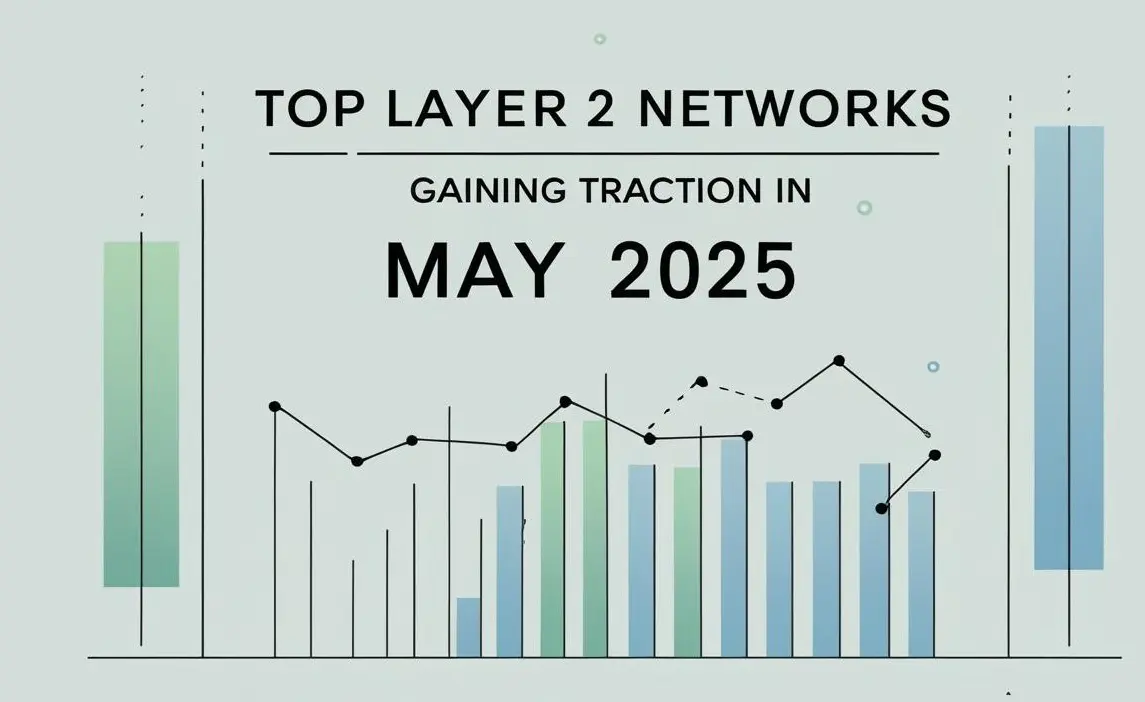
- 3 Top Layer 2 Networks Gaining Traction in May 2025
- 4 Emerging Contenders to Watch
- 5 Why Layer 2s are Gaining Traction
- 6 Challenges of Layer 2 Networks Growth
- 7 Future Outlook: What to Expect in the Next Quarter
- 8 Conclusion
- 9 Frequently Asked Questions
What are Layer 2 networks?
Layer 2 networks are blockchain scaling solutions that are built on top of Layer 1 blockchains such as Ethereum. Their primary goal is to increase transaction throughput and reduce costs while maintaining Layer 1 security.
Layer 2s will be critical infrastructure in the Web3 stack by 2025, as user adoption and application sophistication increase.
Why do Layer 2s Exist?
Layer 1 blockchains, particularly Ethereum, are frequently congested and expensive due to limited block space and increasing demand. During peak activity, users may encounter:
- Slow transaction speeds
- Gas fees over $50
- Obstacles in dApp functionality.
Layer 2 addresses this by processing transactions off-chain before bundling and submitting them to the mainnet in an optimized, compressed format. This means:
- Lower costs
- Faster confirmations
- Reduced load on Layer 1
How Layer 2 Networks Work
Layer 2 networks function by separating transaction execution and settlement. While computations and state changes take place on Layer 2, the final results are routed back to Layer 1 for security and data availability.
Benefits of Layer 2 Networks:
- Scalability: Supports thousands of transactions per second.
- Low fees: Transactions cost cents or less.
- Security: Layer 2s typically inherit Ethereum’s settlement guarantees.
- Composable Ecosystems: Supports DeFi, NFTs, and Web3 apps.
- Easy Onboarding: Most L2 networks offer account abstraction, gasless transactions, and fiat on-ramps.
Layer 2s in 2025: Beyond Scaling
Layer 2 networks today are capable of much more than simply scaling. They’ve grown into independent ecosystems with thriving dApps, developer communities, and even their own governance systems. Many Layer 2 networks are now offering:
- On-chain DAOs
- Native DeFi protocols
- Modular frameworks for Layer 3 applications
- Supports AI, real-world assets (RWAs), and Web3 gaming.
Why They Matter in 2025
In May 2025, the Ethereum ecosystem hosts over $15.5 billion in Layer 2 TVL, with some Layer 2 networks (such as Arbitrum and zkSync) processing more daily transactions than Ethereum itself.
These networks are more than just scaling tools; they are critical battlegrounds for liquidity, developers, and user experience.
As crypto transitions from speculation to utility, Layer 2 networks are becoming the standard environment for building and using decentralized applications.
Layer 2 Surge: The 2025 Landscape at a Glance
As of May 2025, Ethereum’s Layer 2 (L2) ecosystem has grown significantly, owing to technological advancements and increased adoption.
Here we’ll discuss an overview of the current landscape, including a comparison of rollups and sidechains, key metrics, and emerging trends that are driving this surge.
A Brief Comparison of Rollups vs Sidechains
Rollups:
- Process transactions off-chain and send compressed data to Ethereum, inheriting its security.
There are two main types:
- Optimistic Rollups: Assume transactions are valid by default and provide a challenging period for fraud proofs.
- Zero-Knowledge (ZK) Rollups: Use cryptographic proofs to validate transactions, resulting in faster finality.
Sidechains:
- Function as independent blockchains with their own consensus mechanisms.
- Connected to Ethereum via bridges, but do not directly inherit its security.
While rollups provide increased security by leveraging Ethereum’s base layer, sidechains provide greater flexibility and customization, albeit with distinct security concerns.
TVL and Volume Metrics in May 2025
The Total Value Locked (TVL) for Ethereum’s L2 solutions has surpassed $15.5 billion, indicating significant capital inflow and user trust. Platforms such as L2BEAT and DeFiLlama offer comprehensive analytics on these metrics, though the methodologies may differ.
Key Drivers of Layer 2 Networks Growth
Modular Blockchains:
- Projects such as Arbitrum and Optimism use modular architectures to enable scalable and customizable solutions.
Reduced Gas Fees:
- Ethereum’s Layer 1 transaction fees have fallen to five-year lows, averaging around $0.16, encouraging more activity on Layer 2 networks.
Layer 3 (L3) Experiments:
- The development of L3 solutions is currently underway, with the goal of improving scalability and application customization.
Emerging Trends Driving Adoption
Paymaster Integrations:
- Services like AVNU’s Paymaster on Starknet enable users to pay gas fees in tokens other than ETH, simplifying the user experience.
Account Abstraction:
- The implementation of ERC-4337 enables smart contract-based wallets, which include features such as social recovery and multifactor authentication.
AI-Powered dApps:
- Decentralized applications that incorporate AI are gaining traction, with approximately 4.8 million daily active wallets interacting with AI-powered dApps, marking a 23% increase in user engagement.
The Layer 2 ecosystem in May 2025 is characterized by rapid growth, which is driven by technological innovations, lower costs, and improved user experiences.
As these trends continue, Layer 2 networks will play an important role in the widespread adoption of decentralized technologies.
Top Layer 2 Networks Gaining Traction in May 2025
In May 2025, Ethereum’s Layer 2 (L2) ecosystem experienced remarkable growth, thanks to technological advancements, strategic integrations, and increased adoption. Here are the top Layer 2 networks making significant progress:
1. Arbitrum

Dominance in DeFi and Perpetuals
Arbitrum remains a leader in decentralized finance (DeFi), with platforms such as GMX introducing “GMX Express,” which improves on-chain trading experiences. Furthermore, Rage Trade’s initiatives have strengthened Arbitrum’s position in the perpetual trading markets.
Orbit Chains and Stylus Attracting Developers
The introduction of Arbitrum Stylus, which is now available on the mainnet, allows developers to write smart contracts in languages such as Rust and C++, broadening the developer base. Orbit chains enable developers to create customized Layer 3 solutions on top of Arbitrum.
Major May Updates
The Arbitrum DAO launched “The Watchdog,” a grant misuse bounty program, to promote transparency and accountability.
2. Optimism (OP-Stack)

Superchain Ecosystem Synergy
Optimism’s Superchain, which includes multiple OP Stack-based chains such as Base and Zora, enables seamless interoperability by allowing these chains to read each other’s state.
Sequencer Decentralization Roadmap
Optimism is working on decentralizing its sequencer to improve network resilience and trustlessness.
Major Integrations
- Worldcoin’s World App has been migrated to the Optimism mainnet, utilizing the OP Stack for scalability.
- Zora launched its Layer 2 blockchain on Optimism, with a focus on NFT creation and trading.
- DeBank introduced its own OP Chain, which improves social finance tools in the Optimism ecosystem.
3. ZkSync Era
zkPorter and ZK Stack Enhancements
zkSync Era introduced zkPorter, an off-chain data availability solution that significantly improves throughput while lowering transaction fees.
Growing TVL and Gaming Adoption
The zkSync ecosystem has grown, with over 90 active projects and a total value locked (TVL) of more than $1 billion. Gaming platforms such as Tevaera have also received significant funding, indicating a growing interest in zkSync-based gaming.
Developer Activity Surge
The introduction of the ZK Stack has enabled developers to create their own Layer 3 solutions, fostering innovation in the zkSync ecosystem.
4. Starknet

Cairo 1.0 Migration and Enhanced Composability
Starknet completed its migration to Cairo 1.0, which enhanced composability and allowed for more efficient smart contract development.
StarkGate and Ethereum Bridge Stability
StarkGate, Starknet’s bridge to Ethereum, has improved stability, allowing for seamless asset transfers between the two networks.
May Traction
Starknet’s zero-knowledge gaming SDKs are helping traditional finance (TradFi) projects develop innovative applications.
5. Base

Retail-Friendly Growth via Coinbase
Coinbase’s Base has gained popularity among retailers due to its large user base and infrastructure.
NFT Marketplaces and Web3 Social Apps
Platforms such as Farcaster and Warpcast have launched on Base, providing decentralized social networking experiences.
Notable May Traction
Base announced in May 2025 that it had completed Stage 1 decentralization, taking a significant step toward a more open and community-driven network.
These Layer 2 networks are at the forefront of Ethereum’s scalability solutions, each making a unique contribution to the ecosystem’s growth and diversification.
Emerging Contenders to Watch
As Ethereum’s Layer 2 ecosystem evolves, several emerging networks gain traction by providing innovative solutions for scalability, cost-efficiency, and developer experience.
In May 2025, three notable contenders, Linea, Scroll, and Manta Pacific, stood out for their distinct approaches and growing ecosystems.
1. Linea (Consensys): zkEVM Adoption and MetaMask Synergy
Consensys developed Linea, a zero-knowledge Ethereum Virtual Machine (zkEVM) rollup with the goal of providing high throughput and low transaction fees while adhering to Ethereum’s security standards.
Its seamless integration with Consensys tools such as MetaMask and Infura provides developers with a familiar and efficient environment for creating decentralized applications (dApps).
- EVM Compatibility: Linea’s zkEVM ensures that existing Ethereum smart contracts can be deployed without modification, making migration easier for developers.
- MetaMask Integration: Linea’s native support for MetaMask connects it to over 100 million users, streamlining user onboarding and dApp interaction.
- Developer Tools: Compatibility with Truffle and Infura improves the development experience, allowing for more efficient testing and deployment.
- Upcoming Token Launch: The LINEA token is set to launch in Q1 2025, allowing token holders to participate in network governance and further decentralization efforts.
2. Scroll: Proving Speed Breakthroughs and On-Chain zk Toolkits
Scroll is a zkEVM-based Layer 2 solution focused on enhancing Ethereum’s scalability through zero-knowledge proofs. It aims to offer a developer-friendly platform with strong infrastructure support.
- Mainnet Launch: Scroll officially launched its mainnet in October 2023, marking an important milestone in its development.
- Developer Ecosystem: The integration with Infura provides developers with comprehensive tools and infrastructure for building efficient dApps.
- Security Features: Scroll’s Safe {Wallet} and Safe{Core} tools offer advanced on-chain treasury management and multisig capabilities.
3. Manta Pacific: Modular zk Layer and DeFi-Native Scaling
Manta Pacific is a modular Layer 2 network designed for zero-knowledge applications, using the OP Stack and Celestia for data availability. Its emphasis on EVM-native zk applications distinguishes it as a scalable solution for DeFi and beyond.
- Universal Circuits: Manta Pacific introduces universal circuits, which allow developers to create zk applications with Solidity, simplifying the development process.
- High Throughput: The network promises scalability, with up to 4,000 transactions per second (TPS) for high-demand applications.
- Gas Gain Program: Manta Pacific’s Gas Gain Program repurposes gas fee profits as rebates to encourage on-chain activity and user engagement.
Comparison Table: Linea vs. Scroll vs. Manta Pacific
| Feature | Linea | Scroll | Manta Pacific |
| Type | zkEVM Rollup | zkEVM Rollup | Modular zk Layer 2 |
| Developer | Consensys | Scroll Foundation | Manta Network |
| Mainnet Launch | June 9, 2025 | October 17, 2023 | September 12, 2023 |
| EVM Compatibility | Full | Full | Full |
| MetaMask Integration | Native | Via Infura | Supported |
| TPS | High Throughput | High Throughput | Up to 4,000 TPS |
| Native Token | ETH (LINEA token upcoming) | ETH | MANTA |
| TVL (May 2025) | Data Not Available | Data Not Available | $266.89 Million |
| Unique Features | zkEVM, MetaMask Synergy | zkEVM, On-Chain zk Toolkits | Modular Design, Gas Gain Program |
| Developer Tools | Truffle, Infura, MetaMask | Infura, Safe{Wallet}, Safe{Core} | Universal Circuits, Solidity |
These emerging Layer 2 networks, Linea, Scroll, and Manta Pacific, are helping to diversify and scale the Ethereum ecosystem.
Their distinct approaches to zero-knowledge technology, developer experience, and modular design are paving the way for more efficient and user-friendly decentralized applications.
Why Layer 2s are Gaining Traction
May 2025 marks a pivotal moment for Ethereum’s Layer 2 landscape. These networks aren’t just scaling solutions, they’re thriving ecosystems. Their momentum comes from four main drivers:
1. Developer-First Ecosystems and Modular SDKs
- Optimism’s OP Stack, Arbitrum Orbit, and zkSync’s ZK Stack prioritize modular development to increase development velocity, encourage experimentation, and enable Layer 3 extensions.
- These SDKs make it easier to deploy smart contracts, communicate across chains, and test them, reducing time to market.
- Result: A sharp increase in dev tools and GitHub activity, for example, zkSync projects have grown 35% YoY in early 2025.
2. Incentive Programs: Airdrops, Grants, and Retro Rewards
- Layer 2 networks encourage adoption through DAO grants, seed funding, and retroactive token incentives.
- Arbitrum introduced new developer grants and “Watchdog” bounty initiatives in May.
- Matter Labs announced multiple dev grant rounds focused on gaming and DeFi on zkSync.
- These token-based incentives encourage long-term ecosystem alignment while also rewarding early builders.
3. Integration with Real-World Use Cases: Gaming, AI, and RWAs
- Gaming on L2s: Tevaera and Crypto Raiders have launched beta gaming titles on zkSync, while Starknet offers zero-knowledge SDKs for next-gen gaming.
- AI-Powered dApps: Over 4.8 million wallets use AI-integrated dApps on L2s, a 23% increase since Q1 2025.
- Real‑World Assets (RWAs): Chainlink’s Cross-Chain Interoperability Protocol (CCIP), available on Base, Arbitrum, Optimism, and Solana, allows for institutional-grade RWAs such as tokenized BTC (cbBTC) and cross-chain treasury operations in Layer 2 environments.
4. Cross-Chain Compatibility: Bridges, CCIPs, and Intent-Based Transfers
- Chainlink CCIP is now live, allowing for secure asset and messaging flows between Base, Arbitrum, Optimism, Solana, and other platforms. It currently supports over $19 billion in cross-chain assets.
- Intent-based bridge models (vs. traditional bridges) enable users to specify destination intent, while automated solvers optimize routing. This improves UX, lowers costs, and increases security.
- Bridges, CCIP, and smart messaging create a powerful cross-chain fabric that improves interoperability and liquidity across Layer 2 networks.
Layer 2 networks are transitioning from experimental technology to scalable ecosystems by focusing on developers, incentivizing adoption, embracing real-world utility, and enabling seamless cross-chain functionality. This will ensure their success in May 2025 and beyond.
Challenges of Layer 2 Networks Growth
Despite fast advancements, Layer 2 networks face significant challenges that may impede long-term adoption. Here’s a concise, factual view of the main challenges facing Ethereum’s scaling landscape:
1. Liquidity Fragmentation and UX Friction
- As more rollups emerge, liquidity fragments, isolating capital across multiple Layer 2 networks while limiting cross-platform utility and slippage management.
- Users and developers face a difficult experience: moving assets between chains frequently demands multiple bridges and transactions, which increases risk and compounding costs.
2. Sequencer Centralization Debate
- Most rollups still use centralized sequencers to order transactions, which improves performance but undermines decentralization.
- Critics argue that this setup creates a single point of failure vulnerable to censorship or outages.
- Shared or decentralized sequencers are among the proposed solutions, but they are still mostly theoretical or in early stages of development.
3. Post-Dencun Security Concerns and Prover Risks
- The Ethereum “Dencun” upgrade increased data availability and reduced Layer 2 fees; however, some Layer 2 networks still lack robust fraud-proof mechanisms, exposing users to potential risks.
- Vitalik Buterin emphasized that decentralization is only beneficial when supported by mature-proof systems; immature provers can undermine network trust.
- Shared prover models and inconsistent validator counts can enable governance manipulation or transaction censorship.
4. Regulatory Uncertainty: Rollups vs Layer 1
- As the United States moves toward clearer crypto regulations, including the SEC’s formation of a crypto task force in early 2025, it remains unclear whether rollups are classified as securities, platforms, or extensions of Ethereum.
- International frameworks (e.g., US, EU MiCA, Australia) are emerging, but jurisdictional inconsistencies cause friction for Layer 2 developers and compliance teams across borders.
These challenges are not fatal, but they require strategic collaboration among Layer 2 teams, the Ethereum Foundation, regulators, and standards bodies. Addressing them is critical for Layer 2 networks to mature into robust, secure, and user-friendly scaling solutions.
Future Outlook: What to Expect in the Next Quarter
Insight into what’s next reveals how top Layer 2 networks gaining traction in May 2025 will evolve beyond pure scalability.
Anticipated Layer 2 Token Launches and Airdrops
- Users can expect major airdrops on zkSync Era and Starknet in Q2-Q3 2025, which will reward early adopters and increase engagement.
- New token launches, such as Linea’s upcoming token, are likely to generate new activity and developer involvement.
Chain Abstraction and Multi-Chain Wallet UX
- Chain abstraction wallets, such as Arcana, and upcoming tools, are simplifying the user experience by allowing users to send assets across multiple chains without manually switching.
- As baseline wallet features, expect to see more support for passkeys, gas sponsorship, and embedded chain abstraction.
Layer 3 Stacking and Verticalized Rollup Applications
- Application-specific Layer 3 networks (L3s) will become more prevalent, allowing for dedicated gaming, social, and AI environments on top of Layer 2 networks.
- Vertical rollup deployments, such as XAI Games and DEGEN Chain, will launch tailored environments that optimize the user experience and cost.
Ethereum Blobspace Demand Influencing Layer 2 Designs
- The Pectra upgrade increased blobspace from 3 to 6 per block, resulting in a 20% increase in blob usage, making data availability cheaper and more plentiful for L2s.
- As rollups grow, increased blob demand will push Ethereum to higher capacity, influencing Layer 2 fee structures and on-chain strategies.
In Q3 2025, scaling trends will transform into accessible ecosystems, complete with incentive programs, smarter user wallets, and verticalized rollups, all supported by blob-driven economics. Layer 2 networks are maturing rather than simply scaling.
Conclusion
The proliferation of Layer 2 networks in May 2025 marks a watershed moment in Ethereum’s evolution.
From Arbitrum’s DeFi dominance to zkSync’s rapid gaming adoption, and from Base’s retail onboarding strength to Optimism’s Superchain vision, these networks are more than just scalability solutions. They’re evolving into full-fledged ecosystems where users build, transact, and innovate.
The top Layer 2 networks gaining traction in May 2025 are distinguished not only by their throughput or technical prowess.
It’s their ability to build communities, attract developers, and enable real-world applications, whether in AI-powered dApps, tokenized assets, or next-generation gaming.
Now is the time to monitor, build on, or invest in the Layer 2 ecosystems that are reshaping the future of Web3.
Frequently Asked Questions
- What are Layer 2 networks?
Layer 2 networks are blockchain scaling solutions that are built on top of Layer 1 blockchains such as Ethereum.
- Which Layer 2 is the fastest-growing in May 2025?
As of May 2025, zkSync and Base have shown the highest user growth rates.
- Are L2s safe to use?
Leading Layer 2 networks undergo audits and implement fraud/ZK-proof systems, but risks like bridge hacks and sequencer centralization are still present.