

According to Fuzzland, a former employee exploited Bedrock’s UniBTC protocol using malware and insider access, causing $2 million in losses.
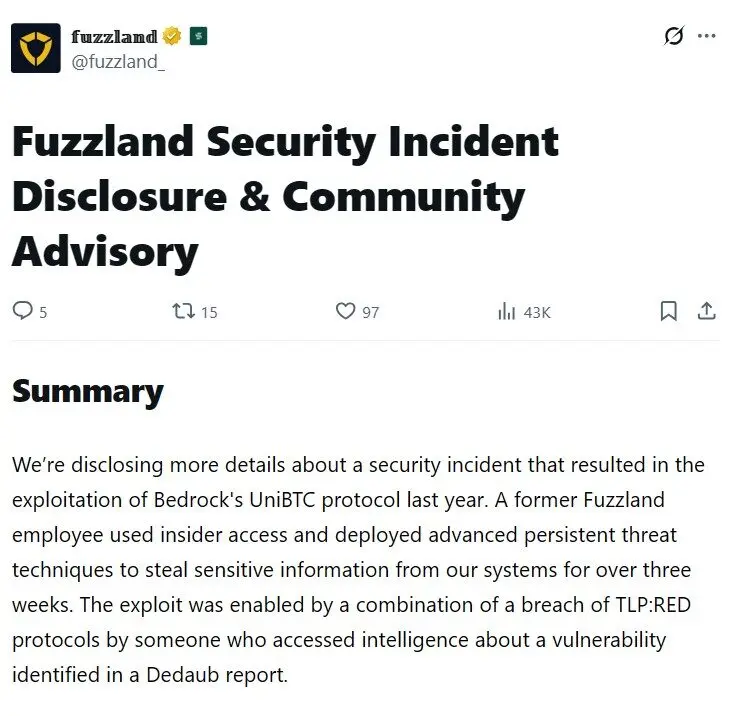
In September 2024, the smart contract analytics platform Fuzzland revealed that a former employee was behind a $2 million exploit that targeted Bedrock’s UniBTC protocol.
According to a recent transparency report by Fuzzland, the insider stole crucial data that allowed the attack by using supply chain attacks, social engineering strategies, and sophisticated persistent threat techniques. The platform stated that during an internal discussion during an emergency response call, the attacker took advantage of the UniBTC vulnerability.
According to the company, the former employee installed malicious code on engineering workstations, opening backdoors, and went weeks without being caught. The attacker could take advantage of the vulnerability initially identified in a Dedaub report and obtain sensitive information thanks to the access.
Before the attack, Fuzzland asserted that it had identified the vulnerability. However, false positive noise caused it to be deprioritized.
Bedrock receives payment from Fuzzland for the $2 million exploit.
The smart contract security platform announced it had started a collaborative investigation with security company ZeroShadow and paid Bedrock for the damages.
Additionally, the business reported to the FBI and Chinese law authorities. According to the statement, it collaborates with SlowMist and Seal 911 to raise industry-wide security standards.
Fuzzland stated that the hack impacted no client or customer data, even though the event resulted in almost $2 million in losses. According to the organization, the issue was confined to a distinct internal setting.
UniBTC, UniETH, and UniLOTX products are available through the multi-asset liquid restaking protocol Bedrock. Users can generate yields by staking these artificially created versions of popular blockchain coins.
Bedrock acknowledged that it had been compromised, affecting their UniBTC product, on September 27. The attacker depleted its decentralized exchange pools of $2 million in liquidity. Despite the attack, DefiLlama reports that Bedrock’s total value locked (TVL) increased from $240 million in September 2024 to $535 million in June 2025.
In 2025, hackers stole $2.1 billion worth of cryptocurrency.
The research was released when hackers increasingly turned to social engineering tactics instead of smart contract flaws. Blockchain security company CertiK said on June 4 that over $2.1 billion had been pilfered in 2025 due to crypto-related incidents.
According to the firm, wallet hacks and phishing assaults were the leading causes of the losses. According to Ronghui Gu, co-founder of CertiK, the rise in social engineering assaults indicates that hackers are changing their tactics.