DeFi once stood as the centerpiece of blockchain utility, but now DePIN, a new contender, has emerged. Let’s explore which blockchain model is shaping 2025’s infrastructure shift.
- 1 Understanding the Basics: What is DePIN and what is DeFi?
- 2 Market Momentum: Which One Is Gaining More Traction in 2025?
- 3 Use Case Comparison: Abstract Finance vs Tangible Infrastructure
- 4 Innovation Stack: How Each Drives Web3 Differently
- 5 Ecosystem and Community Adoption: DeFi vs DePIN
- 6 Regulatory and Sustainability Factors
- 7 Investment Outlook: Where Is Capital Flowing?
- 8 Challenges and Limitations
- 9 Convergence Possibility: DePIN meets DeFi.
- 10 Conclusion
Understanding the Basics: What is DePIN and what is DeFi?
DeFi Recap: The Foundation of On-Chain Finance
Decentralized Finance (DeFi) is a blockchain-based ecosystem that provides financial services without intermediaries. DeFi applications rely on smart contracts, which are most commonly deployed on networks such as Ethereum, Arbitrum, and Polygon.
Core Components of DeFi include:
- Decentralized Exchanges (DEXs): Platforms such as Uniswap and Curve that facilitate peer-to-peer crypto trading.
- Lending Protocols: Services such as Aave and Compound allow users to lend and borrow assets through overcollateralized models.
- Stablecoins: Crypto assets such as DAI or USDC that maintain stable value and serve as liquidity anchors in DeFi ecosystems.
DeFi gained traction between 2020 and 2022 as a disruptive alternative to traditional banking, providing high-yield opportunities and permissionless access. However, its growth has slowed as real-world utility and regulatory concerns become more apparent in 2025.
What is DePIN? The Rise of Real-World Infrastructure on Blockchain
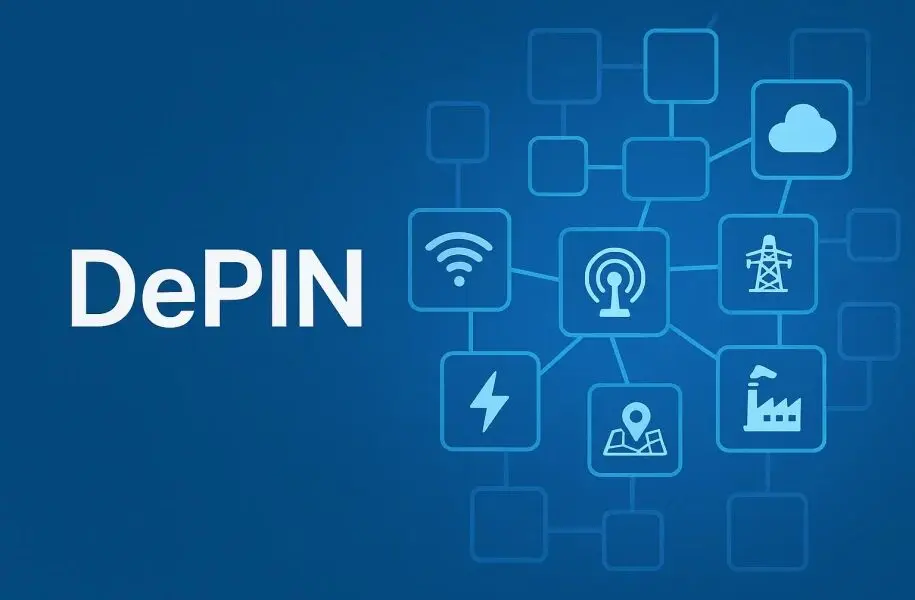
Decentralized Physical Infrastructure Networks (DePINs) are blockchain-based systems that coordinate and incentivize the deployment of real-world physical infrastructure.
Unlike DeFi, which exists solely in the digital realm, DePIN connects blockchain to physical utilities such as wireless networks, mobility, energy, and storage.
Prominent Examples of DePIN Projects:
- Helium (Wireless): Builds a decentralized global network for IoT devices via user-deployed hotspots.
- Filecoin (Storage): Offers decentralized cloud storage and allows users to rent out disk space.
- DIMO (Mobility): Connects vehicle data to the Web3, allowing drivers to monetize their driving behavior and diagnostics.
DePIN shifts the crypto narrative from abstract finance to real-world connectivity, with contributors rewarded for providing physical resources and services through tokenized incentives.
DePIN vs DeFi: Key Distinction in 2025
While DeFi aims to change the way money moves, DePIN is changing the way infrastructure is built and accessed. Both are core innovations in the Web3 stack, but DePIN is emerging as the next frontier for scalable, real-world blockchain adoption in 2025.
Market Momentum: Which One Is Gaining More Traction in 2025?
From 2021 to 2023, DeFi drove the Web3 narrative, fueled by exponential Total Value Locked (TVL) growth. During peak bull cycles, DeFi protocols such as Uniswap, Curve, and Aave drove TVLs to more than $180 billion.
This was the golden era of yield farming, permissionless lending, and composable financial services.
However, 2024-2025 signals a market shift, favoring tangible infrastructure over financial abstraction. DePIN (Decentralized Physical Infrastructure Networks) is quickly gaining traction, establishing itself as the real infrastructure trend of 2025.
Key Data and Trends: DeFi Slows, DePIN Accelerates
DeFi TVL Stagnation:
As of Q2 2025, global DeFi TVL hovers between $60-70 billion, a far cry from the highs of 2021. According to DeFiLlama, the top protocols’ user growth has slowed, indicating both saturation and regulatory friction.
DePIN Funding Surge:
In contrast, DePIN projects raised over $850 million in venture capital from Q3 2023 to Q2 2025, according to Messari’s 2025 Infrastructure Report.
Helium, peaq, WeatherXM, Hivemapper, and DIMO attracted capital due to their ability to tokenize real-world activity and deliver ROI via user-deployed infrastructure.
Electric Capital Developer Report (2025):
Cites an 87% year-over-year rise in developers contributing to DePIN-aligned protocols. By contrast, DeFi developer growth has plateaued since late 2023.
Institutional Attention Shift:
BlackRock, Bosch, and Siemens have publicly backed real-world asset (RWA) platforms that integrate DePIN frameworks, with a focus on mobility, energy, and supply chain sectors.
This is consistent with the broader institutional shift towards “blockchain utility with measurable real-world value.”
Emerging Market Signals
| Year | DeFi TVL (USD) | DePIN VC Funding (USD) | Key Narrative |
| 2021 | $180B | <$100M | DeFi explosion |
| 2022 | $90B | $300M | RWA narratives begin |
| 2023 | $55B | $500M | Rise of DePIN |
| 2024 | $65B | $700M | IoT + DePIN boom |
| 2025 (est.) | $70B | $850M+ | Infra trend shifts |
DePIN vs DeFi in 2025: A Market in Transition
While DeFi remains valuable as the financial layer of Web3, DePIN is emerging as a real-world infrastructure stack that provides scalable utility beyond token speculation.
In a world hungry for tangible returns, decentralized infrastructure is attracting the capital, talent, and institutional validation that DeFi once had.
Use Case Comparison: Abstract Finance vs Tangible Infrastructure
As Web3 evolves in 2025, the use case distinction between DePIN and DeFi reveals a significant shift: from financial engineering to real-world problem solving. DeFi laid the foundation with programmable finance. DePIN now takes blockchain to new physical dimensions.
DeFi Use Cases: Composability-Powered Finance
DeFi protocols enabled a permissionless, borderless financial system, but the majority of use cases remain digital and speculative in nature.
Primary Use Cases:
- Yield Farming:
Yield farming involves users providing liquidity to automated market makers (e.g., Uniswap, Curve) and earning yield through token incentives.
- Lending and Borrowing:
Platforms like Aave and Compound enable overcollateralized loans using crypto assets, resulting in passive income.
- On-Chain Derivatives:
Protocols such as dYdX and Synthetix provide decentralized futures, options, and synthetic asset trading.
Limitations:
- Highly composable, but dependent on other smart contracts.
- High-risk environment due to exploits, temporary loss, and volatility.
- There are limited real-world applications, and value is mostly contained within the crypto loop.
DePIN Use Cases: Infrastructure and Physical Utility
In contrast, DePIN projects reward users for deploying, maintaining, and interacting with real-world infrastructure. The reward model links blockchain tokens to physical contributions.
Leading DePIN use cases:
- Decentralized WiFi (e.g., Helium, World Mobile):
Users deploy nodes or hotspots to extend wireless connectivity and earn token rewards.
- Distributed Energy Grids (e.g., Powerledger, Arkreen):
Blockchain to coordinate peer-to-peer energy distribution and carbon tracking across solar and battery networks.
- Decentralized GPS Mapping (e.g., Hivemapper):
Involves drivers sharing real-time video data from dashcams to create a community-owned map and earn tokens per kilometer.
- Mobility Services (e.g., DIMO, NATIX):
Vehicles share telemetry and road condition data with manufacturers, insurers, and urban planners, which is then monetized through blockchain rewards.
Core Advantage:
DePIN uses tokenized incentives to power real-world infrastructure, expanding Web3’s relevance beyond speculative finance.
How DePIN Expands Blockchain’s Utility Beyond Finance
While DeFi enabled programmable value exchange, DePIN introduces programmable infrastructure coordination. It brings blockchain from screen to street, connecting people, devices, and systems in the physical world.
Key Value Unlocks:
- Broader adoption: Users do not need to “trade” or “stake”; they simply contribute physical resources.
- Inclusive economy: People can earn by sharing connectivity, energy, mobility data, or location services.
- Cross-sector use: Allows for new blockchain applications in telecommunications, logistics, climate science, and urban planning.
DeFi innovated on money. DePIN innovates in infrastructure. In 2025, real-world momentum favors systems that reward action over speculation, with DePIN emerging as a link between blockchain and society.
Innovation Stack: How Each Drives Web3 Differently
As Web3 enters a new phase in 2025, the DeFi vs DePIN innovation stacks differ significantly in terms of design, purpose, and extensibility.
Each has a distinct role in the decentralized economy: one powers on-chain finance, while the other orchestrates real-world infrastructure using blockchain.
DeFi Infrastructure: The Financial Operating System of Web3
DeFi’s stack is highly modular, built around smart contracts that replicate and improve on traditional finance. To address scalability, this stack primarily uses Ethereum Layer 1 and Layer 2 networks such as Optimism, Base, and zkSync Era.
Core Layers in the DeFi Stack:
- Smart Contracts: Automate lending, trading, and staking logic (such as Aave and Uniswap).
- Oracles: External data feeds (such as Chainlink) provide real-time prices, interest rates, and off-chain event triggers.
- Liquidity Protocols: Automated market makers (AMMs) and vaults that enable user-generated financial services.
- Governance Mechanisms: Token holders use assets such as AAVE or COMP to vote on protocol upgrades or risk parameters.
- Settlement Layers: Ethereum, Arbitrum, and L2s provide fast, trustless transaction finality.
Limitations:
While DeFi is highly composable, it is typically limited to token economies and requires crypto literacy, making it inaccessible to non-technical users and institutions.
DePIN Architecture: Blockchain for Real-World Infrastructure
DePIN introduces a hardware-integrated, chain-agnostic stack that brings blockchain functionality to physical environments. Its architecture is designed to support device coordination, tokenized incentives, and data verification at the edge.
Key Layers of the DePIN Stack:
- Physical Layer: Hardware nodes such as IoT sensors, wireless hotspots, vehicles, or smart meters form the network’s backbone.
- Proof of Location / Activity: Data validation via encrypted GPS, device authentication, or peer attestation (used by networks such as Hivemapper and DIMO).
- Tokenization Layer: Contributors receive tokens for sharing data, bandwidth, or power (for example, HNT for Helium users).
- Interoperability and middleware: Platforms such as peaq and IoTeX facilitate communication between devices and on-chain contracts.
- Compute and Storage: Projects such as Akash Network offer decentralized cloud infrastructure for high-throughput data handling.
Strengths:
DePIN enables large-scale resource coordination. Unlike DeFi, it is based on physical contributions rather than financial speculation, making it more accessible and relevant to society.
DePIN vs DeFi: A Stack-Level Comparison
| Stack Layer | DeFi | DePIN |
| Base Chain | Ethereum, L2s | Multichain (Polkadot, Solana, Cosmos, IoTeX) |
| Data Source | Price oracles | Real-world sensors, GPS, and device data |
| Execution Layer | Smart contracts | Edge devices + blockchain integration |
| Incentive Mechanism | Yield farming, staking | Token rewards for physical infrastructure |
| Interoperability | Bridges & oracles | Middleware for IoT + DID systems |
In 2025, DeFi continues to power the programmable financial core of crypto, but its stack remains siloed within on-chain environments. DePIN, on the other hand, broadens the scope of blockchain by integrating Web3 into industries like energy, mobility, telecommunications, and logistics.
Ecosystem and Community Adoption: DeFi vs DePIN
In the Web3 space, a technology’s strength is determined not only by its architecture but also by who builds it, who uses it, and how communities evolve around it.
As of 2025, the ecosystem and community adoption of DeFi vs DePIN are diverging, one based on code and capital markets, the other on coordination and physical participation.
DeFi Ecosystem: Crypto-Native, Capital-Driven
DeFi (Decentralized Finance) has historically been shaped by crypto-native developers, protocol DAOs, and power users who prioritize financial optimization.
The DeFi community is well-versed in tokenomics, composability, and governance mechanics, frequently collaborating across multiple dApps for arbitrage, yield farming, and liquidity mining.
Who is Building DeFi?
Primarily smart contract developers working in Ethereum and EVM-compatible ecosystems.
Protocols are frequently governed by DAOs such as Compound Governance, Curve DAO, and MakerDAO, where token holders vote on upgrades and treasury allocations.
Builders emphasize capital efficiency, interoperability, and automation.
How Is the Community Engaged?
- Motivated by yield: Liquidity providers (LPs) and traders use protocols to maximize returns.
- Short-term loyalty: Many users seek the highest APYs and switch platforms frequently.
- Governance participation: Core users often hold governance tokens and participate in voting decisions.
Key Projects in 2025:
- Compound v3: A streamlined lending model offering isolated risk and gas efficiency.
- Curve Finance: Dominates stablecoin swapping through custom AMM algorithms and DAO-led innovation.
Takeaway: While the DeFi ecosystem is financially agile, it frequently lacks real-world user integration outside of crypto-savvy circles.
DePIN Ecosystem: Real-World Builders and Contributors
DePIN (Decentralized Physical Infrastructure Networks) represents a shift from finance to function, bringing together a broader range of contributors such as IoT engineers, mobility startups, telecom providers, and independent hardware operators.
Who is Building DePIN?
Builders come from various industries, including logistics, connectivity, energy, and urban planning.
Projects frequently operate in a hybrid model: Web3-native smart contracts govern token issuance, while real-world companies or individuals deploy physical infrastructure.
Middleware platforms such as peaq, IoTeX, and Nodle facilitate the integration of hardware and blockchain systems.
How Is the Community Engaged?
- Contribute to earn: Users can deploy hotspots, dashcams, weather stations, or EV chargers and earn tokens for verifiable activity.
- Local-first incentives: Many contributors are tied to specific locations.
- Long-term ownership: Participants have a tangible stake in the infrastructure they use and maintain.
Key Projects for 2025:
- Helium: Enables decentralized 5G and LoRaWAN coverage through user-deployed hotspots.
- WeatherXM: Users are rewarded for collecting local climate data using home-installed stations.
- React Network: Incentivizes the deployment of peer-owned EV charging stations.
- Hivemapper: Crowdsources real-time mapping data from dashcam-equipped drivers.
Takeaway: The DePIN ecosystem engages everyday users, not just traders or coders, adding real-world value and inclusivity to Web3.
DeFi vs. DePIN: Community Dynamics t a Glance
| Category | DeFi | DePIN |
| Builders | Crypto-native devs, protocol DAOs | Hardware engineers, telcos, Web3–IoT startups |
| User Incentives | Yield farming, governance rewards | Tokenized rewards for real-world contributions |
| Participation | Financial speculation, short-term usage | Physical deployment, long-term commitment |
| User Skill Level | Requires DeFi knowledge, Web3 wallets | Accessible to non-crypto users with devices |
| Social Layer | Discords, governance forums | Real-world communities, local deployment groups |
In 2025, DeFi remains Web3’s financial brain, but DePIN is becoming its physical backbone. DeFi thrives on liquidity and composability, whereas DePIN thrives on collaborative infrastructure deployment and community ownership.
As Web3 matures, DePIN’s ability to attract non-technical users, local contributors, and real-world businesses provides a significant advantage in developing lasting ecosystems that go beyond digital interaction.
Regulatory and Sustainability Factors
As blockchain adoption grows in 2025, regulatory clarity and environmental impact have emerged as key themes influencing the future of decentralized ecosystems.
The comparison of DePIN vs DeFi reveals a significant difference in how each sector is perceived and treated by global regulators and sustainability advocates.
DeFi Regulation in 2025: Rising Scrutiny, Slowing Innovation
DeFi’s promise of open and permissionless finance has faced significant regulatory scrutiny. The lack of KYC (Know Your Customer) compliance, pseudonymous transactions, and decentralized governance continue to pose challenges to global financial watchdogs.
Key Regulatory Challenges for DeFi:
- KYC/AML Gaps:
Most DeFi protocols lack integrated identity verification, making them vulnerable to illicit activity (for example, money laundering and terror financing).
- SEC Crackdowns:
The Securities and Exchange Commission (SEC) in the US has increased enforcement actions against DeFi protocols that offer “unregistered securities,” particularly for token sales and staking products.
- MiCA (EU Regulation):
The EU’s Markets in Crypto-Assets (MiCA) framework, effective in 2024, imposes stricter regulations on stablecoins and DeFi protocols that reach EU consumers, including those operated by DAOs.
Implications:
Protocol teams are exploring “RegFi” models, which combine DeFi architecture with regulatory compliance layers.
The evolving DeFi regulation in 2025 is shaping a more cautious, legally bound ecosystem.
DePIN’s Regulatory and Sustainability Advantage
Unlike DeFi, DePIN is viewed favorably by regulators and ESG-conscious investors due to its practical utility and ability to align with public infrastructure goals.
Regulatory Positioning:
- Utility-First Design
DePIN projects such as Helium, DIMO, and WeatherXM do more than just move tokens; they also enable real-world services (connectivity, mapping, and climate monitoring).
- Public–Private Potential:
DePIN networks enable collaboration between governments and enterprises to deploy crowdsourced infrastructure, reducing reliance on monopolistic providers.
- Data Compliance-Ready:
Many DePIN projects include verifiable credentials, encrypted GPS, and proof-of-location protocols to meet privacy and compliance standards.
DePIN Sustainability in Focus (2025):
- Energy-Saving Models:
Arkreen Network and Powerledger are projects that incentivize peer-to-peer solar energy distribution, which helps to achieve climate goals.
- Climate Intelligence Networks:
WeatherXM and Sensor Networks promote climate resilience by crowdsourcing environmental data.
- ESG Reporting & Metrics:
DePIN projects use on-chain ESG analytics to validate impact and adhere to corporate ESG frameworks and sustainable investment mandates.
DePIN vs DeFi: Regulatory & ESG Alignment
| Factor | DeFi | DePIN |
| Regulatory View | Under scrutiny for non-compliance (KYC/AML) | Favorably viewed due to utility-based design |
| Compliance Complexity | High – built around energy, data, and mobility | Moderate – physical anchoring, identity possible |
| ESG Integration | Limited, mostly indirect | High – built around energy, data, mobility |
| Investor Appeal (2025) | Shrinking due to legal ambiguity | Growing via sustainability and public-good focus |
| Real-World Policy Fit | Low abstract finance | High fits into infrastructure policies |
In 2025, DeFi regulation is tightening, forcing protocols to evolve or risk becoming obsolete. Meanwhile, DePIN’s sustainability efforts and real-world integration are gaining attention from regulators and ESG investors.
For both builders and institutions, DePIN provides a compliant, utility-driven framework that aligns blockchain with societal needs.
Investment Outlook: Where Is Capital Flowing?
Web3 investment patterns are shifting significantly in 2025. DeFi remains an important pillar of the decentralized economy, but its growth has slowed.
DePIN, on the other hand, has rapidly attracted investor interest, positioning itself as the next frontier of blockchain-based infrastructure. The difference in capital flow between DePIN and DeFi highlights where the market sees long-term potential.
DeFi: From Hype to Plateau
From 2020 to 2022, DeFi was the darling of crypto venture capital. Billions of dollars were invested in protocols that enable decentralized lending, trading, and yield optimization. However, by 2024 and into 2025, DeFi investment had begun to plateau.
With most financial primitives already built and Total Value Locked (TVL) growth slowing, many investors are reassessing where value can be created.
In addition to innovation fatigue, regulatory pressures have slowed DeFi’s growth. Global frameworks, such as the EU’s MiCA regulations and US enforcement actions, have made compliance more difficult for permissionless DeFi protocols.
As a result, funding is now primarily directed toward projects that provide regulatory alignment or real-world asset (RWA) exposure, such as tokenized bonds and asset-backed lending. Venture firms are becoming more cautious, preferring capital-efficient protocols to speculative yield farms.
DePIN: The New Investment Magnet
While DeFi’s star dims, DePIN is rising quickly. Decentralized infrastructure networks are appealing to investors because they use blockchain technology to solve real-world problems.
From telecom to mobility to energy, DePIN introduces new ways to deploy and monetize physical assets through crypto incentives.
Venture capital investment in DePIN projects has already exceeded expectations in 2025. Helium, WeatherXM, Hivemapper, and DIMO have raised significant funds to expand their real-world networks. Importantly, this capital is not coming solely from crypto-native investors.
Hardware manufacturers, logistics companies, cloud providers, and even public-private infrastructure funds are all supporting DePIN ventures. They see these systems as future-proof infrastructure deployment models, rather than speculative technology.
One of the reasons DePIN is so attractive to investors is its hybrid value model, which aligns token rewards with real-world usage and infrastructure uptime.
Investors can place bets on the adoption of both the crypto and the underlying service. This dual exposure strengthens DePIN startups, particularly during broader market downturns.
Broader Capital Sentiment
DeFi’s slowing pace is not a death sentence; it is still vital to the crypto economy. However, the story about where the smart money will go in 2025 has clearly shifted.
Early-stage capital, ecosystem grants, and strategic corporate funding are flowing into DePIN, which has a clear link between blockchain coordination and practical utility.
In practical terms, DeFi is now competing for attention in a saturated market. DePIN, on the other hand, is pioneering new frontiers such as community-owned wireless networks, decentralized GPS mapping, energy trading, and climate intelligence that go far beyond crypto.
These narratives are not only more relevant to regulators and institutions, but also more appealing to ESG-conscious investors.
In 2025, investors prioritize blockchain projects with practical applications, long-term scalability, and societal value. This is why DePIN has taken the lead.
While DeFi continues to play an important role in Web3’s financial layer, DePIN is now viewed as the driving force behind real-world adoption and the destination for serious infrastructure capital.
Challenges and Limitations
While both DeFi and DePIN are groundbreaking Web3 innovations, neither model is without flaws. Their distinct architectures also present new challenges, ranging from security vulnerabilities to physical coordination challenges.
A realistic comparison of DePIN vs DeFi must account for these limitations in order to understand where each stands today and what improvements are required moving forward.
DeFi Challenges: Code-Driven, But Disconnected
Despite being battle-tested, DeFi faces significant challenges that limit its mainstream adoption and long-term viability.
1. Smart Contract Risks
DeFi protocols run entirely on autonomous code, which, while efficient, is still vulnerable to bugs, exploits, and economic manipulation. High-profile hacks, such as those targeting Curve and Euler Finance, demonstrate how a single smart contract flaw can result in the loss of billions of dollars in user funds.
2. Fork Culture and Liquidity Fragmentation
Open-source DeFi projects are frequently copied, resulting in protocol forks that reduce liquidity and user interest. This fork culture creates a race to the bottom effect, particularly when new platforms offer unsustainable incentives to attract users.
3. Limited Real-World Utility
The majority of DeFi activity occurs within the crypto ecosystem, specifically trading, staking, and synthetic assets. The lack of direct real-world impact makes it difficult for non-crypto users to see its relevance or necessity in daily life.
DePIN Challenges: Physical Ambition Meets Technical Complexity
While DePIN brings blockchain to the real world, it also presents a new level of operational difficulty.
1. Hardware Dependencies
DePIN networks rely on physical device deployment, which includes sensors, hotspots, and cameras. This introduces cost barriers, supply chain issues, and the risk of inconsistent hardware performance, particularly in emerging markets.
2. Data Integrity and Validation
Many DePIN models reward users for uploading data (such as location, temperature, and bandwidth). However, without centralized control, ensuring the accuracy and honesty of data remains a challenge.
Peer-validation and cryptographic proofs are being experimented with by projects such as Hivemapper and WeatherXM, but it’s still in its early stages.
3. Physical Coordination Complexity
Building decentralized infrastructure in the real world entails navigating zoning laws, hardware logistics, maintenance, and variable geographic conditions. This slows scaling compared to software-native solutions such as DeFi.
A Balanced Perspective: Different Tools for Different Problems
DeFi and DePIN aren’t competing; they are complementary. Each solves a different type of problem.
- DeFi introduces trustless finance and capital markets to the blockchain ecosystem.
- DePIN transforms blockchain into a layer that coordinates real-world services and infrastructure.
Each has unique vulnerabilities and growth barriers. DeFi must improve user safety and find real-world relevance, while DePIN must show that its models can scale efficiently and maintain data integrity across thousands or millions of devices.
In the conversation of DePIN vs DeFi, it’s important to note that the future of Web3 relies on addressing financial and infrastructure coordination issues. That requires different strengths, tools, and a willingness to face unique challenges head-on.
Convergence Possibility: DePIN meets DeFi.
The difference between DePIN and DeFi is often overstated. While they address different layers of the Web3 stack (physical infrastructure versus digital finance), their relationship is becoming more complementary, rather than competitive.
As the Web3 ecosystem matures in 2025, we’re seeing more evidence that DePIN and DeFi are converging to enable new hybrid use cases.
Are DePIN and DeFi Mutually Exclusive? Not at All
DeFi specializes in programmable, permissionless financial services. Meanwhile, DePIN uses blockchain incentives to coordinate real-world hardware. At first glance, they appear to operate in distinct domains, but the reality is more nuanced.
Many DePIN networks depend on DeFi primitives to function effectively. DeFi is emerging as a critical financial layer for DePIN economies, with staking mechanisms that secure networks and micro-lending protocols that assist users in financing hardware.
Example: Tokenized Hardware Yielding DeFi Returns
Take a DePIN device, such as a decentralized wireless hotspot, an EV charger, or a weather sensor. These devices generate data or provide services in return for network tokens. Here is where convergence occurs:
- Staking Hardware as Collateral:
Devices can be represented on-chain as NFTs or SBTs (soulbound tokens), allowing for borrowing against projected earnings through DeFi protocols.
- Liquidity Pools for Hardware Tokens:
DePIN tokens, like traditional tokens, can be added to lending pools to improve capital efficiency and user flexibility.
- Yield-Generating Infrastructure:
Earnings from a weather station on WeatherXM can be automatically deposited into a DeFi yield optimizer, such as Yearn or Beefy, to maximize rewards.
These are not theoretical models; they are being tested in live ecosystems.
Future Projections: Hybrid Models Becoming the Norm
As user behavior evolves and protocols seek scalability, DePIN-DeFi hybrids are expected to become standard in verticals such as:
- Mobility:
Drivers using DIMO to monetize vehicle data could stake earnings in DeFi protocols to secure loans for maintenance or insurance.
- Energy:
Peer-to-peer energy networks, such as Arkreen, allow users to tokenize excess solar power and sell it on decentralized marketplaces using stablecoins or DeFi rails.
- Telecom
Helium node operators could pool tokens into a decentralized treasury governed by DeFi governance models, allowing for community-owned telecom funding.
This convergence not only improves utility but also creates economic connections between previously isolated Web3 silos.
In the evolution of DePIN vs DeFi, we are transitioning from opposition to orchestration. The two sectors are becoming increasingly interdependent: DePIN adds real-world value and adoption, while DeFi provides the financial infrastructure to support and scale it.
The Web3 stack of the future will not be isolated. Instead, it will be collaborative, with your car’s data repaying a DeFi-funded loan and your solar panels earning yield via an AMM. In this world, DePIN and DeFi coexist as a unified path toward a more open, utility-driven digital economy, rather than clashing.
Conclusion
DeFi and DePIN are two distinct but complementary pillars in the Web3 ecosystem. DeFi reimagines financial services by replacing traditional intermediaries with smart contracts, enabling decentralized lending, trading, and savings.
In contrast, DePIN brings blockchain into the real world, allowing users to contribute to and profit from decentralized infrastructure such as wireless networks, mobility systems, and environmental sensors.
In the comparison of DePIN vs DeFi, it is clear that both offer fundamental value. DeFi creates the programmable capital layer; DePIN applies that layer to real-world coordination.
Understanding these fundamentals is the first step toward seeing how they operate independently and how they will increasingly collaborate to define the next era of blockchain innovation.