

Ethereum backs gas limit hike as Vitalik Buterin warns against rushing network scaling despite growing capacity needs.
As the network nears a crucial scaling decision, Ethereum is ready to expand its gas limit capacity, but co-founder Vitalik Buterin advises caution.
Ethereum Is Prepared For Gas Limit Bump, According To Vitalik Buterin
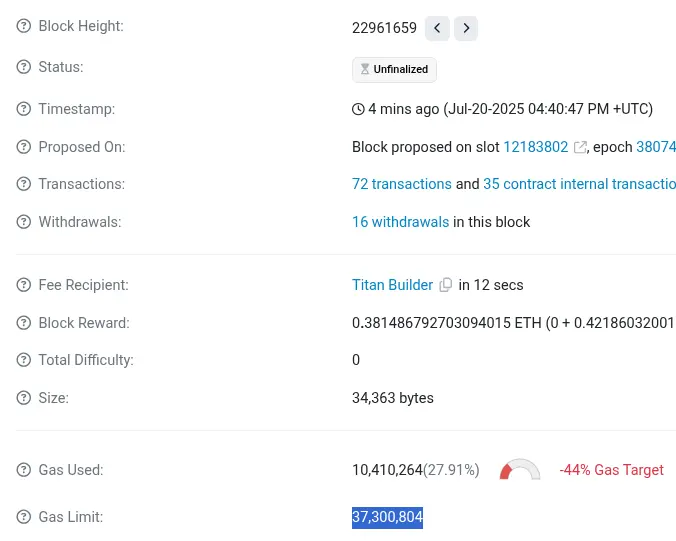
Nearly half of validators have expressed support for increasing the Layer 1 gas limit from the current 37.3 million to 45 million, according to Ethereum co-founder Vitalik Buterin.
This modification can significantly increase Ethereum’s transaction throughput, enabling the blockchain to handle larger quantities and more intricate processes.
Buterin emphasized that years of engineering advancements and study had led to this endeavor.
Additionally, he mentioned how crucial it has been to recently update Geth, the Go Ethereum client, to version 1.16.0.
It made it easier for smaller validators to keep up by reducing the storage space of archive nodes from more than 20 terabytes to about 1.9 terabytes.
The gas limit on Ethereum serves as a cap on the maximum amount of processing power that each block may require.
By raising this cap, each block may handle more transactions, which speeds up the network.
However, it might also overburden independent validators, which could result in centralization.
Using catchphrases like “pump the gas,” community groups have pushed for the raise, arguing that it is a reasonable reaction to the rising demand.
Nearly 48% of staked ETH aims for the higher cap, even though validators can progressively change the gas limit (by around 0.1% every block).
As Ethereum’s Scaling Efforts Pick Up Speed, Caution Is Advised
Vitalik Buterin agreed that scaling requires “thoughtful engineering” and pushing boundaries.
Increases in gas restrictions have occasionally raised concerns that the network may become overly resource-intensive, locking out smaller node operators and undermining decentralization.
Buterin claimed that new client updates, such as the Geth PBSS archiving mode, have made capacity expansion simpler and safer.
Disk space requirements are reduced by over 90% thanks to these upgrades.
As Ethereum’s capacity increases, this helps keep it decentralized.
Buterin also cautioned that attempting to scale Ethereum too rapidly could harm the network’s stability.
He underlined that growth, security, and decentralization must all be balanced because they are crucial to Ethereum’s mission.
Buterin revealed intentions to increase Ethereum’s scalability by up to ten times over the next year, which would further the project’s lofty objectives, according to CoinGape.
Notably, Ethereum is striving to enhance its system in ways that go beyond simple adjustments to Layer 1 costs.
Recent improvements, such as Proto-Danksharding and the following Pectra roadmap, aim to increase the efficiency of Layer 2 rollups and sharding.
By lowering expenses and speeding up transactions, these modifications hope to lessen network congestion.
The broader trends in the cryptocurrency space are also helping Ethereum.
By Executive Order 14178, the White House is getting ready to release its first official report on digital assets on July 22.
Institutional investors are interested in Ethereum, as evidenced by the $6.44 billion 56 organizations have amassed.
The expansion of Ethereum’s gas limit demonstrates the network’s expansion and its intention to satisfy growing demand.