
A16z Crypto says ZK-proofs can protect privacy while aiding law enforcement, weeks after Tornado Cash’s Roman Storm was found guilty.
Modern cryptographic approaches, such as zero-knowledge proofs, can preserve user privacy while enabling law enforcement to act against illegal actors, according to the venture capital firm Andreessen Horowitz’s crypto-focused investment arm.
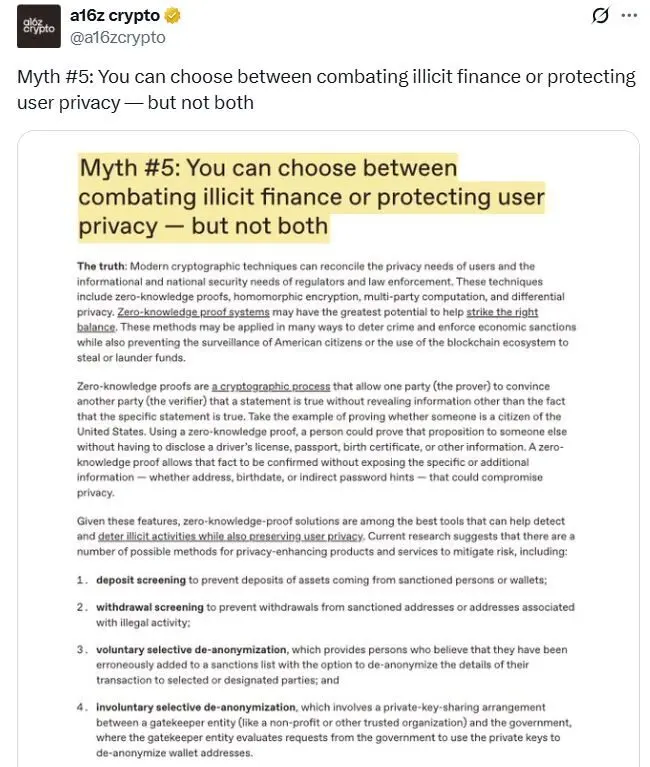
ZK-proofs, which confirm the authenticity of data without revealing any specific private information, have the “greatest potential” by demonstrating the origin of funds without publicly disclosing private information, according to a16z Crypto policy partner Aiden Slaven and regulatory counsel David Sverdlov’s report released on Tuesday.
Their study was released just two weeks after Roman Storm, a co-founder of Tornado Cash, a cryptocurrency mixing service that lets users hide the source and destination of cryptocurrencies, was convicted of conspiracy to operate an unauthorized money transmission service.
In the Tornado Cash case, prosecutors and law enforcement contended that mixing services that mask the source of funds aid criminal activity by offering a way to conceal illicit revenues.
“The cash-out points will have reasonable assurances that the cryptocurrency did not originate from proceeds of crime, while the users can retain privacy over their onchain transactions if users can furnish such proofs upon exchanging crypto for fiat currency,” Slaven and Sverdlov stated.
There Are Numerous Privacy-Related Applications For ZK-Proofs
Additionally, ZK-proofs can be helpful for everyday tasks like confirming citizenship or something similar, according to Slaven and Sverdlov.
“A zero-knowledge proof allows that fact to be confirmed without exposing the specific or additional information — whether address, birthdate, or indirect password hints — that could compromise privacy.”
“That fact can be verified using a zero-knowledge proof without disclosing any additional or specific information that could jeopardize privacy, such as an address, birthdate, or indirect password hints.”
At the Science of Blockchain Conference on August 4, US Securities and Exchange Commission Commissioner Hester Peirce repeated this view, stating that privacy-preserving technology had to be protected.
Privacy Technology Is Prepared For Widespread Use
Cryptographic privacy technology is frequently criticized for its scalability; however, Slaven and Sverdlov claim that developments like lower computing overhead are making it more feasible for larger-scale deployment.
They stated that “zero-knowledge proofs are becoming a more effective tool for meeting the needs of law enforcement while maintaining individual privacy as cryptographers, engineers, and entrepreneurs continue to improve their scalability and usability.”
ZK-proofs were highlighted to preserve user privacy while facilitating compliance checks in the US government’s July crypto report. The technology is also used for interbank messaging and tokenized cash settlements on JPMorgan’s private blockchain, Nexus.
Additional Cryptographic Privacy Technologies That Are Worth Investigating
According to Slaven and Sverdlov, other alternatives to ZK-proofs are worth investigating.
One such alternative is homomorphic encryption, a kind of cryptographic technology that permits using some data, like numbers, without decrypting other private information, such as names.
Other options include differential privacy, which guarantees that aggregated data gathered through techniques like surveys cannot be used to identify specific individuals, and multiparty computation, which enables numerous people to collaborate on calculations without anyone disclosing their private information to other parties.
From the telephone and telegraph to the internet, new technologies have always raised new concerns about the imminent loss of privacy, according to Slaven and Sverdlov.
“Blockchains have proven no different, and privacy on blockchains is often misunderstood as either creating a dangerous level of transparency or a haven for crime.”