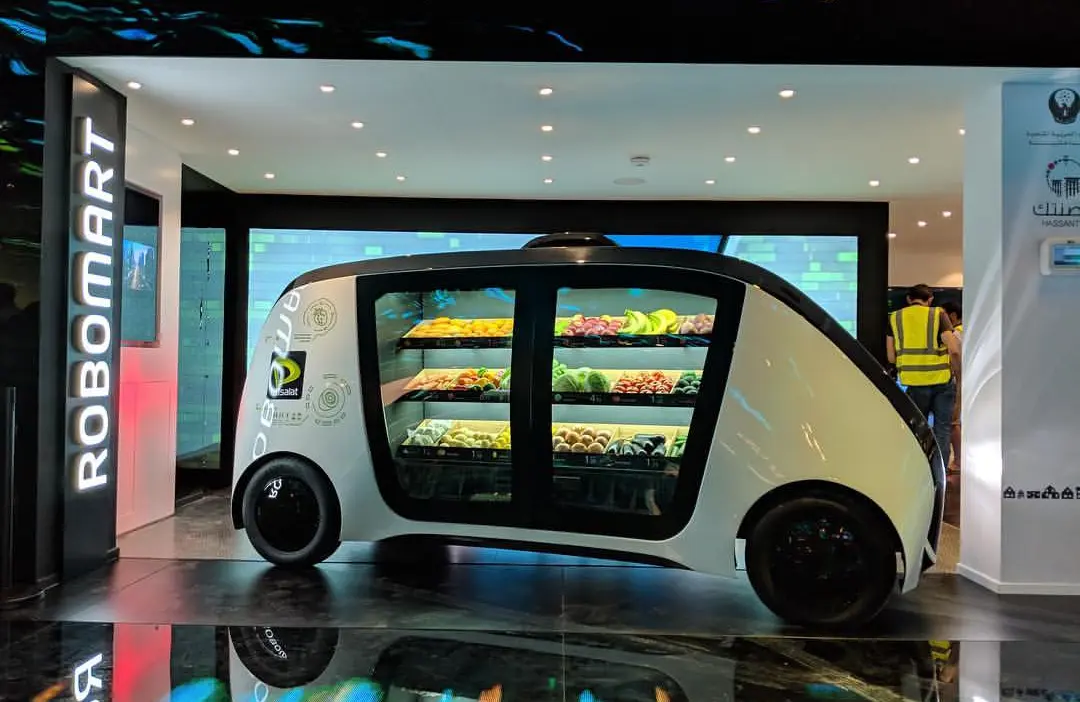
Robomart introduced a new delivery robot with a flat $3 fee, aiming to compete with DoorDash and Uber Eats in the growing food delivery market.
Robomart, a startup specializing in the development of self-driving delivery robots, is introducing its most recent robot with the ambitious objective of leveraging it to generate revenue from on-demand delivery.
On Monday, the Los Angeles-based organization disclosed its patented Robomart RM5. The level-four autonomous vehicle comprises 10 individual containers that store customer orders and can transport up to 500 pounds.
This framework is intended to facilitate bulk ordering, enabling a robot to handle multiple deliveries simultaneously.
Ali Ahmed, Robomart’s co-founder and CEO, disclosed to TechCrunch that the company intends to implement an on-demand delivery business model comparable to established food delivery platforms.

This model entails retailers collaborating with Robomart to develop their own storefronts on Robomart’s program, similar to applications like Uber Eats or DoorDash.
The cost structure for customers is distinct. Ahmed explained that Robomart’s customers must pay a fixed $3 delivery fee for each order, which the company intends to be a more appealing alternative to the numerous fees levied by other delivery apps.
Ahmed stated, “We regard this as the establishment of our own autonomous marketplace.” “That is an autonomous marketplace for on-demand delivery that utilizes self-driving robots, which is quite distinctive in this industry.”
In preparation for introducing its delivery service later this year, Robomart intends to begin onboarding retailers in its inaugural market, Austin, Texas, within the next few months.
This announcement signifies a significant expansion from Robomart’s origins. The company was established in 2017 and began testing an autonomous “store on wheels” in 2020.
This mobile autonomous store was equipped with various items, including ice cream and pharmacy items, and was delivered directly to customers who requested it.
Ahmed stated that the organization’s transition to on-demand delivery was an inevitable consequence of its initial “store on wheels” strategy. He further noted that the organization was aware of its intention to address on-demand delivery from the outset.
2015 Ahmed established Dispatch Messenger, an on-demand delivery platform in the United Kingdom, before Robomart.
Ahmed stated that his previous organization could not sustain profitability while employing human delivery couriers for economic reasons.
This directed his attention toward automation as a means of reducing expenses. Ahmed is now of the opinion that they have successfully deciphered the code.
Ahmed stated, “Our robots reduce the cost of a delivery by as much as 70%.” “That is a significant distinction.” A single delivery costs $9 to $10 if the driver is compensated at $18 per hour.
Ahmed expressed his immense pride in Robomart’s accomplishments, which have been achieved with minimal funding. The company has secured funding from various sources, including Hustle Fund, SOSV, and Wasabi Ventures, for less than $5 million.
Ahmed stated, “We have raised nearly $4 million in funding, which has allowed us to construct five generations of robots and currently operate the first autonomous marketplace for the road.” “I am proud of our team, and it is a testament to the extent of our accomplishments.”
Ahmed believes that Robomart is introducing a novel product to the market at a price that will appeal to consumers, even though the on-demand delivery sector is crowded with numerous significant legacy players, such as Grubhub and Uber Eats.
“To offer them this extraordinary proposition of $3 with no additional fees, the mere price markups can be prohibitively expensive,” Ahmed stated. “They are unaware that they are paying the markup and other fees and tips.” This renders [our model] highly appealing to both retailers and consumers.