
Anatoly Yakovenko proposes a meta chain to address blockchain fragmentation, aiming to boost scalability and unify the ecosystem across networks.
Anatoly Yakovenko suggested a data availability layer to link cross-chain data across top networks to improve blockchain interoperability.
Anatoly Yakovenko, co-founder of Solana Labs, suggested a novel data availability (DA) solution to address continuing fragmentation and lack of interoperability between blockchain networks.
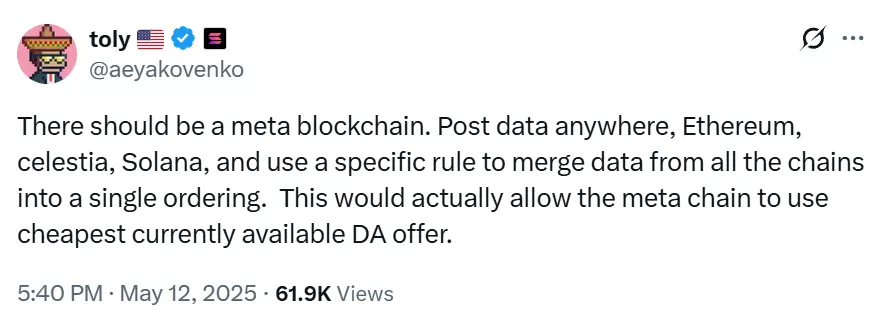
Yakovenko suggested a “meta blockchain” in a post on X on May 12 to compile and arrange data uploaded across several layer-1 chains, such as Ethereum, Celestia, and Solana.
Yakovenko said, “This would allow the meta chain to use the cheapest currently available DA offer.”
Third-party solutions known as data availability layers ensure blockchains have the information they need to confirm transactions.
Since today’s segregated layer-1 (L1) blockchain networks cannot communicate or exchange data, blockchain interoperability is one of the most critical problems for Web3 developers. This issue necessitates the use of cross-chain interoperability solutions like DA layers.
Enhancing DA solutions is a priority for other top blockchains as well. With the introduction of EIP-7594, Ethereum’s next Fusaka upgrade, anticipated in late 2025, will concentrate on increasing the Ethereum mainnet’s capability as a DA layer.
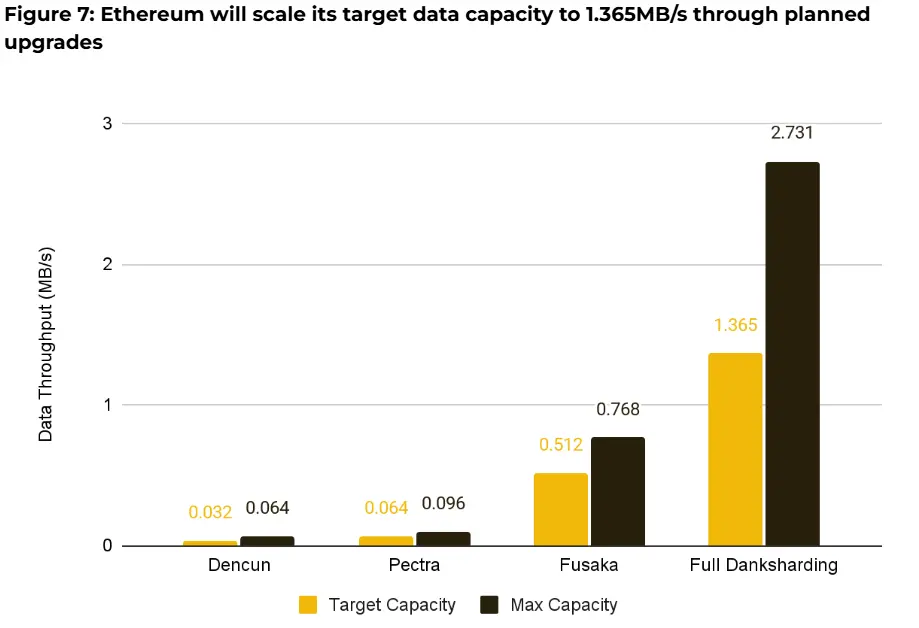
Depending on whether current layer-2 blockchains continue to select Ethereum for data availability in the future, this update could increase Ethereum’s value accretion, according to a spokeswoman for Binance Research.
“Everything else is cheap when data availability is cheap.”
In a reply to his original post, Yakovenko stated that developing less expensive DA solutions is crucial to lowering the expenses related to blockchain-based transactions, adding:
“Making data availability cheap allows for making everything else cheap. Bandwidth is the irreducible bottleneck.”
Additionally, he proposed that a more sophisticated approach would do away with external sequencers by combining transactions across chains using a rule-based system that would enable users to transmit operations “anywhere.”
Other well-known experts in the blockchain sector have also demanded more interoperability and cooperative tokenomics among the top blockchains.
Charles Hoskinson, the inventor of Cardano, stressed the importance of collaborative economics in the cryptocurrency sector during his Paris Blockchain Week 2025 speech to combat the increasing competition from established IT companies venturing into the blockchain arena.
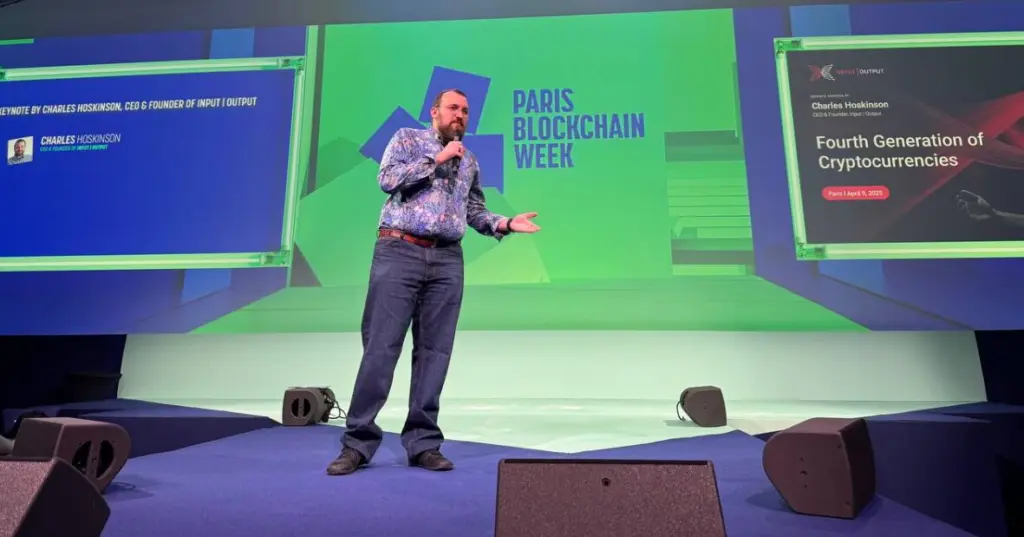
“The issue with the current state of affairs in the cryptocurrency industry is that the market structure and tokenomics are inherently antagonistic.” It’s a zero-sum,” Hoskinson declared. “You need to find tokenomics and market structure that allow you to be in a cooperative equilibrium instead of picking fights.”
Cardano has been working on “Minotaur,” a multi-resource consensus system that integrates several consensus processes and networks to simultaneously pay a unified block reward to numerous networks to align blockchain network incentives.