
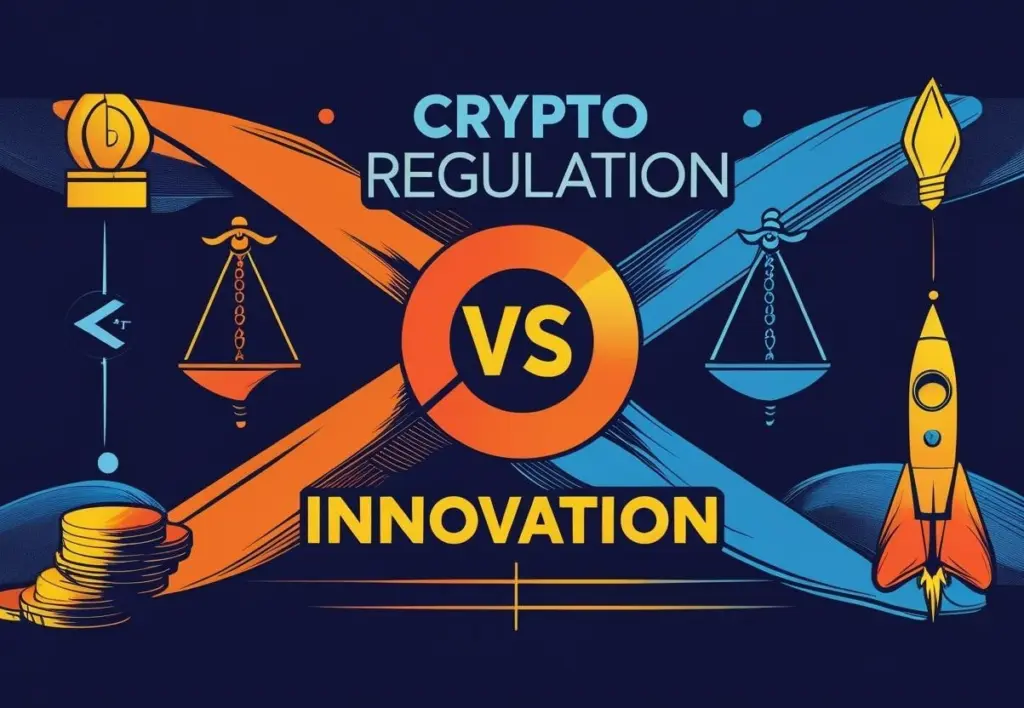
In 2025, the battle between crypto regulation vs crypto innovation is no longer theoretical but defining.
With trillions of dollars flowing through decentralized finance, stablecoins, NFTs, and tokenized real-world assets, governments are struggling to catch up.
State of Crypto Regulation in 2025

What Does Regulation Mean for Innovation?
In 2025, crypto regulation is no longer in its infancy; it is rapidly maturing. Globally, governments are shifting from reactive crackdowns to structured frameworks. However, the central question remains: Crypto Regulation and Innovation: Can They Coexist in 2025?
United States: Still a Jurisdictional Tug of War
The United States continues to have internal agency conflicts. The SEC insists that most tokens are securities, whereas the CFTC classifies many as commodities.
The much-anticipated FIT21 bill, passed by the House but awaiting Senate approval, aims to clearly define digital assets and assign oversight responsibilities. Until it is enacted, regulatory uncertainty persists.
At the same time, stablecoin legislation is still stalled, frustrating developers who want clear paths to launching compliant dollar-pegged assets.
European Union: MiCA is Fully Active
The EU is a global leader in the full implementation of Markets in Crypto-Assets (MiCA) regulation. Since its implementation in late 2024, all crypto service providers have been required to follow strict guidelines regarding licensing, AML/KYC, custody, and whitepaper disclosures.
MiCA has improved cross-border compliance through a “passporting” mechanism, allowing a crypto company licensed in one EU country to operate in all 27 member states. While the new rules raise the bar, they also provide legitimacy and confidence to the industry.
Asia: A Tale of Two Paths
Asia exhibits a regulatory split. Singapore and Hong Kong are thriving as crypto hubs that encourage innovation, with clear licensing regimes for exchanges, custodians, and token issuers.
Hong Kong approved crypto derivatives and margin trading under its Virtual Asset Service Provider (VASP) regime in early 2025, thereby expanding its digital asset ecosystem.
China, on the other hand, continues to prohibit retail crypto trading while supporting state-run CBDC pilots. While India does not outright ban crypto, it does impose harsh taxation and aggressive AML monitoring, which discourages long-term growth.
New Regulatory Categories Emerging in 2025
In response to technological evolution, global regulators have expanded their scope:
Decentralized Autonomous Organizations (DAOs) are now recognized in some jurisdictions, but they are being scrutinized for legal accountability and treasury control.
Layer 2 Protocols and Rollups: As rollups become increasingly essential to Ethereum’s scalability, regulators are examining their role in transaction custody, data integrity, and security.
Regulated Stablecoins: Stablecoins are being regulated to ensure consumer protection, redemption guarantees, and AML compliance, ranging from PayPal USD in the United States to MiCA-compliant Euro tokens in Europe.
What Does Regulation Mean for Innovation?
In 2025, crypto regulation is trying to strike a delicate balance between protecting consumers and markets and stifling innovation. Mature jurisdictions, such as the EU, are showing that clear rules can encourage growth.
Others, including the United States, risk losing ground due to legislative inertia. Across Asia, success depends on whether governments enable open innovation or lean toward state dominance.
Proper regulation is no longer an enemy of innovation; rather, it serves as the foundation for widespread adoption. However, clarity, consistency, and collaboration are required for both to thrive.
The Innovation Front: Where Crypto is Pushing Boundaries
Crypto Regulation and Innovation: Can They Coexist in 2025? The tension reignites as new trends emerge alongside unsecured zones.
Emerging Trends in 2025
1. Real-World Asset Tokenization
In 2025, RWA tokenization is moving from theory to practice, bringing real estate, bonds, and private credit on-chain. The pipeline has grown from $50 billion in 2024 to a projected $0.6 trillion this year, with forecasts of $18.9 trillion by 2033.
Major players like Securitize are facilitating compliant digital securities across multiple chains, indicating a convergence between traditional finance and DeFi.
2. ZK Technology and Privacy-Preserving Chains
Regulators worldwide are promoting zero-knowledge rollups (ZK-rollups) to enhance privacy controls and maintain auditability. These chains enable confidential transactions, laying the groundwork for institutional-grade privacy while still meeting compliance standards.
3. DePIN (Decentralized Physical Infrastructure Networks)
DePINs are edging into mainstream adoption by tokenizing physical assets such as bandwidth, storage, energy, and IoT devices.
DePINs promise democratic infrastructure, but they are now under regulatory scrutiny for accountability, licensing, and security.
4. Smart Legal Contracts and AI with Blockchain
AI is becoming more integrated into smart contracts, automating regulatory compliance, dynamic underwriting, and legal verification. As DAOs become formal entities, AI-smart contracts ensure enforceability and legal consistency.
Unregulated Frontiers
Flash‑Loan Exploit Risks
Flash loans remain a source of innovation, providing short-term capital and enabling arbitrage. However, they are also prone to hacks, spills, and rug pulls. The technology outpaces regulation, creating a high-risk domain of experimental finance.
Privacy Coins vs AML/CFT Rules
Countries are tightening AML and CFT laws, particularly regarding privacy coins. Regulators are concerned about their potential misuse in illicit financing. As a result, true privacy assets are stigmatized, pushed into grey zones, or excluded from regulated ecosystems.
Tension Revisited: Innovation Under Regulation
Each innovation pushes boundaries, but regulation frequently follows suit. RWAs and DePINs demand new legal frameworks; ZK-chains challenge AML regulations; and flash loans put liquidity safeguards to the test.
The 2025 narrative echoes the central question: “Can Crypto Regulation and Innovation Coexist in 2025?” It is dependent on the law’s ability to adapt and meet technological advances.
Regulation must be forward-thinking and collaborative, or it risks stifling the very innovation it seeks to legitimize. In 2025, the true winners will be the jurisdictions and protocols that strike the right balance.
Case Studies: When Regulation and Innovation Collide or Cooperate
Real-world examples of regulatory conflict or harmony
Success Story: Switzerland’s Crypto Valley
Switzerland’s Crypto Valley, spanning Zug and Zurich, has exploded with over 1,749 blockchain companies, including 17 unicorns, with a combined valuation of approximately $593 billion by early 2025.
Firms such as Ethereum, Cardano, and SEBA Bank thrive in an environment of regulatory clarity, guided by the friendly DLT Act and FINMA’s clear crypto rules.
This environment shows the effectiveness of “smart regulation”: proportional, risk-based rules that promote compliance and innovation.
Failure Example: Ripple vs SEC
Ripple’s four-year legal battle with the SEC over whether XRP is a security ended in March 2025, with the SEC dropping its appeal and Ripple paying $50 million (the rest returned), sparking a >10% XRP price increase.
This case highlights regulation by enforcement, as prevailing in court does not prevent prolonged uncertainty, discouraging many tokens from innovating in the United States.
Middle Ground: The UK’s “Regulatory Sandbox”
The UK FCA is creating a regulatory sandbox and exempting foreign stablecoin issuers from licensing, easing market entry while protecting users by maintaining oversight of domestic entities.
The sandbox provides a cooperative path forward for regulators and startups by combining consumer safeguards with innovation-friendly policy.
Web3 Gaming: Navigating NFT Securities Law
NFT-powered gaming, tokenized characters, loot drops, and play-to-earn are on the edge of securities law. The SEC’s decision to drop inquiries into Yuga Labs and OpenSea is a cautious victory, but there is no clear precedent for whether in-game NFTs are securities.
Developers remain cautious: too much regulation may stifle creativity, while too little invites enforcement.
Synthesis: Friction and Harmony in Action
These case studies show that clear, adaptive, and sandbox-regulated environments, such as Switzerland and the UK, promote innovation. In contrast, adversarial approaches, such as the SEC’s enforcement-heavy stance in the Ripple case, have chilling effects.
As Web3 explodes into NFTs and DAOs, finding the balance between protection and possibility is critical.
Industry Reactions: Builders, Investors, and Legal Experts Speak
The global regulatory landscape for crypto in 2025 is shifting, but the industry isn’t standing still. Builders, investors, and legal professionals are actively shaping how innovation responds to stricter regulations.
The central question: Can Crypto Regulation and Innovation Coexist in 2025, is no longer just theoretical. It’s playing out in boardrooms, blockchains, and courtrooms globally.
Startups: Fleeing Uncertainty, Embracing Clarity
Crypto startups are moving from unpredictable regulatory environments to countries with structured, pro-innovation rules.
- Dubai and Abu Dhabi have emerged as crypto havens, thanks to VARA and ADGM, which offer clear licensing, fast approvals, and tax incentives. The UAE now hosts major players such as Binance and Kraken, as well as local DeFi projects.
- Switzerland’s Crypto Valley remains a top destination, providing legal recognition for blockchain firms under the DLT Act, which has fueled a thriving Web3 ecosystem.
- Lisbon, Singapore, and Hong Kong are also attracting developers with clear rules and sandboxes favorable to innovation.
In contrast, founders in the United States frequently express frustration. The lack of clarity from the SEC and CFTC, combined with the slow progress of the FIT21 Act, has prompted many to “build elsewhere.”
Investors: Regulation as Both Risk and Catalyst
- For venture capitalists, regulation is a two-edged sword.
- Some, such as Paradigm, have openly called for principles-based regulation, flexible laws that foster innovation while discouraging fraud.
- Coinbase Ventures and other institutional investors are backing startups that proactively comply with anticipated future laws, betting that regulatory alignment will result in massive market share.
- However, investor sentiment remains cautious in jurisdictions where regulation appears punitive or inconsistent, particularly in the United States and parts of Asia.
Nonetheless, many agree that clear rules attract institutional capital. Without them, crypto remains high risk and low trust.
Legal Experts: From Rule-Based to Principles-Based Frameworks
Legal professionals are increasingly advocating for principles-based regulation over rigid, prescriptive laws.
This approach, used in countries such as Switzerland and the UAE, focuses on desired outcomes (e.g., investor protection, financial transparency) rather than dictating specific technical processes.
- This model allows innovators to experiment while remaining within legal bounds
- Experts argue that principles-based laws are more adaptable to fast-changing technology than rulebooks designed for Web2 financing.
In contrast, the rules-based US model, which is dominated by decades-old securities law, is frequently criticized as being too rigid for decentralized protocols.
DAOs and The Regulation Dilemma
Decentralized Autonomous Organizations (DAOs) highlight one of the most difficult legal issues in crypto: how do you regulate an entity that has no CEO, no headquarters, and is controlled by token holders?
- Some jurisdictions, including Wyoming (U.S.) and Liechtenstein, now recognize DAOs as limited liability organizations (LLCs).
- Legal scholars are looking into hybrid structures in which DAOs operate as registered entities for legal and tax purposes while maintaining decentralized governance models.
Without such clarity, DAOs risk being trapped in regulatory limbo, open to litigation, unable to open bank accounts, or legally recognize contracts.
The industry has made it clear that regulatory clarity, rather than regulatory chaos, fosters innovation. Builders want frameworks to work within, investors want laws they can trust, and legal experts want systems that evolve with technology.
As we navigate 2025, the emerging consensus is this: Crypto Regulation and Innovation: Can They Coexist in 2025? Yes, but only if regulation moves as quickly as the technology it seeks to govern.
The Role of Self‑Regulation and Decentralized Compliance
As traditional regulation catches up, crypto projects are becoming more self-regulating, embedding compliance directly into code and community governance. This shift seeks to align innovation and safety without relying on bureaucratic approval.
On-Chain KYC/AML and RegTech Emergence
Modern RegTech solutions integrate on-chain KYC/AML protocols, real-time monitoring, and zero-knowledge proofs (ZKPs) to balance privacy and compliance:
- As of 2025, AI-driven KYC platforms have reduced onboarding times by approximately 42% and adopted biometrics in 72% of systems.
- CipherTrace, TRM Labs, and Elliptic offer DeFi-specific cross-chain AML monitoring and compliance suites.
- Tools like Chainalysis and Polygon ID enable privacy-preserving compliance using ZKPs.
E Money Network, a crypto-native platform, uses integrated KYC and KYT systems to prevent fraud in real time, showing that privacy and compliance can coexist.
Self-Regulation in DeFi: KYT Over KYC
Instead of cumbersome identity checks, some protocols use Know Your Transaction (KYT), which analyzes wallet history to detect suspicious behavior. This allows users to keep their anonymity while meeting compliance standards.
Decentralized Identity (DID) and Cross-Border Harmony
Global DID systems are being tested to streamline identity across borders:
- China’s RealDID allows mainland residents to connect to Hong Kong platforms anonymously while remaining compliant.
- EU and UAE are working on interoperable e-ID frameworks that complement KYC demands.
Hybrid and Self-Regulating Blockchains
Platforms such as Swisstronik and Arcana Network combine on-chain compliance and decentralization:
- Swisstronik integrates KYC/AML modules using ZKPs and AI, which is praised on Reddit for bridging privacy and regulation.
- Arcana integrates AML/KYC directly into cross-chain transactions, enabling compliance across blockchains without compromising openness.
Why this matters in 2025
The FATF warns that only about 40 of 138 countries meet crypto AML standards, and self-regulation could bridge the gap before formal law is implemented.
U.S. efforts like FINRA, FinCEN, and the SEC’s new task force highlight a move toward co-regulation where industry-led compliance supports official frameworks
Self-regulation via RegTech tools, identity frameworks, and hybrid protocols is crypto’s strategic response to changing regulation. When builders embed compliance by design, regulators can focus on standards and oversight, not imposing restrictive bans.
The Way Forward: Bridging the Regulatory-Innovation Divide.
In 2025, the global crypto ecosystem is at a crossroads. Regulatory pressure is increasing, as is technological advancement.
The challenge is no longer to choose between innovation and regulation, but to create frameworks that allow both to thrive. The path forward necessitates balance, adaptability, and collaboration.
1. Adaptive, Principles-Based Regulation
Rigid, one-size-fits-all regulation is becoming obsolete. Leading jurisdictions now prefer principles-based frameworks that define desired outcomes (such as consumer protection or financial stability) without stifling technological innovation.
- Switzerland’s DLT Act and the UAE’s VARA regulations are excellent examples of clarity while remaining flexible enough to allow for innovation.
- The UK’s regulatory sandbox, expanded in 2025, allows startups to test products while being supervised by the Financial Conduct Authority (FCA), providing real-time feedback loops for both innovators and regulators.
Why it matters: Principles-based approaches allow the crypto space to evolve without regulators constantly changing the rules.
2. Regulatory Sandboxes and Innovation Zones
More countries are establishing regulatory sandboxes, controlled environments where startups can test new products with less oversight.
- Hong Kong’s SFC has established an advanced “Tokenization Lab” within its ASPIRe framework for streaming digital asset approval.
- Singapore has added tokenized securities and stablecoins to its sandbox program.
- Nigeria’s SEC is piloting its Accelerated Regulatory Incubation Programme (ARIP) for blockchain startups to promote responsible growth.
- Sandboxes provide real-world evidence for policymaking while lowering the risk of overregulation.
3. Cross-Border Coordination and Standards
To scale responsibly, crypto needs global alignment. Inconsistent rules across countries result in fragmentation and regulatory arbitrage.
- The Financial Action Task Force (FATF) is pushing for the Travel Rule to be implemented in more than 90 countries by the end of 2025.
- The EU’s MiCA framework and the United States’ FIT21 bill (pending final approval) aim to unify domestic laws, but global interoperability remains critical.
Industry push: Organizations such as the International Organization of Securities Commissions (IOSCO) and the World Economic Forum (WEF) are collaborating with the crypto industry to develop shared standards for token taxonomy, custody, and smart contract audits.
4. Public–Private Collaboration
One of the most effective ways forward is co-creation among regulators and industry stakeholders:
- Crypto firms such as Coinbase, Circle, Chainalysis, and Consensys are participating in global policy roundtables.
- In Africa, countries such as Nigeria and Kenya are forming multi-stakeholder advisory councils that include regulators, banks, fintech startups, and legal experts.
- In Asia, Web3 associations are formalizing self-regulatory codes to guide DeFi and DAO behavior ahead of official laws.
Result: This ensures regulation is not reactionary, but rather proactive and informed by real-world use cases.
5. Policy Proposals for a Balanced Future
To avoid suffocating innovation with excessive oversight, forward-thinking jurisdictions should:
- Clearly define asset classes (utility tokens, stablecoins, and securities).
- Create “graduated compliance” based on risk level and user exposure.
- Encourage self-regulatory organizations (SROs) to enforce technical standards.
- Support the adoption of decentralized identity (DID) and RegTech for privacy-compliant KYC/KYT.
- Tax credits or grants can be used to incentivize green crypto and ESG projects.
Cooperation, rather than confrontation, is the way forward. Countries that embrace adaptive regulation, encourage sandbox experimentation, and invest in public-private partnerships will lead the next wave of Web3 transformation.
Conclusion
In 2025, the crypto industry no longer exists in a regulatory vacuum. Governments have moved past speculation bans and reactive crackdowns. Instead, a new chapter is beginning, one in which regulation and innovation are no longer enemies, but rather partners in shaping the future of digital finance.
So, can regulation and innovation coexist in 2025?
Yes, when regulators prioritize outcomes over micromanagement, and when innovators treat compliance as a feature rather than a barrier.
The ecosystems that strike a balance between freedom and responsibility, code and accountability, and speed and sustainability will emerge victorious.
The future of crypto is not about taking sides. It’s about building bridges, and they’re already being laid.