
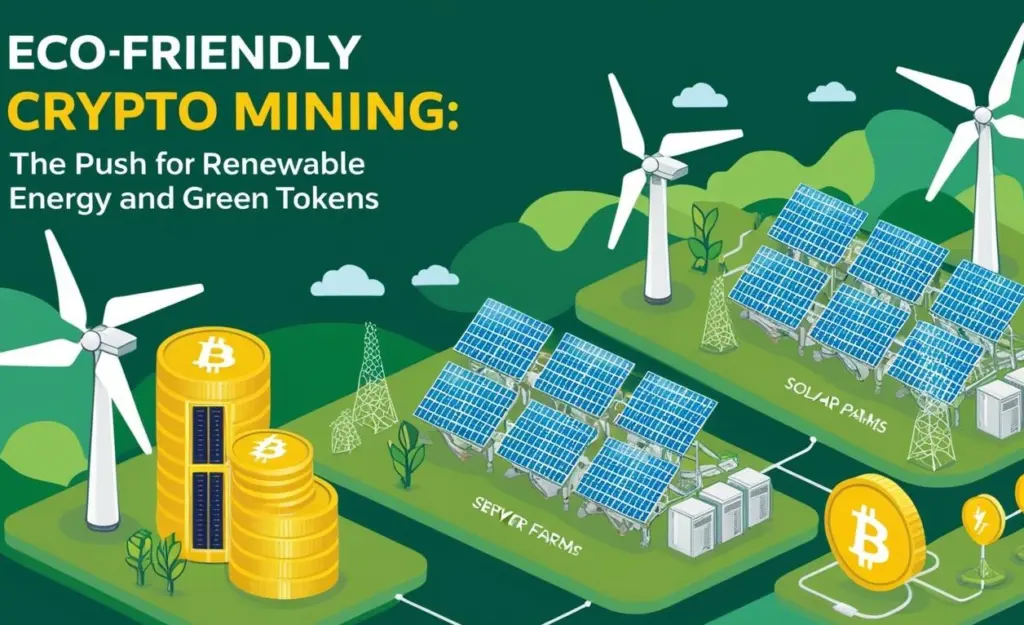
With mounting environmental concerns and regulatory pressures, the crypto industry is transitioning toward eco-friendly crypto mining.
Renewable energy sources and innovative green tokens are paving the way for a cleaner, more cost-effective future in blockchain technology.
What is Eco-Friendly Crypto Mining?

Eco-friendly crypto mining is the use of renewable, low-carbon, and energy-efficient methods to validate blockchain transactions and generate cryptocurrencies.
Unlike traditional Proof-of-Work (PoW) mining, which is based on high-powered computing and fossil fuels, eco-friendly mining incorporates renewable energy sources such as solar, wind, hydroelectric, and geothermal power to minimize environmental impact.
Key Features of Eco-friendly Crypto Mining:
- Use of Renewable Energy: To reduce carbon emissions, mining farms use solar panels, wind turbines, hydroelectric dams, and geothermal sources.
- Energy-Efficient Consensus Mechanisms: Use alternative blockchain protocols such as Proof-of-Stake (PoS), Proof-of-Space, and Proof-of-Storage, which require significantly less energy than PoW.
- Carbon Offset Programs: Some crypto projects invest in carbon credits and reforestation efforts to neutralize their environmental impact.
- Waste Heat Recovery: Innovative mining setups reuse excess heat produced by mining rigs to heat buildings, greenhouses, or industrial processes.
Sustainable Hardware: Entails using energy-efficient mining equipment, such as ASIC miners with lower power consumption, and mining operations in naturally cold regions to reduce cooling costs.
Why is Eco-Friendly Crypto Mining Important?
- Reduces Carbon Footprint: Traditional mining operations contribute significantly to global CO₂ emissions, making sustainability crucial.
- Regulatory Compliance: Governments around the globe are tightening restrictions on energy-intensive crypto mining, pushing the industry toward greener alternatives.
- Investor and Consumer Demand: Environmentally conscious investors are more likely to back green tokens and sustainable crypto projects.
- Long-Term viability: Sustainable mining solutions ensure that blockchain technology continues to grow and be accepted.
With the rise of green blockchain initiatives and eco-friendly mining solutions, the crypto industry is making significant progress toward sustainability and reduced environmental impact.
The Environmental Impact of Traditional Crypto Mining
High Energy Consumption
Traditional crypto mining, particularly Proof-of-Work (PoW) mining, is based on solving complex mathematical problems in order to validate transactions and secure blockchain networks.
This process needs specialized hardware, such as ASIC miners and GPUs, which consume massive amounts of electricity.
Bitcoin mining alone is estimated to consume between 100 and 150 terawatt-hours (TWh) per year, comparable to the annual energy consumption of entire countries such as Argentina or the Netherlands.
The energy intensity of PoW mining raises concerns regarding long-term viability and resource allocation.
Carbon Footprint
Most mining operations use fossil-fuel-powered grids, which significantly contribute to carbon emissions and environmental degradation.
According to studies, Bitcoin mining accounts for 0.1% of global carbon emissions, with mining hotspots such as China (before restrictions), Kazakhstan, and the United States using coal and natural gas-powered electricity.
The high carbon footprint goes against global efforts to reduce greenhouse gas emissions and transition to cleaner energy sources.
Global Regulatory Concerns
Governments globally are taking action against energy-intensive crypto mining due to environmental and energy security risks.
China banned Bitcoin mining in 2021, citing concerns about excessive energy consumption and carbon neutrality.
Regulators in the European Union and the United States are considering policies to restrict or incentivize greener mining through taxation and compliance.
Countries with abundant renewable energy, such as Iceland and Canada, are attracting sustainable mining projects, whereas regions that rely heavily on fossil fuels are under increasing pressure to regulate operations.
The Need for Change
As concerns about the environmental impact of crypto mining grow, industry leaders and blockchain innovators are advocating for environmentally friendly mining alternatives, such as renewable energy adoption and carbon-neutral initiatives.
The Shift Towards Eco-Friendly Crypto Mining
Industry Awareness: Pushing for Sustainable Solutions
The environmental impact of traditional crypto mining has raised concerns among governments, institutions, and the general public. As a result, the industry is turning to sustainable blockchain solutions to reduce energy consumption and carbon emissions.
- Public Pressure: Environmental advocates and policymakers are pushing for greener mining solutions to reduce the carbon footprint of Proof-of-Work (PoW) mining.
- Institutional Influence: Companies such as Tesla, Microsoft, and PayPal have reconsidered their crypto investments due to sustainability concerns, urging the industry to adopt environmentally friendly practices.
- Regulatory Initiatives: Countries such as Sweden and the European Union are considering imposing restrictions or carbon taxation on energy-intensive mining operations.
Green Blockchain Initiatives: Promoting Sustainable Mining
Several projects and organizations are actively working to reduce the environmental impact of crypto mining through renewable energy adoption and carbon-neutral strategies:
- Crypto Climate Accord (CCA): Inspired by the Paris Climate Agreement, the Crypto Climate Accord (CCA) seeks to decarbonize the crypto industry by 2030 through energy efficiency and renewable adoption.
- Bitcoin Mining Council(BMC): An industry-led initiative to improve transparency and sustainability in Bitcoin mining by encouraging the use of renewable energy sources.
- Green Crypto Projects:
- Chia Network (XCH): Employs a Proof-of-Space-and-Time (PoST) consensus mechanism to reduce energy consumption.
- Algorand (ALGO): A carbon-negative blockchain that offsets network emissions.
- Ethereum 2.0: Transitioned from PoW to Proof-of-Stake (PoS), reducing energy consumption by 99.95%.
Investor and Consumer Demand for Sustainable Crypto
The demand for eco-friendly crypto mining is rising as investors and users prioritize sustainability.
- Eco-Conscious Investors: Institutional investors are embracing green tokens and blockchain projects that emphasize sustainability, pushing miners to adopt renewable energy solutions.
- Carbon-Neutral Cryptocurrency Funds: Companies such as Grayscale and Fidelity are exploring carbon-neutral crypto funds to attract ESG (Environmental, Social, Governance) investors.
- Sustainable Mining Farms: Crypto mining farms are relocating to regions with abundant renewable energy, such as hydropower in Canada, geothermal energy in Iceland, and solar energy in Texas.
With industry-wide initiatives, regulatory changes, and growing consumer demand, eco-friendly crypto mining is becoming a reality. The next step is to explore how renewable energy sources and innovative green tokens are reshaping the landscape of sustainable blockchain technology.
Renewable Energy Solutions for Crypto Mining
As the crypto industry faces increasing scrutiny for its environmental impact, renewable energy solutions for crypto mining are emerging as a viable alternative.
Mining operations can significantly reduce carbon emissions and achieve carbon neutrality by utilizing solar, wind, hydroelectric, and geothermal energy sources.
Solar-Powered Mining: Reducing Dependency on Fossil Fuels
Solar energy is one of the most accessible and scalable renewable sources for eco-friendly crypto mining. Mining farms can use sunlight to power operations instead of relying on traditional electricity grids.
- Lower Energy Costs: Solar-powered mining lowers operating costs by reducing reliance on fossil-fuel-based energy.
- Notable Projects:
- Genesis Mining (Sweden): Utilizes solar and hydroelectric power for sustainable Bitcoin mining.
- Soluna Holdings: Invests in solar-powered data centers for crypto mining in North Africa.
- Challenges: Large-scale solar farms and battery storage solutions are needed to maintain 24/7 mining capabilities.
Wind and Hydroelectric Mining Farms: Harness Natural Energy
Many mining operations are switching to wind and hydroelectric power, which provide reliable, renewable energy.
- Hydropower Mining Hubs:
- Before the ban, Sichuan, China, was a major hub for Bitcoin mining using hydroelectric power.
- Canada and Norway: Use their abundant hydroelectric resources to power sustainable mining farms.
- Wind Energy in Crypto Mining:
- West Texas Mining Farms: Takes advantage of the state’s abundant wind energy capacity.
- The Sustainable Bitcoin Mining (SBM) Initiative: Advocates for wind-powered mining as a carbon-neutral solution.
- Key Benefits: Hydropower and wind energy are low-cost, high-efficiency alternatives to fossil fuels, resulting in a more sustainable crypto ecosystem.
Geothermal and Alternative Energy Sources: Innovative Green Mining
Geothermal energy is emerging as a cutting-edge solution for sustainable blockchain mining, providing consistent and eco-friendly power.
- El Salvador’s “Volcano-Powered” Bitcoin Mining:
- The country established a geothermal Bitcoin mining facility powered by its active volcanoes.
- This initiative has helped to power Bitcoin mining with 100% renewable energy, establishing a global precedent.
- Iceland’s Geothermal Mining Farms:
- Iceland’s abundance of geothermal energy has made it a top location for eco-friendly crypto mining.
- Other Alternative Energy Innovations:
- Biogas Mining: Biogas mining is the process of converting agricultural waste into energy for mining.
- Tidal Energy: Experiments using oceanic energy to power blockchain networks.
As green mining initiatives gain traction, more crypto operations will incorporate renewable energy solutions to improve efficiency and minimize environmental impact.
With continued advancements in solar, wind, hydro, and geothermal power, the future of eco-friendly crypto mining appears bright.
Green Tokens and Sustainable Blockchain Projects
As the crypto industry faces increasing scrutiny for its environmental impact, green tokens, and sustainable blockchain projects are emerging as viable solutions. These initiatives aim to reduce energy consumption, offset carbon emissions, and promote eco-friendly crypto mining practices.
Proof of Stake (PoS) and Energy-Efficient Alternatives
Bitcoin uses traditional Proof-of-Work (PoW) mining, which requires massive computational power and consumes a lot of energy. Proof-of-Stake (PoS) and other consensus mechanisms offer more energy-efficient alternatives by eliminating the need for energy-intensive mining.
- PoS (Proof-of-Stake): Validators are chosen based on how many tokens they stake, which significantly reduces electricity consumption.
- Delegated PoS (DPoS): A scalable version of PoS in which token holders vote for delegates to validate transactions.
- Proof-of-Space and Time (PoST): Chia Network uses this mechanism to leverage unused storage space rather than computational power.
- Hybrid Consensus Models: Combining PoW and PoS to improve security while using less energy (e.g., Ethereum 2.0 transition to PoS).
These alternatives reduce carbon emissions while maintaining security and decentralization.
Carbon-Neutral Cryptocurrencies
Several blockchain projects are paving the way for sustainable cryptocurrency development by implementing low-energy protocols and carbon offset programs.
- Algorand (ALGO): is a carbon-negative blockchain that purchases credits to offset emissions.
- Cardano (ADA): Employs a PoS-based Ouroboros protocol, which consumes significantly less energy than Bitcoin.
- Chia (XCH): Uses Proof-of-Space and Time (PoST), which reduces energy consumption while raising concerns about e-waste from storage device wear.
- Hedera Hashgraph (HBAR): Uses a unique hashgraph consensus mechanism, making it one of the most energy-efficient ledgers.
These projects show that crypto innovation can work alongside sustainability efforts.
Tokenized Carbon Offsetting
Blockchain technology is also used to offset carbon emissions and promote environmental sustainability.
- KlimaDAO: A decentralized autonomous organization (DAO) that tokenizes carbon credits, enabling users to purchase, trade, and retire carbon offsets.
- The Toucan Protocol: Aims to bring carbon markets on-chain, making them more accessible and transparent.
- Moss (MCO2): A blockchain-based carbon credit project that promotes reforestation in the Amazon rainforest.
Tokenized carbon credits use blockchain’s transparency and security to ensure verified and traceable carbon offsets, making sustainability more accessible.
The rise of green tokens and sustainable blockchain projects demonstrates that the crypto industry is moving toward a more environmentally conscious future.
By embracing energy-efficient consensus mechanisms, carbon-neutral blockchains, and tokenized sustainability initiatives, the industry can reduce its environmental footprint while maintaining decentralization and innovation.
Challenges and Obstacles to Sustainable Crypto Mining
Scalability of Renewable Energy Solutions
The transition to renewable energy for crypto mining poses scalability challenges. Although solar, wind, and hydroelectric power provide eco-friendly alternatives to fossil fuels, they frequently lack the capacity needed for large-scale mining operations.
- Limited Output: Renewable energy sources can struggle to provide consistent high-power levels, particularly during peak mining periods or in regions with variable weather conditions.
- Storage Issues: Renewable energy’s intermittent nature requires advanced storage solutions (for example, batteries), which can be expensive and technologically difficult to scale.
Economic and Infrastructure Constraints
Adopting eco-friendly crypto mining methods requires significant financial and infrastructure investments.
- High Capital Costs: The transition from fossil fuels to renewable energy requires a significant initial investment in solar panels, wind turbines, and associated infrastructure.
- Technological Barriers: Creating and maintaining energy-efficient mining equipment, such as low-power ASIC miners, can be technically challenging and costly.
- Infrastructure Development: In many areas, the existing power grid and local infrastructure are not designed to integrate renewable energy, limiting the growth of green mining operations.
Regulatory Uncertainty
Government policies are critical to the adoption of sustainable crypto mining practices, but regulatory uncertainty remains a significant barrier.
- Inconsistent Policies: Different regulations across countries pose challenges for global mining operations, causing confusion about standards and compliance requirements.
- Impact on Investment: Investors may be hesitant to commit to eco-friendly mining projects due to perceived legal and financial risks.
- Future Regulations: The lack of a standardized regulatory framework for green crypto mining makes long-term planning difficult for businesses, potentially impeding innovation and scalability.
These challenges indicate that, while promoting eco-friendly crypto mining is important for reducing the industry’s environmental impact, addressing scalability, economic, and regulatory barriers is critical for its long-term growth.
The Future of Eco-Friendly Crypto Mining
Advancements in Green Mining Technologies
Innovative developments in mining hardware and software are poised to transform eco-friendly crypto mining. Energy-efficient ASIC miners and improved GPU designs promise to significantly reduce power consumption.
Furthermore, waste heat recovery systems where excess energy from mining rigs is repurposed for heating or industrial processes are emerging as a viable solution for increasing overall energy efficiency.
These technological advancements will help to reduce operational costs and the environmental impact of crypto mining.
Global Adoption of Sustainable Mining Policies
Governments globally are increasingly recognizing the importance of sustainable mining practices. Future regulatory frameworks are expected to encourage renewable energy adoption through tax breaks, subsidies, and simplified compliance for green crypto mining operations.
Such policies will encourage miners to switch from fossil fuels to renewables such as solar, wind, and hydroelectric power. This global push for sustainability not only reduces mining’s carbon footprint but also strengthens the crypto industry’s long-term viability.
The Function of Decentralized Networks in Sustainability
Decentralized energy grids and blockchain-based sustainability initiatives are expected to play an important role in the future of eco-friendly crypto mining.
Mining operations can optimize energy usage by utilizing decentralized networks, which allow for dynamic distribution and localized energy generation. Projects that combine blockchain with renewable energy systems enable transparent tracking of energy consumption and carbon credits.
This combination of decentralized technology and green energy solutions will accelerate the adoption of sustainable mining practices, setting new standards for efficiency and environmental responsibility.
Together, these advancements point to a bright future for eco-friendly crypto mining, one that not only reduces environmental impact but also lays the foundation for a more sustainable, economically viable, and globally competitive blockchain ecosystem.
Conclusion
Renewable energy and eco-friendly crypto mining practices are not just trends but essential for the long-term sustainability of blockchain technology. Green tokens bolster this shift by providing both financial incentives and environmental benefits.
As the crypto industry evolves, sustainable practices will become the foundation for innovation and global competitiveness.
Miners, developers, and investors are encouraged to support eco-friendly crypto mining initiatives and look into emerging green crypto projects.
Stay informed about renewable energy solutions and sustainable blockchain innovations to help shape the future of a responsible digital economy.