

Economist warns of a new long-term inflationary regime, the worst in 30 years, set to reshape global markets and economies.
It is important to note that Bitcoin (BTC) has been more popular during periods of increasing inflation, as its scarcity and speculative appeal tend to fuel demand.
Is it possible for inflation to ignite the subsequent Bitcoin bull run?
Henrik Zeberg, the Head macroeconomist at Swissblock, recently shared a century-old perspective on the 10-year bond yield of the United States government. His chart divides historical economic phases into inflationary and deflationary administrations.
It emphasizes a “rounding bottom” pattern in bond yields as a precursor to inflation, which has already manifested.
“Does not mean immediate inflation (on the contrary). But it means that the Economy and the Financial World in the coming decade will be completely different from what they have been for the last 30 years,” Zeberg wrote.
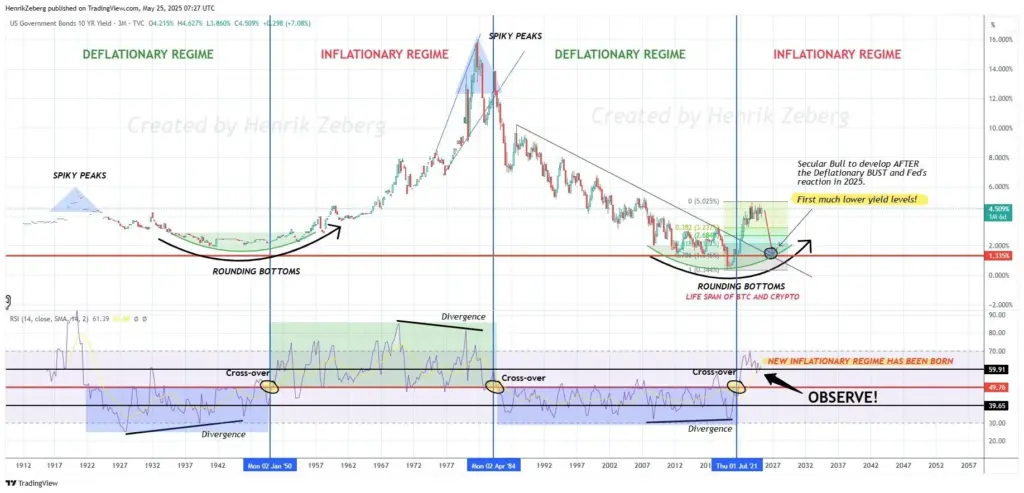
Zeberg’s analysis implies that before a sustained upward trend in yields occurs, there may be a deflationary collapse in 2025. This would provoke a robust policy response from the Federal Reserve. The inflection point will initiate a new secular bull market.
A crypto analyst, Michaël van de Poppe, also emphasized that the bond market’s collapse could potentially compel central banks to print additional money. Eventually, this could result in the collapse of a debt bubble and a subsequent deflationary period. He recently provided a strategy for navigating this in a post on X.
“What’s the way for you to get out of this? Maximize the coming years through investing into risk-on assets: Crypto, Altcoins, and Bitcoin,” he stated.
He subsequently advised that the gains be transferred to safer assets, such as cash, commodities, and Bitcoin (as a store of value), in anticipation of the upcoming market collapse. Eventually, the gains should be reinvested in risk assets during the recovery. Van de Poppe characterized this cyclical strategy as “probably the best game plan” for navigating the forthcoming economic turbulence.
Bitcoin’s significance as a hedge against rising prices increases as the global economy prepares for a potential inflationary regime. Earlier, Geoff Kendrick, Head of Digital Assets Research at Standard Chartered, emphasized the increasing trend.
Notably, the inflationary outlook has already begun to impact financial markets, with Bitcoin being particularly affected. The largest cryptocurrency recently reached a new all-time peak, surpassing $110,900.
Ryan Lee, Chief Analyst at Bitget Research, attributed this rally to various factors. These encompass a post-halving supply shortage, growing regulatory clarity, and institutional adoption.
“Macroeconomic factors are exerting an influence,” Lee stated that Bitcoin’s appeal as a hedge is further bolstered by persistent inflation and rate reduction expectations, with many setting a realistic near-term target of $113,000 by June 2025.
Nevertheless, he warned that Bitcoin’s swift rallies frequently precede corrections, citing potential hazards such as a stronger US dollar or geopolitical tensions.