

Ever heard of the world’s first blockchain-based country, where code replaces borders, smart contracts govern, and digital citizens shape a new era of sovereignty?
- 1 Introduction: What If a Country Were Built on Code?
- 2 What is a Blockchain-Based Country?
- 3 Meet the World’s First Blockchain-Based Country: Bitnation
- 4 How It Works: Governance Without Government
- 5 Digital Sovereignty vs. Legal Reality
- 6 Benefits and Risks of Blockchain Nations
- 7 Global Reaction & Cultural Impact
- 8 Future Outlook: Are Blockchain Nations the New Frontier?
- 9 Conclusion
- 10 Frequently Asked Questions (FAQs)
Introduction: What If a Country Were Built on Code?
Imagine waking up in a country with no borders, no presidents, no passports, just lines of code and a shared vision. No parliaments, no embassies.
Just digital citizens logging in from Lagos, Lisbon, and Lima, all governed by smart contracts rather than bureaucrats.
This isn’t a scene from a sci-fi novel. It’s the foundational idea behind the world’s first blockchain-based country.
In an era where decentralization is reshaping finance, identity, and trust, the next frontier is governance itself. Could code replace constitutions?
Could citizenship be claimed through NFTs instead of birthrights? Could a nation’s treasury be held in a multi-signature wallet, with every expenditure voted on by its people in real-time?
This article explores the emergence, structure, and profound implications of the world’s first blockchain-based country. We’ll break down how it works, who’s building it, and why it might just redefine what we mean by “nationhood” in the 21st century.
As we step into this digital territory, we’ll look at what makes this project revolutionary and why traditional governments should be paying attention.
What is a Blockchain-Based Country?
To understand what makes the world’s first blockchain-based country so groundbreaking, we must first examine what actually defines a country.
Traditionally, a nation is expected to meet four criteria: a permanent population, defined territory, functioning government, and the capacity to enter relations with other states.
Sovereignty and recognition, especially by global entities like the United Nations, cement its place in international law.
But what happens when a “country” isn’t carved into a map, but encoded onto a distributed ledger?
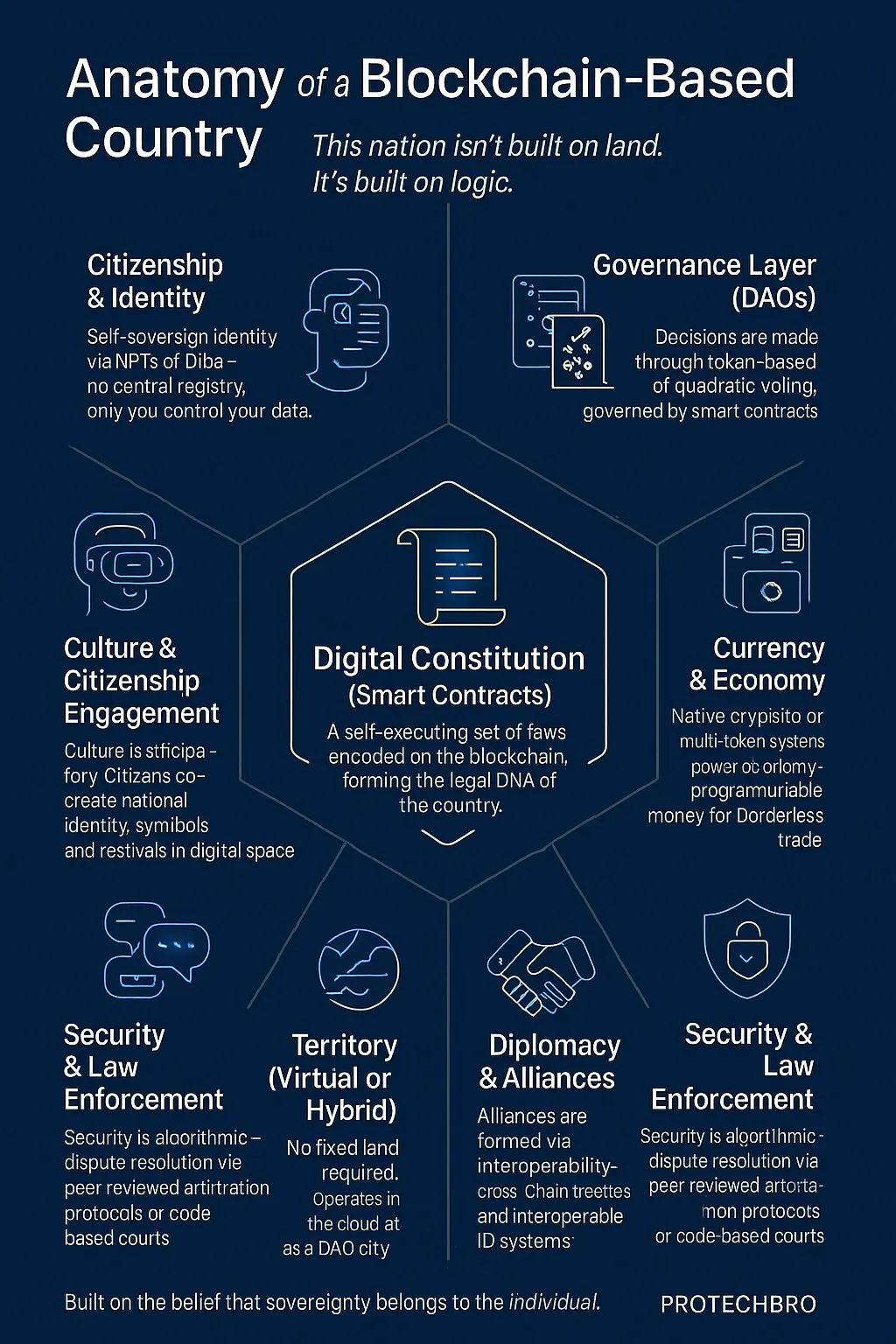
A blockchain-based country radically challenges the old frameworks. There’s no need for physical borders when citizenship is digital. Governance is automated through smart contracts, not parliaments.
A decentralized autonomous organization (DAO) might fulfill the role of a government, and token-based voting can replace traditional ballots. In this system, national assets could exist solely as crypto-treasuries secured across nodes scattered worldwide.
The roots of this concept aren’t entirely new. Digital nations and experimental micronations have long tested the limits of statehood. The Principality of Sealand, a rusted sea fort off the coast of England, has claimed independence since 1967.
Liberland, founded in 2015 between Croatia and Serbia, issued passports and even embraced crypto for governance, yet lacked the traction to be widely recognized or sustainably run.
What sets the world’s first blockchain-based country apart is its structural commitment to decentralization from the start. Rather than mimic statehood, it reimagines it.
With digital identity protocols, on-chain constitutions, and asset-backed crypto economies, this emerging nation is designed to operate autonomously, transparently, and globally, without a square inch of soil.
By leveraging blockchain as the bedrock of governance, it transitions from an experiment to a plausible sovereign entity. And in doing so, it raises an urgent question: in the digital age, is code the new constitution?
Meet the World’s First Blockchain-Based Country: Bitnation
In 2014, Bitnation emerged as a pioneering initiative that redefined what it means to be a country. Rather than laying claim to land, it laid claim to code. Conceived as a decentralized governance platform, Bitnation branded itself as the world’s first blockchain-based country.
Instead of embassies, it offered apps. Instead of bureaucracy, it deployed smart contracts. Its mission: to empower individuals with the tools of statehood, without the state.
Built on Ethereum, Bitnation used smart contracts to facilitate a wide range of sovereign functions. Individuals could issue self-sovereign IDs, register blockchain-based marriages, notarize documents, and even establish peer-verified land titles.
The platform functioned as a digital nation builder, where users could launch their own decentralized voluntary nations (DVNs) and set their own rules of governance.
Through the Bitnation Pangea app, citizens could vote, arbitrate disputes, and even codify laws, all without ever interacting with a centralized authority.
As the world’s first blockchain-based country, Bitnation didn’t just mimic statehood; it decentralized it. It offered services traditionally reserved for governments: ID cards, marriage certificates, even diplomatic and consular services. Refugees, stateless individuals, and digital nomads found it especially appealing, as it provided them with legal identity and community recognition on a global scale.
Over its lifespan, Bitnation hit several key milestones. It hosted the first-ever blockchain-recorded marriage, piloted land registry solutions in underserved regions, and launched the Pangea Arbitration Token (PAT) to power its decentralized legal system.
By 2017, Bitnation had drawn users from over 100 countries and had received global recognition for its blockchain-based refugee ID program.
But as of 2025, Bitnation is no longer active. Its domain has changed hands, and its community has largely disbanded.
While no direct successor has officially taken its place, its foundational ideas live on in newer experiments such as network states, jurisdictional DAOs, and blockchain-based e-residency platforms.
Though Bitnation itself has faded, its legacy as the world’s first blockchain-based country remains a cornerstone of digital nation-building.
How It Works: Governance Without Government
What made Bitnation radical was not just what it offered, but how it operated. It demonstrated that governance could be programmed. Through Ethereum-based smart contracts, Bitnation automated legal agreements, identity management, and rule enforcement.
The core infrastructure relied on decentralized autonomous organizations (DAOs), allowing for fluid, adaptive governance structures that evolved based on citizen participation.
Citizenship was granted through decentralized identity systems (DIDs) or cryptographic tokens. In some cases, NFTs served as digital passports or proof of belonging.
Individuals could join or leave voluntary nations with the click of a button, selecting governance models that resonated with their values, be it democratic, technocratic, or entirely experimental.
Laws were proposed and passed via smart contracts, and disputes were settled by community-appointed arbitrators. These arbitration services were backed by a reputation token system, rewarding fair and timely judgments.
Bitnation’s governance model wasn’t just about representation; it was about automation, transparency, and voluntary association.
Use cases were as ambitious as they were diverse. The platform enabled blockchain-based e-residency for those excluded from traditional nation-states.
It supported peer-to-peer law enforcement, allowing communities to define and uphold their own codes. It offered borderless arbitration, removing the dependency on national court systems. All of this, orchestrated without a single politician or bureaucrat.
As the world’s first blockchain-based country, Bitnation laid the digital groundwork for the next evolution of citizenship.
It showed that nations could exist not as geographical entities, but as programmable communities powered by code, consensus, and cryptography.
Digital Sovereignty vs. Legal Reality
Despite its innovative architecture and global reach, the world’s first blockchain-based country faces a persistent question: is it really a country? Legally speaking, no.
While Bitnation achieved digital sovereignty through voluntary participation and decentralized governance, it never gained formal recognition under international law.
The absence of physical territory, diplomatic recognition, and a centralized government means it doesn’t meet the traditional criteria set by the Montevideo Convention.
This creates an undeniable tension between digital legitimacy and legal reality. For instance, Bitnation could issue its own passports and ID cards, but they held no legal weight at airports or border crossings.
Its smart contracts might have facilitated marriages or land titles, but those documents weren’t always recognized by national courts.
The lack of a centralized jurisdiction meant that enforcing decisions, like arbitration rulings or contractual disputes, relied entirely on voluntary compliance.
Other initiatives, like Estonia’s e-Residency program or Palau’s blockchain ID cards, offer a useful contrast.
While these programs also embrace blockchain, they are backed by recognized nation-states. Estonia’s e-Residency gives global citizens access to banking, business registration, and taxation services, all within the framework of EU law.
Palau’s ID system, while digital-first, is grounded in a government-regulated system. Unlike the world’s first blockchain-based country, these initiatives offer legal grounding, not just technological novelty.
That’s what separates symbolic experimentation from real-world utility. Bitnation pushed boundaries, but its lack of legal enforceability ultimately limited its impact.
The tension between voluntary association and formal state recognition remains unresolved, and until it is, blockchain-based nations live in a twilight zone between sovereignty and simulation.
Benefits and Risks of Blockchain Nations
Despite the challenges, the appeal of the world’s first blockchain-based country was, and remains, powerful. At its core, Bitnation represented an escape hatch from traditional governance.
It offered privacy and self-sovereignty in an era of growing surveillance. It enabled individuals to participate in borderless political systems, free from the constraints of nationality, geography, or authoritarian regimes.
Its censorship-resistant infrastructure meant that identities, contracts, and records could persist even when traditional governments failed.
In conflict zones or authoritarian states, having a blockchain-stored ID or marriage certificate offered continuity and dignity when state services collapsed.
The global nature of these systems invited collaboration and inclusion, allowing communities to build their own laws and resolve their own disputes, often more transparently than existing legal systems.
But the freedom came with significant risks. Without centralized oversight, these systems were vulnerable to scams, governance failures, and rogue actors. The absence of accountability mechanisms meant that users had limited recourse when things went wrong.
Laws executed by smart contracts were final, whether they made sense or not. Dispute resolution systems depended on good-faith participation, and there were no appeals courts or international treaties to fall back on.
Case studies reflect this complexity. Couples married on-chain through Bitnation might find their unions unrecognized in their home countries.
Disputes settled through blockchain arbitration may never be enforceable in traditional courts. While these examples demonstrate the functional potential of a blockchain nation, they also reveal its fragility when measured against established legal norms.
As the world’s first blockchain-based country, Bitnation laid a foundation for digital sovereignty, but also exposed the trade-offs of escaping centralized power. It offered a new way to organize society, but not without consequences.
Global Reaction & Cultural Impact
The debut of the world’s first blockchain-based country sparked global curiosity and stirred polarized reactions. To some, Bitnation was a utopian experiment, a daring reimagination of governance free from corruption, borders, or coercion.
To others, it came across as a libertarian fantasy, promising too much autonomy with too little accountability. The media often struggled to classify it: Was it a digital micronation? A cyberpunk provocation? Or the prototype of a new civic era?
Within the crypto community, Bitnation attracted a niche but passionate following. Early adopters praised its commitment to decentralization and citizen autonomy.
Developers were drawn to the idea of programmable governance, while activists saw it as a tool for empowering the unbanked and stateless. For a time, the world’s first blockchain-based country embodied the ultimate use case for Ethereum beyond DeFi: nation-building on a peer-to-peer ledger.
Its ripple effects reached into virtual worlds. Projects like Decentraland began incorporating on-chain voting and DAO governance. Satoshi Island, a private island in Vanuatu rebranded as a blockchain-based society, echoed many of Bitnation’s principles, offering NFT-based land ownership and community rule-making. These metaverse nations borrowed from Bitnation’s blueprint, proving its cultural imprint extended far beyond a single app.
On the regulatory side, governments took a mixed approach. Some ignored it entirely, viewing it as a harmless digital novelty. Others saw the issuance of passports and diplomatic titles as a challenge to sovereignty.
Though no major government launched formal pushback, Bitnation highlighted growing tensions between code-based jurisdictions and state-based rule of law—a tension that’s only deepened as DAOs and crypto economies scale.
Future Outlook: Are Blockchain Nations the New Frontier?
A decade after Bitnation’s launch, the world is still grappling with its implications. But signs point to a future where the idea of multichain global citizenship is not only plausible, but inevitable.
In a world where more people work, earn, and socialize online, governance models that transcend geography have real appeal.
The world’s first blockchain-based country may not have lasted, but it cracked open a door that cannot easily be closed.
Digital nations could soon become lifelines for stateless individuals. Refugees fleeing war or persecution often lose access to state services, education, ID, and legal protection.
Blockchain-based citizenship could restore these essentials, offering portable, tamper-proof identity and access to decentralized social services. Smart contracts could manage aid, coordinate housing, or even distribute income using global stablecoins.
Meanwhile, DAOs are evolving into full-fledged digital governments. They already fund infrastructure, coordinate labor, and manage treasuries.
As tooling improves, these organizations may take on functions of city councils, school boards, or even central banks, executing policy automatically, guided by consensus algorithms and transparent rules.
Cities like Prospera in Honduras and initiatives like CityDAO in Wyoming are early steps in this direction.
Though the world’s first blockchain-based country has faded from active use, its legacy looms large. It dared to ask if citizenship could be coded, if nations could be voluntary, and if sovereignty could be decoupled from territory.
As we step into a future shaped by AI, Web3, and borderless commerce, those questions have never been more relevant.
Conclusion
Bitnation, the world’s first blockchain-based country, didn’t just disrupt governance; it redefined it. Though it no longer operates, its foundational concepts remain deeply influential.
From issuing blockchain-based IDs to executing peer-to-peer justice via smart contracts, Bitnation proved that a country need not be bound by soil, only by shared code and voluntary consensus.
In tracing its rise and ripple effects, we’ve seen how digital sovereignty can coexist with legal ambiguity. We’ve explored how decentralized autonomous organizations (DAOs), metaverse nations, and NFT-based citizenships are reshaping the way we think about governance, identity, and belonging.
And through it all, the world’s first blockchain-based country stands as a prototype, imperfect but visionary, for a future where nations are software, not soil.
So what does citizenship look like in a decentralized world? Perhaps it’s no longer defined by flags, borders, or birthrights, but by protocols, smart contracts, and shared values.
Perhaps in the near future, your rights won’t be granted by a government, but by a community you choose to opt into—one governed by transparency, consensus, and immutable code.
What if your next passport isn’t printed on paper, but minted as an NFT? What if your next country is just a few lines of code away? The revolution in nationhood has already begun. The only question now is: will you log in?
Frequently Asked Questions (FAQs)
What is a blockchain-based country?
A blockchain-based country is a decentralized digital nation that uses blockchain technology for governance, identity, and civic services without relying on physical territory.
Which was the world’s first blockchain-based country?
Bitnation, launched in 2014, was the world’s first blockchain-based country, offering services like blockchain ID, marriage certificates, and decentralized arbitration.
Is Bitnation still active in 2025?
No, Bitnation is no longer active as of 2025. Its domain has changed ownership, and the project has ceased public operations.
Can I become a citizen of a blockchain country?
Yes, some blockchain nations and DAOs offer digital citizenship through smart contracts, NFTs, or decentralized identity systems.
Are blockchain nations legally recognized?
No, blockchain nations are not formally recognized under international law and lack legal sovereignty despite offering digital governance.