
DePIN networks are bringing blockchain into the physical world by enabling community-owned infrastructure for wireless networks, cloud compute, mobility data, and clean energy.
What Are DePIN Networks?
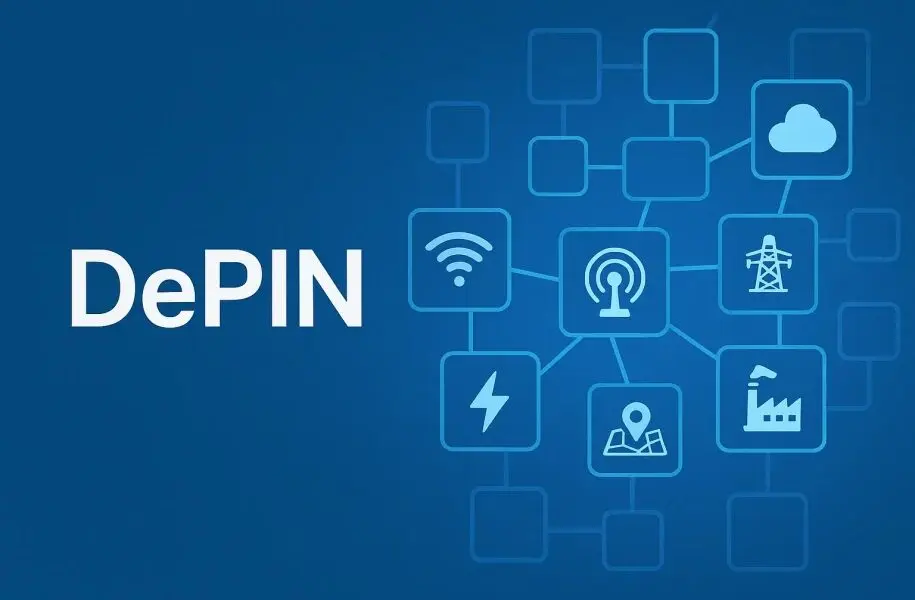
DePIN (Decentralized Physical Infrastructure Networks) refers to blockchain-based systems that coordinate, reward, and govern real-world infrastructure through decentralized participation.
These networks enable individuals and organizations to contribute physical assets such as wireless nodes, storage servers, vehicles, or solar panels and earn token incentives for providing services that were previously dominated by centralized entities.
Definition and Origin
DePIN represents a new Web3 paradigm in which blockchain expands beyond the digital realm and into the physical world.
Rather than relying on centralized corporations or governments to build and maintain infrastructure, DePINs delegate this responsibility to a network of independent contributors.
This model gained popularity after the success of projects such as Helium, which proved that decentralized wireless coverage could be built by ordinary users operating small hotspots.
The term “DePIN” became popular around 2022-2023 to describe a growing class of protocols aimed at token-incentivized real-world infrastructure deployment.
It represents the evolution of the decentralized internet, moving beyond financial use cases such as DeFi to tangible, physical utilities.
Core Characteristics of DePIN Networks
Unlike centralized systems, where corporations own and manage the infrastructure, DePIN networks distribute ownership among a global community of users.
Participants supply and operate hardware, such as wireless nodes, sensors, and storage devices, which together form the service’s backbone.
Incentive-Driven Participation
DePIN is fundamentally based on token economics. Participants are rewarded with native tokens for providing useful work or resources.
These incentives encourage network growth and long-term participation, often through mechanisms such as Proof of Physical Work (PoPw) or Proof of Coverage (PoC).
Blockchain-Based Validation, Governance, and Payment
Every action, from infrastructure deployment to data submission and service validation, is logged and verified on the blockchain.
Smart contracts manage payments automatically, while DAOs can make governance decisions, ensuring transparency and community participation.
Examples of DePIN Sectors
DePIN is a growing ecosystem that spans multiple real-world industries, rather than a single vertical.
Connectivity: Helium
Helium pioneered decentralized wireless by allowing users to set up low-power hotspots and earn HNT tokens for providing network coverage. It has since expanded into 5G networks.
Compute and Storage: Filecoin and Akash
Filecoin allows users to rent out storage space through a decentralized marketplace. Akash goes a step further by providing cloud compute resources, challenging AWS and Google Cloud by leveraging underutilized infrastructure.
Mobility & Mapping: DIMO and Hivemapper
DIMO enables drivers to share vehicle data in exchange for rewards, whereas Hivemapper creates decentralized navigation maps from dashcam contributions, offering alternatives to centralized mapping giants.
Energy: Arkreen

Arkreen incentivizes clean energy production by tokenizing solar infrastructure and enabling decentralized carbon credit generation, thereby aligning DePIN with sustainability goals.
Why It Matters: Addressing Real-World Infrastructure Problems
As the digital and physical worlds become more interconnected, resilient, accessible, and decentralized infrastructure becomes increasingly important. Traditional models, which are centralized, opaque, and slow to innovate, have underserved many markets and underutilized assets.
DePIN networks are bringing blockchain to the physical world by solving real-world infrastructure problems using a Web3-native approach.
Current Challenges with Traditional Infrastructure
Centralized Monopolies and Inefficiencies
A small number of powerful corporations or government-backed entities control the majority of infrastructure systems, including telecommunications, energy, and mobility.
These monopolies frequently stifle innovation, create single points of failure, and limit service reach, particularly in rural or emerging markets.
Lack of Transparency in Data and Pricing
Pricing models in centralized systems are frequently arbitrary or hidden. Whether it’s cloud storage costs or electricity billing, users have little control over how rates are determined or how their data is used.
Underutilized Physical Infrastructure
Every day, vast amounts of global compute power, storage capacity, mobility data, and even renewable energy are left unused. Idle server racks, cars, and solar arrays represent wasted potential that centralized models fail to capitalize on.
How DePIN Solves These Problems
Trustless Coordination and Payments
DePIN protocols use smart contracts to automatically verify work and process payments, eliminating the need for middlemen. This trustless model ensures that contributors receive adequate rewards without relying on centralized authorities.
Micro-Incentives for Contributors
Tokenized incentive mechanisms, such as Proof of Physical Work (PoPw), allow DePIN projects to reward individuals for small but significant contributions, such as providing a few gigabytes of storage, sharing real-time mobility data, or operating a wireless hotspot.
Democratized Access to Infrastructure
DePIN networks reduce the barrier to entry for both users and providers. Anyone can contribute hardware or data, and anyone can benefit from decentralized infrastructure services that are significantly less expensive than traditional providers.
Real-World Data: DePIN’s Growing Impact
- According to Messari’s 2024 DePIN report, the DePIN sector is expected to reach a $3.5 trillion total addressable market (TAM) across industries such as energy, wireless, mobility, and compute.
- Helium, one of the first DePIN success stories, has deployed more than 980,000 hotspots worldwide, creating a decentralized LoRaWAN network that is now used in smart city applications and industrial IoT.
- Filecoin’s storage capacity reached 14 EiB (exbibytes) in 2024, thanks to contributions from thousands of independent node operators, making it one of the largest decentralized data storage platforms.
- DIMO, a vehicle data network, reported over 30,000 connected vehicles globally as of early 2025, indicating growing enterprise interest in real-time mobility analytics.
These figures demonstrate how DePIN is rapidly scaling by addressing real-world needs through decentralized, cost-effective, and community-driven infrastructure.
Traditional infrastructure systems are not scaling equitably and transparently.
DePIN networks are bringing blockchain into the physical world, not as an abstract ideal, but as a tangible solution to inefficiency, waste, and exclusion, enabling individuals to build, share, and benefit from critical infrastructure around the world.
How DePIN Networks are Bringing Blockchain into the Physical World
As blockchain expands beyond digital finance into tangible sectors, DePIN networks bring blockchain to the physical world by enabling decentralized, token-powered alternatives to traditional infrastructure.
Whether it’s enabling global wireless connectivity, distributing cloud storage, mapping city roads, or generating clean energy, DePIN protocols are transforming real-world systems into community-driven, on-chain ecosystems.
This transformation is not hypothetical; it is already unfolding. DePIN is making an impact in four key sectors, as shown by real-world examples.
- Decentralized Wireless (DeWi): A Case Study with Helium
The Helium Network is a pioneering DePIN project in the decentralized wireless (DeWi) space. Instead of relying on telecom giants to build costly cellular and IoT networks, Helium enables everyday users to set up LoRaWAN or 5G hotspots and earn HNT tokens for providing wireless coverage.
Peer-to-Peer 5G and IoT Coverage:
Helium’s dual-layer system enables peer-to-peer 5G and IoT coverage, including LoRaWAN for low-power IoT and 5G for fast mobile connectivity. Node operators install hardware devices that function as mini-towers, forming a peer-to-peer wireless mesh.
Incentivized Deployment:
Users earn rewards through Proof of Coverage (PoC), a cryptographic protocol that verifies each node’s geographic location and uptime. This tokenized system promotes global expansion without requiring centralized coordination.
Real-World Impact:
Helium has deployed over 980,000 hotspots in 70+ countries (as of late 2024), providing affordable connectivity in both urban and rural areas. Its low-cost infrastructure is used for a variety of applications, including smart agriculture and supply chain asset tracking.
Why this matters: By turning citizens into Helium demonstrates how DePIN networks are bringing blockchain to the physical world while also making it more inclusive.
- Decentralized Compute and Storage: Filecoin and Akash
Traditional cloud computing and storage are centralized, expensive, and dominated by hyperscalers such as AWS and Google Cloud. DePIN projects such as Filecoin and Akash disrupt this by coordinating underutilized resources via blockchain.
Blockchain-Based Resource Coordination:
Filecoin offers blockchain-based resource coordination, allowing users to rent out spare hard drive space in exchange for FIL tokens. Akash Network, on the other hand, enables decentralized computing by allowing developers to run containers on idle GPU/CPU resources.
Trustless Rentals, Transparent Pricing:
Smart contracts automate pricing, uptime, and payments, reducing the need for trust between buyers and sellers. This provides a censorship-resistant solution for hosting dApps, AI training workloads, and backup storage.
Web3 Performance, Web2 Scale:
As of 2024, Filecoin provides over 14 exbibytes (EiB) of decentralized storage capacity. Akash supports major Web3 apps and LLM inference workloads, and it serves as the foundation for decentralized AI.
Why it matters: These platforms show how DePIN networks are bringing blockchain into the physical world by reimagining cloud infrastructure as a public utility owned by its users.
3. Mobility and Mapping: DIMO and Hivemapper
Transportation is another area where blockchain meets the real world. DIMO and Hivemapper are two mobility-focused DePIN networks that convert vehicles and dashboard cameras into decentralized data miners.
DIMO allows drivers to connect their cars to a hardware dongle or app and share telemetry data, such as speed, battery health, and location, with the network. Drivers earn tokens in exchange for maintaining ownership of their data.
Decentralized Map Creation (Hivemapper):
Hivemapper equips contributors with AI-powered dashcams to collect road footage. It uses blockchain incentives to transform that data into an up-to-date map, thereby challenging Google Maps’ monopoly.
Use Cases and Benefits:
These systems offer real-time data for autonomous vehicle navigation, fleet optimization, urban planning, and insurance. Hivemapper currently has contributors in over 100 countries, with maps covering thousands of kilometers.
These DePINs indicate how blockchain can transform moving vehicles into revenue-generating data nodes, providing yet another example of how DePIN networks are bringing blockchain to the physical world.
4. Green Energy Networks: Arkreen and Other
The intersection of blockchain and energy is critical to sustainability. Arkreen and similar projects aim to decentralize the clean energy ecosystem by tokenizing electricity production and distribution.
Blockchain for Solar Panel Registration:
Arkreen enables individuals and businesses to register solar panels and microgrids on the blockchain. Each energy-producing unit becomes a verifiable data point capable of generating token rewards.
Tokenized Green Incentives:
Users earn tokens for energy produced and fed into the grid. These rewards can be traded, saved, or used to offset carbon emissions.
DePIN Meets ESG:
Arkreen and similar projects align with ESG principles by supporting local energy ownership, climate accountability, and data transparency.
Why this matters: By decentralizing energy infrastructure and rewards, these networks highlight how DePIN networks are bringing blockchain to the physical world to address one of the planet’s most pressing issues: clean, distributed energy.
From wireless networks and cloud services to mobility and clean energy, DePIN networks are bringing blockchain into the physical world in practical, measurable ways.
These networks flip traditional infrastructure on its head, empowering users to not only consume but also own and operate the critical systems society depends on.
As adoption grows, so too does the opportunity for everyday people to participate in and profit from physical infrastructure secured by blockchain, incentivized by tokens, and governed by communities.
Incentive Models and Token Economics
The use of tokenized incentives distinguishes DePIN networks’ approach to bringing blockchain to the physical world. Unlike traditional infrastructure models that rely on centralized funding or government subsidies, DePINs scale using decentralized economic incentives.
Contributors, whether they’re hosting hardware, providing bandwidth, or collecting physical data, are rewarded with crypto tokens tied to the network’s utility and growth.
How Token Rewards Incentivize Infrastructure Growth
At the heart of DePIN ecosystems is a simple but effective mechanism: token rewards for real-world contributions.
- DePIN networks encourage global participation, decentralized control, and bootstrap growth by issuing native tokens to participants who deploy hardware or provide valuable services.
- Individuals are incentivized to purchase and install physical devices such as wireless hotspots, dascams, and compute nodes.
- Rewards are usually calculated based on usefulness, availability, uptime, and geographic coverage.
- These tokens can be traded, staked, or used for network fees, creating a circular economy that sustains both supply and demand.
Important Mechanisms: Proof of Physical Work (PoPw) and Proof of Coverage (PoC)
DePIN networks use blockchain-based mechanisms to cryptographically validate physical-world contributions, ensuring trust and transparency in reward distribution.
- Proof of Physical Work (PoPw)
PoPw is a consensus or verification layer that confirms that a user has taken a meaningful and verifiable physical action.
- PoPw is used by platforms such as DIMO to validate data collected from connected vehicles.
- Unlike traditional Proof of Work (used in Bitcoin), PoPw prevents wasteful computation and connects work to measurable real-world activity.
- Example: A solar panel that generates energy or a vehicle that transmits telemetry data earns tokens through PoPw.
- Proof of Coverage (PoC)
PoC ensures that infrastructure, such as wireless nodes or sensors, exists in a specified location and functions properly.
- Helium uses proof-of-concept (PoC) to reward hotspot operators for location uniqueness and signal verification.
- It uses GPS data, radio frequency challenges, and peer validations to prevent fraud and double claims.
- PoC promotes network density where it is most needed, not just where the rewards are easiest to earn.
Together, these mechanisms link incentives to real-world utility, discouraging gaming while encouraging meaningful participation.
Balancing Supply and Demand for Network Sustainability
Sustainable tokenomics necessitates a careful balance of incentives and utility. If too many people join too soon, or if demand for services falls behind supply, token value and network efficiency suffer.
- Dynamic reward models adjust based on usage, demand zones, or time-weighted participation.
- Burn mechanisms and staking requirements are used to combat inflation and align long-term incentives.
- Data usage metrics (e.g., how much bandwidth or storage is actually used) aid in fine-tuning rewards to reflect true utility rather than passive presence.
For example:
- Filecoin balances supply by making storage providers lock up collateral and show long-term data retention.
- Akash adjusts pricing through open bidding markets between compute buyers and sellers.
Gamifying Infrastructure Deployment and Maintenance
Gamification is another innovative approach to DePIN economics. Leaderboards, badges, streaks, and bonus incentives are used by networks to encourage behavior that is not solely motivated by profit.
- Hivemapper rewards users for mapping new or under-mapped areas and assigns “missions” to encourage specific coverage tasks.
- DIMO uses vehicle diagnostic streaks and participation rewards to keep drivers connected over time.
- Referral systems and NFT-based ownership also help DePIN networks spread virally by tying contributions to unique digital identities.
Gamification not only improves network coverage and consistency, but it also fosters community and makes physical infrastructure more engaging to use, particularly for non-technical users.
DePIN networks, by combining Proof of Physical Work, Proof of Coverage, and real-time token economics, provide a revolutionary new way to build and maintain physical infrastructure bottom-up, permissionless, and community-powered.
These systems indicate that blockchain is more than just a backend ledger; it is a coordination layer for real-world action.
DePIN networks are bringing blockchain to the physical world at scale by optimizing token incentives and implementing transparent validation, making infrastructure not only usable but also ownable.
Challenges and Limitations
While DePIN networks are bringing blockchain into the physical world in transformative ways, the path to broad adoption is not without challenges. DePIN must overcome a number of structural and operational challenges for it to compete with traditional infrastructure systems.
1. Hardware and Onboarding Fiction
One of DePIN’s key strengths, real-world hardware deployment, is also a major barrier.
- Physical setup is required for user acquisition, which frequently involves custom routers, sensors, cameras, and compute nodes.
- Unlike pure DeFi or NFT platforms, users must install, maintain, and occasionally troubleshoot devices, which can be intimidating for non-technical users.
- Logistics issues such as shipping delays, firmware updates, or device malfunctions can impede participation and network growth.
Example: Many Helium users reported confusion about optimal hotspot placement and syncing issues, which had an impact on reward fairness and network performance.
2. Regulatory Gray Zones
As DePIN expands into sectors such as telecommunications, energy, and mobility, it will inevitably enter regulated industries, often without a clear legal framework.
- Wireless spectrum usage, such as in DeWi projects, may require national licenses or result in conflicts with telecom operators.
- Energy DePINs may clash with regional utility laws, particularly when it comes to microgrid operations or carbon credit verification.
- Mobility and surveillance networks, such as Hivemapper, must navigate privacy laws and data-sharing protocols.
Most countries’ regulators have yet to catch up with the new decentralized infrastructure model, causing uncertainty for users and investors.
3. Upfront Capital Costs
Deploying DePIN infrastructure is not free, and the initial cost of hardware can be a significant barrier, particularly in emerging markets.
- Decentralized routers (Helium), high-resolution dashcams (Hivemapper), and compute GPUs (Akash) can all cost hundreds or thousands of dollars.
- Token volatility adds financial risk to the acquisition; participants may spend significant capital with no return on investment if token prices fall or reward models change.
While token subsidies help to offset these costs initially, long-term sustainability necessitates consistent demand and usage-based incentives.
4. Scalability and Coordination
Coordinating a global network of independent hardware contributors is a significant challenge.
- Network saturation can result in diminishing returns. For example, too many Helium hotspots in a single area dilute token rewards without improving service quality.
- Malicious actors or fake devices (such as location spoofing or idle nodes) can exploit reward systems and undermine network integrity.
- On-chain data validation and storage must scale efficiently to avoid congestion, particularly in high-frequency data networks such as DIMO or Hivemapper.
To address this, many DePIN projects are looking into Layer 2 solutions, ZK proofs, and data offloading protocols, but these are still evolving.
5. User Experience and Community Management
While DePIN is a technological innovation, its success is dependent on broad adoption and trust.
- Many projects lack user-friendly onboarding, mobile apps, and plug-and-play setups.
- Poor communication, unclear tokenomics, and abrupt protocol changes have historically alienated early adopters.
- Strong, transparent communities are required to manage governance, resolve disputes, and promote long-term participation.
Example: Helium’s migration to Solana and changes to its reward model sparked outrage among some node operators who felt left in the dark.
Despite its promise, DePIN must address significant real-world limitations before it rivals centralized infrastructure. These challenges are not unsolvable, but they require careful planning, regulatory foresight, and sustainable economic models.
Nonetheless, the progress made thus far is impressive, and each obstacle overcome serves as evidence of the power of decentralized physical networks.
As tools improve and legal clarity emerges, DePIN networks are bringing blockchain into the physical world as a viable infrastructure movement rather than just an idea.
The Future of DePIN: From Niche to Normal
DePIN networks are still in their early stages, but the progress is undeniable.
As there is a growing demand for decentralized control, real-world data, and sustainable infrastructure, DePIN networks are bringing blockchain to the physical world in a way that has the potential to transform how global systems are built, owned, and operated.
1. Market Growth and Projections
The potential market for DePIN is enormous.
- According to Messari’s 2024 DePIN sector report, DePIN protocols could reach over $3.5 trillion in addressable markets in connectivity, energy, compute, and mobility.
- Venture capital is catching on, with over $850 million invested in DePIN startups in 2023 alone, including major funding rounds for Helium, DIMO, and io.net.
- As of 2025, DePIN projects are active in over 100 countries, with thousands of contributors actively maintaining decentralized infrastructure networks.
This marks a transition from speculative token models to real-world utility tokens linked to physical service delivery.
2. Integration with Emerging Technologies: AI, IoT, and Edge Computing
The next stage of DePIN will be defined by convergence with other frontier technologies, such as:
- Artificial Intelligence (AI): DePINs like Akash power decentralized GPU networks for AI training and inference. Others feed real-world sensor data into AI models for predictive analytics.
- Internet of Things (IoT): DePIN and IoT are a natural fit. Devices that collect and stream data (cars, solar panels, weather sensors) can now do so on-chain using micro-rewards and immutable tracking.
- Edge Computing: DePIN can enable low-latency, cost-efficient, and censorship-resistant infrastructure with edge devices and 5G networks.
These integrations will enable smart cities, precision agriculture, autonomous transport, and next-generation logistics, all coordinated via decentralized platforms.
3. Institutional Adoption and Government Interest
While DePIN began as a grassroots movement, it is now receiving serious attention from institutional players:
- Telecom Partnerships: Helium’s 5G rollout includes partnerships with established carriers such as Dish Network, enabling traditional providers to access decentralized coverage at a lower cost.
- Government Pilots: Local governments are piloting DePIN for smart grid initiatives, citizen Wi-Fi networks, and open mobility data platforms, especially in underserved areas with traditional infrastructure.
- Enterprise Integration: Startups and corporations are evaluating Akash and Filecoin as alternatives to hyperscaler cloud platforms, particularly for privacy-sensitive or decentralized applications.
This hybrid public-private partnership model has the potential to accelerate DePIN infrastructure adoption.
4. Evolving Governance and Sustainability Models
To advance from niche to norm, DePIN projects must improve their governance and token economics:
- Progressive Decentralization: DePINs gradually transfer control to DAOs for community oversight and adaptability.
- Sustainability-Focused Rewards: Reward curves are evolving from early bootstrapping to usage-based models, reducing token inflation and promoting long-term value.
- Carbon-Neutral Operations: Green DePINs like Arkreen integrate carbon credits and smart energy routing, showing that decentralization can align with ESG goals.
DePIN projects can become core infrastructure for Web3 and beyond by putting user trust, economic stability, and environmental responsibility first.
5. A Global, Inclusive Infrastructure Movement
Perhaps the most powerful promise of DePIN is inclusion.
- Anyone with basic hardware and internet access can contribute to infrastructure, from rural farmers hosting solar nodes to urban drivers uploading road data.
- DePIN allows infrastructure to be owned by the people who use it, rather than large corporations or governments.
This democratization of physical networks is at the core of how DePIN networks are bringing blockchain into the physical world, making global infrastructure more equitable, transparent, and community-driven.
DePIN is no longer a Web3 experiment; it is a thriving infrastructure movement with enormous potential. By combining token economics with real-world hardware, DePIN networks are laying the foundation for a new type of global infrastructure: one that is open, participatory, and built from the start.
The coming years will likely determine whether DePIN remains a niche for Web3 pioneers or evolves into the invisible infrastructure layer that powers everything from wireless networks to clean energy and decentralized AI.
Conclusion
As Web3 moves beyond digital finance and token speculation, DePIN networks are bringing blockchain to the real world, one node, dashcam, sensor, and solar panel at a time.
The first act of blockchain was to ensure financial sovereignty. Its next act is infrastructure sovereignty, where the same principles of decentralization and trustlessness apply to roads, devices, power grids, and cities.
DePIN is more than just technology; it’s about agency. It empowers individuals to own a portion of the networks they use, earn for their participation, and contribute to systems previously monopolized by corporations or governments.