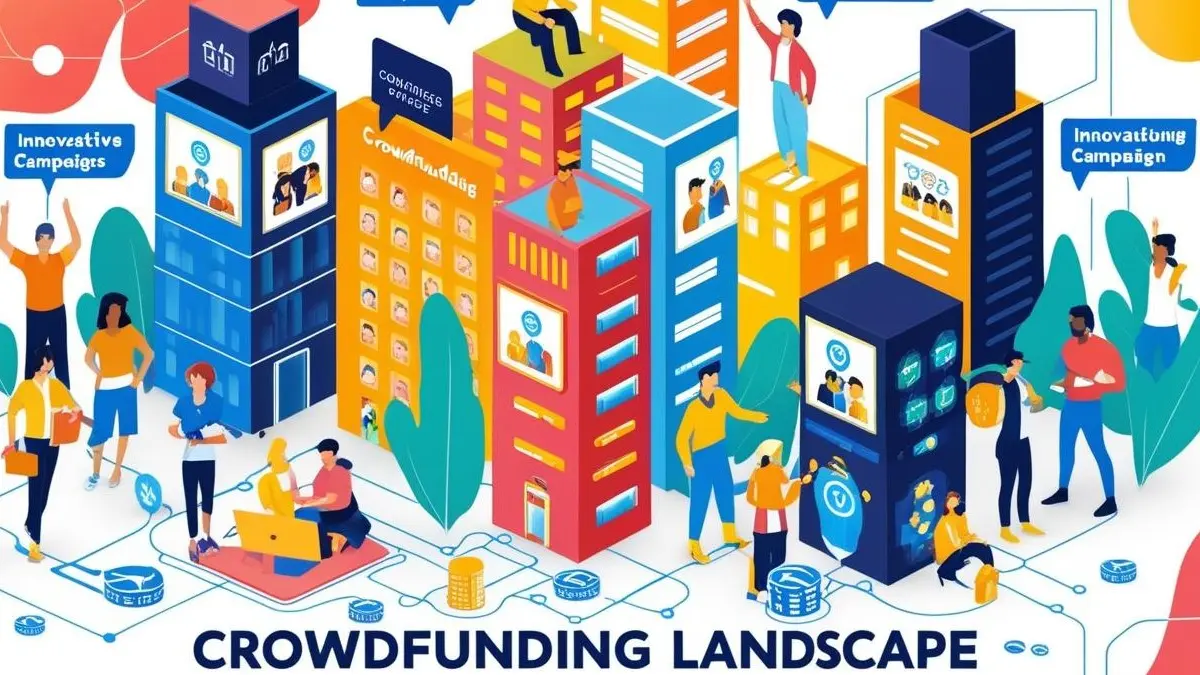
STOs are reshaping the crowdfunding landscape by introducing compliance-driven frameworks, enabling global accessibility, and fostering trust through blockchain transparency.
Here, we’ll explore how STOs are revolutionizing traditional fundraising methods while creating a more inclusive and efficient investment ecosystem.
- 1 What Is The Crowdfunding Landscape?
- 2 What are Security Token Offerings (STOs)?
- 3 How STOs Are Reshaping the Crowdfunding Landscape
- 4 Benefits of STOs in Crowdfunding Landscape:
- 5 Real-World Examples of STOs Reshaping Crowdfunding Landscape
- 6 Challenges STOs Face in the Crowdfunding Landscape
- 7 The Future of Crowdfunding With STOs
- 8 Conclusion
What Is The Crowdfunding Landscape?
Crowdfunding is a fundraising approach in which individuals or organizations raise capital by pooling small donations from a large number of people, usually through internet platforms.
Traditional crowdfunding sites such as Kickstarter, Indiegogo, and GoFundMe act as intermediaries, connecting project creators with possible supporters or funders.
This strategy has democratized fundraising by enabling start-ups, creative projects, and charity organizations to raise funding without depending on traditional financial institutions.
Current Status of Traditional Crowdfunding
Traditional crowdfunding sites have had great success in recent years, supporting various initiatives in technology, arts, and social causes. However, they have some limitations:
Lack of Transparency:
Lack of transparency can lead to trust issues among donors and supporters as they often lack visibility into how their donations are used.
Limited Investor Rights:
Supporters usually receive rewards, privileges, or early product access but do not earn equity or ownership in the funded project.
Illiquidity of Funds:
Funds are illiquid, meaning supporters cannot withdraw or transfer their contributions, making investments inflexible.
High Platform Fees:
High platform costs might reduce project creators’ overall revenue.
These challenges indicate the importance of a more efficient and transparent system that benefits both creators and contributors.
Blockchain’s Role in Revolutionizing Crowdfunding Landscape
Blockchain technology is revolutionizing the crowdfunding landscape by resolving its inherent limitations. Here’s how:
- Enhanced Transparency: Blockchain’s decentralized ledger makes transactions and funding allocations transparent and immutable. This increases trust between project creators and investors.
- Tokenization of Ownership: Blockchain-based crowdfunding introduces security tokens to enable contributors to own equity or ownership stakes in the projects. This adds real financial value to participants beyond simple rewards.
- Improved Liquidity: Blockchain technology creates secondary markets for token holders to trade their investments, providing liquidity compared to traditional crowdfunding.
- Reduced Costs: Blockchain-powered crowdfunding eliminates intermediaries, resulting in reduced transaction and operational costs.
- Global Accessibility: Blockchain technology enables global participation in crowdfunding campaigns without geographical restrictions and traditional banking systems.
By incorporating blockchain technology into crowdfunding, projects can facilitate a more inclusive, transparent, and rewarding environment for all stakeholders.
This innovation is paving the way for the emergence of Security Token Offerings (STOs) as a next-generation option to transform crowdfunding.
What are Security Token Offerings (STOs)?
Security Token Offerings (STOs) are blockchain-based investment vehicles that represent ownership of real-world assets such as equities, debt, real estate, and other financial instruments.
Unlike traditional crowdfunding incentives, STOs issue securities to contributors, providing actual value and ownership rights backed by legal compliance. These tokens are stored and traded on a blockchain, which ensures transparency, security, and efficiency in asset transactions.
How STOs Work
STOs operate by issuing digital tokens on a blockchain network, each representing a financial asset. This is how they operate:
Asset Tokenization:
Asset tokenization involves converting real-world assets, like property or corporate shares, into smaller, tradable units. Each token represents a portion of the asset’s value.
Regulatory Frameworks:
STOs follow legal and regulatory standards, such as securities laws, to protect investors and ensure compliance. This establishes them as a safe alternative to unregulated offerings.
Blockchain Infrastructure:
Blockchain technology enables secure, tamper-proof transactions. Smart contracts automate and enforce terms like payout schedules and voting rights.
Investor Access:
Investor Access: Security tokens can be purchased by both retail and institutional investors, increasing ownership diversity and democratizing access to high-value assets.
By aligning with regulatory standards and offering real-world asset backing, STOs bring a level of trust and legitimacy that ICOs failed to deliver. They effectively bridge the gap between traditional finance and blockchain, making them a transformative solution for crowdfunding.
How STOs Are Reshaping the Crowdfunding Landscape
Democratization of Investment
Security token offerings (STOs) make investment more inclusive by offering fractional ownership of traditionally high-value assets like real estate, private equity, and fine art.
With fractional ownership, investors no longer need to commit huge sums of capital, lowering the barrier to entry for retail investors.
This democratization of investment allows wider participation in financial markets and enables individuals to build diverse portfolios, which were previously accessible to high-net-worth individuals or institutional investors only.
Enhanced Transparency
One of the most significant advantages STOs bring to the crowdfunding landscape is the transparency provided by blockchain technology. All investment transactions are recorded in real-time using the blockchain’s immutable ledger, ensuring a secure and tamper-proof record.
This degree of transparency reduces fraud risk, ensures accountability for project teams, and fosters investor trust. Real-time tracking of token ownership boosts investor trust and addresses a long-existing challenge in traditional crowdfunding.
Compliance and Investor Protection
STOs are distinguished by their stringent adherence to global financial regulations, creating a safer environment for both issuers and investors.
Unlike traditional crowdfunding, where the regulatory environment might be uncertain, STOs are designed to comply with securities regulations across multiple jurisdictions. This compliance ensures that:
- Investor rights, like dividend distribution and profit sharing.
- Risks associated with scams and noncompliance are mitigated.
- Proper due diligence practices for issuers to protect investor funds.
By incorporating regulatory safeguards, STOs align blockchain technology with traditional financial standards, providing a balance of innovation and security.
Liquidity in Secondary Markets
One of the most transformative features of STOs in reshaping the crowdfunding landscape is their ability to provide increased liquidity via secondary markets.
Traditional crowdfunding frequently freezes investor funds for an extended period of time, leaving no obvious exit plan. In contrast, STOs allow investors to trade their tokens on compliant secondary markets, enabling:
- The ability to exit investments based on market conditions.
- Improved market involvement through easier access to trading platforms.
- The presence of a secondary trading environment contributes to valuation stability.
This liquidity advantage benefits not just retail investors but also institutional investors seeking transparent and regulated market environments.
Security token offerings (STOs) are reshaping the crowdfunding landscape by combining blockchain’s innovative potential with the confidence and reliability of traditional finance.
Their capacity to democratize investments, provide transparency, conform to regulations, and provide liquidity creates fresh opportunities for both investors and project teams.
Benefits of STOs in Crowdfunding Landscape:
Wider Accessibility
One of the most notable benefits of security token offerings (STOs) is their capacity to attract a global investor base and eliminate geographical barriers.
Unlike traditional crowdfunding platforms, which are generally confined to local or regional participants, STOs provide global investment opportunities.
Blockchain technology enables seamless cross-border transactions, enabling issuers to reach a wider audience and investors to access projects from all over the world. This global engagement democratizes the crowdfunding landscape, making it more inclusive and accessible than ever before.
Reduced Costs
STOs drastically reduce the costs of crowdfunding by reducing the reliance on intermediaries like brokers, banks, and legal advisors.
Blockchain’s decentralized infrastructure streamlines processes such as token issuance, investor verification, and fundraising, lowering operational and administrative costs.
For issuers, this means cheaper setup and compliance expenses. Reduced fees provide investors with more value for their capital, encouraging wider participation.
Faster Settlements
Blockchain technology enables instantaneous transactions, significantly reducing the time required for fundraising and settlement.
Traditional crowdfunding techniques usually require lengthy approval processes and fund disbursement delays, which can slow project progress. In contrast, STOs enable:
- Tokens are issued in real-time upon an investment
- Efficient fund transfers that avoid banking delays.
- The project timeline accelerated due to faster access to funds.
This efficiency improves the entire experience for issuers and investors, fostering a more dynamic crowdfunding landscape.
Long-term Viability
The regulatory nature of STOs ensures their long-term viability in the crowdfunding landscape.
Unlike Initial Coin Offerings (ICOs), which suffer fraud and regulatory crackdowns, STOs follow strict compliance criteria, including securities laws and investor protections. This robust framework:
- Builds investor trust by ensuring accountability.
- Encourages institutional participation by adhering to traditional financial norms.
- Reduces risks for all stakeholders and promotes a stable environment for innovation.
STOs bridge the gap between traditional finance and blockchain, creating a long-term crowdfunding model that balances innovation, security, and compliance.
Real-World Examples of STOs Reshaping Crowdfunding Landscape
Example 1: Real Estate Tokenization
Real estate has traditionally been an illiquid and high-barrier investment sector, available only to institutional investors and high-net-worth individuals. STOs have disrupted this model by enabling fractional ownership of high-value properties. For example:
Case Study: Aspen Digital
Aspen Digital tokenized ownership of the St. Regis Aspen Resort, a luxury hotel in Colorado, via an STO. Investors from globally could buy security tokens representing shares in the property. This enabled:
- Global accessibility for small-scale investors.
- Token trading on secondary markets, improving liquidity.
- Blockchain technology enables transparent ownership and real-time tracking.
STOs democratize access to prime real estate, making property investments more inclusive and efficient.
Example 2: Equity-Based STOs
Startups are increasingly raising funds through equity-based STOs, which offer investors tokenized shares that represent ownership in their companies. Compared to traditional equity crowdfunding, STOs offer additional benefits such as regulatory compliance, liquidity, and transparency.
Case Study: INX Limited
INX Limited, a blockchain trading platform, held a regulated STO to raise funds for its operations. The platform issued security tokens representing equity to retail and institutional investors in accordance with US securities laws. This STO achieved the following:
- Regulatory oversight boosting investor confidence.
- Increased global investor participation.
- A pioneering example of how blockchain-based equity fundraising aligns with traditional financial principles.
This case shows how STOs help startups raise funds while providing tangible benefits to investors.
These examples highlight how STOs are reshaping the crowdfunding landscape by integrating the accessibility of blockchain technology with the credibility of traditional finance.
STOs create new opportunities for issuers and investors by tokenizing real-world assets and providing innovative equity models, resulting in a more dynamic and inclusive investment ecosystem.
Challenges STOs Face in the Crowdfunding Landscape
STOs have revolutionized crowdfunding by integrating blockchain and traditional finance, but they still face challenges in the crowdfunding landscape that could hinder broad adoption. Here is a breakdown of the major challenges:
Regulation Variability
One of the major challenges for STOs is a lack of uniform regulations across jurisdictions.
Each country has its own set of financial and securities laws, resulting in a patchwork of regulatory requirements.
For example, the Securities and Exchange Commission (SEC) in the United States has stringent regulations, whereas Malta and Switzerland have more flexible frameworks.
This variation complicates cross-border offerings, making it expensive and time-consuming for issuers to ensure compliance.
- Major Insight: Harmonized global regulations are critical for STOs to thrive on a larger scale.
Investor education
Although STOs are an appealing alternative to traditional crowdfunding, many investors, particularly those in traditional finance, are unfamiliar with the concept.
Retail investors frequently struggle to distinguish STOs from Initial Coin Offerings (ICOs), leading to skepticism as a result of previous ICO scams.
Institutional investors may be hesitant to invest because blockchain technology is perceived as new and complex.
- Major Insight: More education and awareness campaigns are required to bridge this knowledge gap.
Technological Barriers
The blockchain infrastructure that supports STOs also poses challenges, such as:
- Scalability Issues: Many blockchains are limited in their ability to handle large volumes of transactions, making them unsuitable for high-demand crowdfunding campaigns.
- Interoperability: Because most STO platforms operate on separate blockchains, token transfers between ecosystems can be difficult.
- Key Insight: Advancements in blockchain technology, such as Layer-2 solutions and interoperability standards, are critical to overcoming these barriers.
Market maturity
The STO market is still in its early stages, with lower adoption rates than traditional crowdfunding or ICOs.
The secondary markets for trading security tokens remain underdeveloped, limiting liquidity.
Mainstream financial institutions have been slow to adopt STOs, limiting their growth.
- Major Insight: For STOs to be broadly adopted, institutional players must actively participate, and secondary market infrastructure must be robust.
While STOs have enormous potential to transform the crowdfunding landscape, they must address challenges such as regulatory complexity, technological constraints, and market immaturity.
By addressing these challenges, STOs can unlock new opportunities and reshape the way investments are raised and managed on the crowdfunding landscape.
The Future of Crowdfunding With STOs
The crowdfunding landscape is shifting significantly as security token offerings (STOs) emerge as a popular fundraising model.
STOs, which use blockchain technology, are redefining how businesses and investors interact. Here’s a breakdown of the future trends shaping the crowdfunding landscape with STOs:
- Increased Adoption of STO Crowdfunding Platforms
As governments globally provide clearer regulatory frameworks for blockchain-based financial instruments, STO platforms are expected to gain mainstream traction. This regulatory clarity builds trust between issuers and investors, encouraging greater participation. The primary drivers are:
- Global Reach: STOs remove geographical barriers, enabling businesses to connect with a broader, more diverse investor base.
- Retail Investor Participation: Fractional ownership allows retail investors to participate in high-value markets such as real estate and private equity, which were previously dominated by institutional investors.
- Integration with Traditional Finance
The integration of blockchain and traditional finance is on the horizon. Traditional crowdfunding platforms and financial institutions are beginning to look into STO technology to improve their services.
- Institutional Investment: Banks and asset managers are looking into STOs as a way to modernize their investment offerings.
- Hybrid Platforms: Future platforms may combine the benefits of blockchain transparency and automation with traditional finance’s established trust and compliance mechanisms.
- Technological Innovation in STO Platforms
The advancement of blockchain technology drives innovation, paving the way for more robust and scalable STO platforms.
- Layer-2 Solutions: New technologies such as Layer-2 protocols (e.g., Polygon, Optimism) improve transaction speeds and lower costs, making STO platforms more efficient.
- AI and Predictive Analytics: Artificial intelligence will help STO platforms by improving market insights, risk assessment, and fraud detection.
- Interoperability: Efforts to create cross-chain compatibility will enable STO platforms to interact seamlessly with other blockchain ecosystems, increasing their utility and accessibility.
- Democratization of Crowdfunding
STOs aim to make crowdfunding more accessible by lowering entry barriers and increasing investment flexibility.
- Tokenization of Assets: The tokenization of real-world assets such as real estate, art, and commodities will offer new investment opportunities for small investors.
- Secondary Markets: Increased liquidity in secondary markets will enable investors to trade tokens and manage their portfolios more effectively.
- Global Standardization and Regulatory Progress
A unified approach to STO regulations across borders will be critical to the broad adoption of this model.
- Harmonized Regulations: International regulatory bodies are likely to collaborate to develop standardized guidelines for STOs, thereby promoting trust and reducing compliance complexities.
- Investor Protection: Future STO frameworks are likely to include stronger measures to protect investors, thereby legitimizing the model.
The future of the crowdfunding landscape with STOs is promising, with a more transparent, efficient, and inclusive ecosystem.
By bridging the gap between traditional finance and blockchain, STOs have the potential to revolutionize fundraising for both businesses and investors.
Conclusion
Security Token Offerings (STOs) are reshaping the crowdfunding landscape in unprecedented ways. By seamlessly integrating blockchain technology with traditional fundraising, STOs address many of the limitations of traditional crowdfunding methods.
STOs offer benefits such as fractional ownership, increased transparency, regulatory compliance, and secondary market liquidity, making them a more efficient and attractive option for issuers and investors alike.
To stay ahead in this evolving landscape, businesses and investors must recognize the potential of STOs. Explore innovative STO platforms, learn about blockchain-based investments, and position yourself to succeed in the next chapter of crowdfunding.
The future of capital raising is here: transparent, efficient, and designed for global participation.