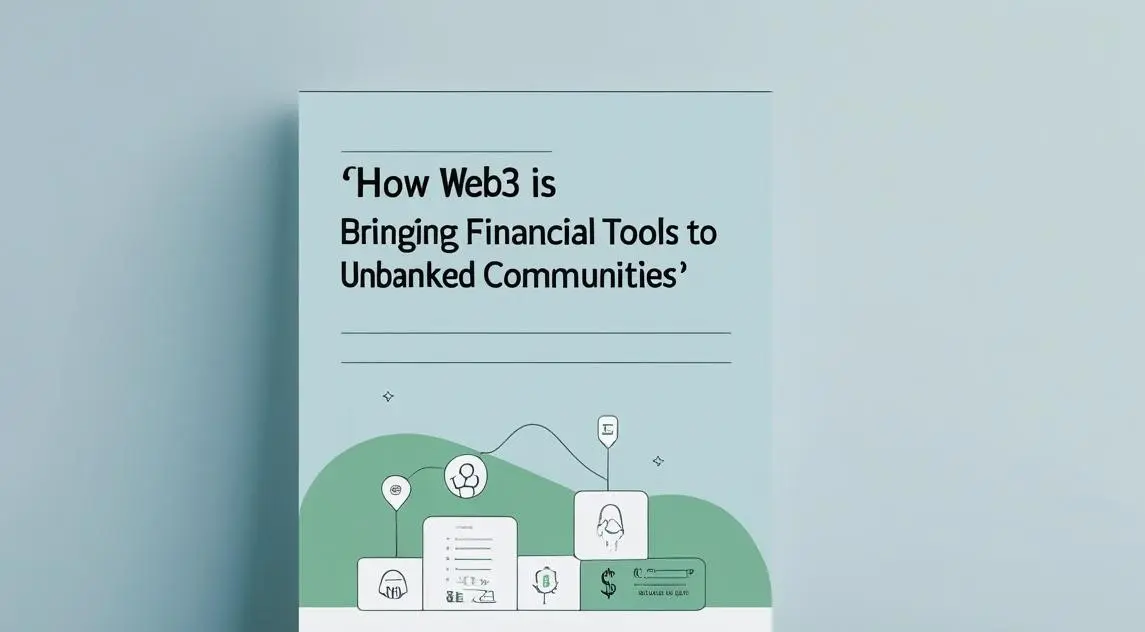
Let’s explore how Web3 empowers unbanked communities with decentralized wallets, stablecoins, and global access to financial tools. Over 1.4 billion adults worldwide remain unbanked in 2025, lacking access to even the most basic financial services.
- 1 Understanding The Unbanked Crisis
- 2 What Is Web3, and Why It Matters
- 3 Web3 Use Cases Empowering the Unbanked Communities
- 4 Digital Identity and Reputation Systems in Web3
- 5 Challenges to Adoption in Unbanked Regions
- 6 Case Studies: Web 3 in Action
- 7 Outlook: Can Web3 Deliver Scalable Financial Inclusion?
- 8 Conclusion
Understanding The Unbanked Crisis
The unbanked are individuals who do not have access to traditional financial services such as checking or savings accounts.
Closely related are the underbanked, who may have limited access to financial institutions but still rely on alternative services like payday lenders, mobile money, or informal savings groups.
The Unbanked Population in 2025
According to the recent World Bank data, an estimated 1.4 billion people around the world remain unbanked in 2025. Despite rising smartphone penetration and mobile fintech growth, core barriers continue to prevent large segments of the population from accessing the formal financial system.
Key Regions Affected
- Sub-Saharan Africa: More than 45% of adults remain unbanked. Rural populations frequently lack access to physical banks, relying on cash economies.
- South Asia: While India, Pakistan, and Bangladesh have made progress with mobile banking, tens of millions still lack formal accounts.
- Latin America: In nations like Mexico and Brazil, informal economies dominate in low-income communities where banks are distrusted or absent.
Major Financial Access Barriers
- Lack of Official Documentation
Many unbanked adults do not have the government-issued IDs required to open accounts or obtain credit. This disproportionately affects women and displaced people.
- Geographic Isolation
In remote villages or underserved urban areas, the nearest physical bank could be several hours away. Digital infrastructure is also limited, especially in areas without reliable internet or mobile service.
- High Banking Fees and Minimum Balances
Traditional banking products frequently come with high service fees or minimum deposit requirements that low-income people cannot afford.
- Distrust of Financial Institutions
Corruption, exclusion, and financial mismanagement have created skepticism towards centralized banking, particularly in regions with unstable currencies or histories of bank failures.
In 2025, over 1.4 billion people remain unbanked, primarily in Sub-Saharan Africa, South Asia, and Latin America. These populations face significant financial access barriers, such as a lack of identification, remote location, high banking fees, and distrust in institutions.
To address the unbanked communities in 2025, solutions that do not rely on traditional finance infrastructure must be developed.
What Is Web3, and Why It Matters
Web3 refers to the internet’s next evolution, one based on decentralized technologies such as blockchain and smart contracts.
Unlike Web2, which is heavily reliant on centralized platforms (banks, technology companies, and governments), Web3 gives users control over their data, assets, and identity.
Key Features of Web3
- Decentralization: There is no single point of control. Platforms run on distributed networks such as Ethereum or Solana, which reduces reliance on traditional banks or gatekeepers.
- Permissionless Access: Anyone with an internet connection and a crypto wallet can use Web3 apps; no bank accounts, credit scores, or formal identification are required.
- Self-Custody: Users store their assets using crypto wallets such as MetaMask or Trust Wallet, eliminating the need for intermediaries.
Web3’s secure, portable identity verification tools include Soulbound Tokens, decentralized identifiers (DIDs), and verifiable credentials.
Web3 vs. Fintech
While fintech apps like Venmo or Chime digitize traditional banking, users still need to pass KYC, have bank accounts, and follow regulated systems.
In contrast, Web3 completely eliminates intermediaries. It allows users to interact directly with decentralized financial tools (DeFi), reducing exclusion from legacy systems.
Why It’s Ideal for the Unbanked Communities
For the unbanked communities, Web3 provides a secure, borderless alternative to traditional finance. Users in rural Kenya or Venezuela can use a smartphone and the internet to access savings protocols, stablecoin payments, and even earn yield, all without visiting a bank.
Web3 Use Cases Empowering the Unbanked Communities
Web3 technologies are changing the way people access financial services by providing practical, low-barrier tools to those who are excluded from traditional banking systems.
These innovations have a greater impact in regions with limited or no financial infrastructure. Here’s how Web3 is bringing financial tools to unbanked communities in 2025:
1. Decentralized Wallets as Bank Accounts
Tools: MetaMask, Trust Wallet, Valora (Celo)
These mobile-first, non-custodial wallets serve as digital bank accounts without the banks. Anyone with a smartphone can store, send, and receive crypto, including stablecoins, without needing a government-issued ID or going to a bank branch.
- Case Study: In Kenya and Venezuela, users use Trust Wallet and Celo’s Valora to hold savings and access DeFi protocols.
2. Stablecoins for Everyday Transactions
Currencies: USDC, cUSD (Celo), USDT
Stablecoins are pegged to fiat currencies (usually USD), making them an effective hedge against local currency inflation. In unstable economies, they are now used to pay for groceries, rent, tuition, and cross-border transactions.
- Use Case: Due to extreme inflation in Argentina and Nigeria, stablecoins are replacing local currencies in daily purchases.
3. DeFi Lending and Borrowing Without Credit Scores
Platforms: Aave, Goldfinch, and Celo’s Moola Market
Individuals with no traditional credit history or collateral can access capital through DeFi lending. Protocols such as Goldfinch provide undercollateralized loans based on community trust and on-chain reputation.
- Use Case: Farmers and entrepreneurs in Sub-Saharan Africa use Goldfinch’s crypto-native credit system to access loans.
4. Remittances Without High Fees
Networks: Solana, Stellar, Celo
Blockchain enables real-time and low-cost international money transfers. These peer-to-peer remittances avoid banks and intermediary fees.
- Statistics: On average, Web3 remittance fees are 90% cheaper than traditional providers like Western Union.
5. DAOs and Earning in the Global Gig Economy
Platforms: Gitcoin, Opolis, and Dework
Web3 provides income opportunities through DAOs (Decentralized Autonomous Organizations), freelance bounty programs, and microtask platforms. These tools pay contributors in crypto and do not require a bank account.
- Use Case: Young adults in the Philippines and Pakistan earn income through DAO-based jobs and tasks on platforms such as Dework.
Web3’s real-world applications are breaking down barriers that have historically excluded billions. From saving and sending money to borrowing and earning, decentralized finance is transforming global inclusion.
Digital Identity and Reputation Systems in Web3
In 2025, digital identity is emerging as a key component of financial inclusion in Web3, especially for unbanked communities. Billions of people are unable to access global finance because they lack traditional documents or verified IDs.
However, blockchain-based reputation systems are changing the game by providing new ways to prove identity, build trust, and gain access to financial tools that are not available through traditional institutions.
Why Digital Identity Is Important for Financial Access
The majority of financial services, including loans, insurance, and even opening a savings account, require verified identity. The unbanked communities face significant challenges due to a lack of documentation (e.g., birth certificates, utility bills, national IDs).
Web3 identity solutions offer secure, user-controlled alternatives that are not dependent on centralized governments or institutions.
Key Web3 Identity Solutions in 2025:
- Soulbound Tokens (SBTs)
SBTs, introduced by Ethereum co-founder Vitalik Buterin, are non-transferable NFTs that represent personal achievements, affiliations, or credentials (such as work history or education).
- SBTs allow users to gradually build on-chain reputation.
- Ideal for proving creditworthiness and eligibility for DeFi loans.
- Polygon ID
Polygon ID is a self-sovereign identity framework that uses zero-knowledge proofs (ZKPs) to verify user traits (such as age or nationality) without revealing sensitive information.
- Used in compliance-friendly DeFi and KYC-lite platforms.
- Unbanked users can prove their eligibility without centralized oversight.
- WorldCoin
Worldcoin, built by Tools for Humanity, provides a global identity layer based on biometric verification (via Orb iris scan) tied to a World ID.
- Although controversial, adoption is increasing in countries like Argentina, Kenya, and India.
- Provides universal access to financial apps with a single proof of personhood.
- Proof of Humanity (PoH)
PoH is a human registry that uses video verification and social vouching to prove personhood.
- Supports UBI projects and DAO participation.
- Allows individuals to verify their uniqueness without the need for banks or states.
Building Credit History Without Banks
Web3 introduces new ways to credit reputation without a centralized credit bureau.
- On-chain activity (wallet history, loan repayments, DAO participation) can be tracked and converted into a decentralized credit score.
- Protocols such as Spectral Finance and Arcx are creating credit models based on wallet data and behavioral patterns.
By removing the gatekeepers and introducing decentralized, privacy-preserving identity systems, Web3 is providing unbanked communities with a passport to digital finance that they can control.
Challenges to Adoption in Unbanked Regions
While Web3 has the potential to transform unbanked communities, it faces significant barriers to adoption in the real world. From inadequate digital infrastructure to a lack of financial education, these challenges must be addressed before decentralized financial tools can achieve global reach.
1. Infrastructure Gaps: Limited Internet and Device Access
Many unbanked communities, particularly in Sub-Saharan Africa, rural India, and Southeast Asia, lack consistent access to electricity, smartphones, and the internet.
- In low-income countries, only 36% have internet access (World Bank, 2024).
- Web3 apps usually require high data bandwidth or modern smartphones, which are out of reach for many people.
2. Education and Financial Literacy
Many people in unbanked communities lack not only financial education but also basic digital literacy.
- New users are unfamiliar with concepts such as wallets, private keys, seed phrases, and smart contracts.
- Without clear onboarding, Web3 can be more intimidating than traditional banking. Organizations such as the Celo Foundation and Blockchain for Humanity are working to close the gap by providing localized training.
3. Regulatory Uncertainty
Adoption of crypto can be risky or even criminalized in regions with underdeveloped or ambiguous regulations.
- For example, Nigeria, despite being a leading crypto adopter, has a history of central bank restrictions on digital assets.
- Unclear rules can limit partnerships with mobile money providers and make it difficult for users to cash out. This undermines both innovation and user trust in Web3 platforms.
4. Crypto Volatility and Scams
Most crypto prices are volatile, which causes fear among new users, particularly in economically fragile regions.
- Bitcoin and Ethereum can fluctuate by 10% or more within days, making them unreliable for daily needs.
- Furthermore, unregulated markets are prime targets for scams, rug pulls, and phishing attacks, with newcomers being most vulnerable. Stablecoins help, but trust is still earned gradually.
5. User Experience (UX) Challenges
Most Web3 apps are designed for tech-savvy audiences, with cluttered interfaces, confusing jargon, and poor mobile optimization.
- For unbanked users with basic phones or limited screen time, the onboarding process must be simple.
- Wallet recovery via seed phrases is a significant barrier if users do not have a secure location to store them or are aware of the risk of losing them. Solutions such as social recovery wallets and biometric login (e.g., Worldcoin) attempt to address this, but adoption remains low.
Despite its promise, Web3 faces a significant challenge before it can truly serve the unbanked communities on a large scale. Bottlenecks include infrastructure, education, regulation, and usability, all of which the ecosystem is becoming more aware of and working to address.
Case Studies: Web 3 in Action
To understand how Web3 is bringing financial tools to unbanked communities, real-world applications must be examined. Several Web3 projects are actively reshaping financial access in developing economies, especially in Africa.
These initiatives prove that, when designed with the local context in mind, decentralized technologies can overcome traditional barriers and provide significant economic empowerment.
1. Celo’s Impact in West Africa
Celo is a mobile-first Layer 1 blockchain that was designed specifically for use in developing economies.
- It supports stablecoins such as cUSD and cEUR, which are commonly used for everyday transactions in some countries.
- Celo works seamlessly with low-cost Android smartphones and only needs a phone number to create a wallet, making it ideal for first-time users.
- Celo reported in 2024 that more than 1.3 million users in West Africa had accessed Web3 financial services through mobile wallets built on its platform.
2. Kotani Pay: Bridging Web3 and Feature Phones in Kenya
Kotani Pay enables users without smartphones or internet access to interact with blockchain services through USSD codes, similar to mobile airtime top-ups.
- It supports basic DeFi actions such as sending stablecoins, checking balances, and receiving payments without the need for an app or internet.
- This innovation is especially effective in rural Kenya, where 75% of the population use feature phones rather than smartphones.
- Kotani Pay enables universal basic income (UBI) programs and humanitarian disbursements via DAOs and aid organizations.
3. Fonbnk: Earning Crypto with Airtime in Developing Markets
Fonbnk provides a radically simple way to earn crypto: selling unused mobile airtime.
- In regions where airtime is considered currency, Fonbnk enables users to convert airtime into USDC on Polygon via a peer-to-peer network.
- Millions of people who do not have formal bank accounts now have the opportunity to earn and save crypto.
- Fonbnk is active in Nigeria, Ghana, and Uganda, providing on-ramp and off-ramp services without requiring a bank account.
4. Grassroots DAO and Digital Farming Cooperatives
Grassroots DAO is a decentralized organization that helps smallholder farmers form digital cooperatives.
- It was built on Celo and allows for transparent savings pools, cooperative financing, and crop insurance.
- Members use blockchain-based tools to vote on financial decisions, track shared assets, and apply for microloans.
- It has enabled farmers in Uganda and Tanzania to transition from cash-based to community-managed digital wallets.
These case studies show Web3 is more than just a theory; it is actively addressing real-world financial challenges. From earning USDC through airtime to managing farming cooperatives using DAOs, blockchain tools are evolving to meet the unbanked where they are.
Outlook: Can Web3 Deliver Scalable Financial Inclusion?
More than technology, the future of Web3’s ability to provide financial tools to unbanked communities is dependent on accessibility, trust, and collaboration.
As blockchain infrastructure matures, several trends emerge that could help Web3 reach the billions who are still excluded from the formal financial system.
Interoperability and Mobile-First Design as Catalysts
To be successful on a global scale, Web3 must function across devices, networks, and chains.
- Interoperability protocols such as Cosmos IBC and Polkadot make it easier to bridge value and identity between blockchains.
- Meanwhile, platforms such as Celo and Kotani Pay demonstrate the power of mobile-first solutions by allowing access via 2G or USSD.
Impact: Lower hardware and connectivity requirements lower the barriers for rural and low-income users.
The Role of AI in On-Chain Credit Scoring
One of the major obstacles to lending in unbanked communities is the lack of formal credit history.
- AI models, combined with on-chain activity, are currently being explored to create decentralized credit scores.
- Projects like Spectral Finance and Covalent are working to assess lending risk based on user wallet behavior rather than paperwork.
Impact: People in unbanked communities can obtain loans without a traditional credit system, using only their DeFi activity as proof.
Partnerships Between DeFi and NGOs
Scaling inclusion involves more than just technology; it also requires partnership.
- NGOs such as Mercy Corps and UNDP are working with DeFi protocols to pilot aid disbursements, savings circles, and microloans.
- These alliances help to build local trust and education, which are both necessary for adoption.
Impact: NGOs act as cultural and logistical bridges, allowing DeFi to reach communities where traditional crypto marketing cannot.
Long-Term Vision: Self-Sovereign Financial Identity
The core of scalable financial inclusion is self-sovereign identity (SSI).
- Individuals can own and manage their identity and credentials without the need for intermediaries using tools such as Polygon ID, Worldcoin, and Proof of Humanity.
- When combined with Soulbound tokens or on-chain history, users can create portable, censorship-resistant identities that grant access to loans, jobs, and services across borders.
Impact: A Web3-native identity system has the potential to replace banks and governments as financial gatekeepers.
The future of Web3’s ability to bring financial tools to unbanked communities is dependent on increasing access, building trust, and designing for inclusivity.
With mobile-first innovation, decentralized identity, and AI-driven credit models, Web3 has the potential to transform from a niche technology to a powerful tool for global financial equity.
Conclusion
Web3 has huge potential to bridge financial gaps that traditional banking systems have long neglected. Web3 is empowering unbanked communities all over the world by providing decentralized tools that do not require formal identification, physical branches, or high fees.
From mobile wallets that serve as digital bank accounts to stablecoins that protect against inflation to peer-to-peer lending without credit scores, each innovation represents a step toward inclusive, borderless finance.
With Web3 identity solutions and community-driven DAOs, the foundation for a new financial infrastructure is already in motion.
As these tools become simpler, interoperable, and tailored to real-world needs, Web3’s vision of bringing financial tools to unbanked communities will become a reality, one wallet, one transaction, one empowered person at a time.