
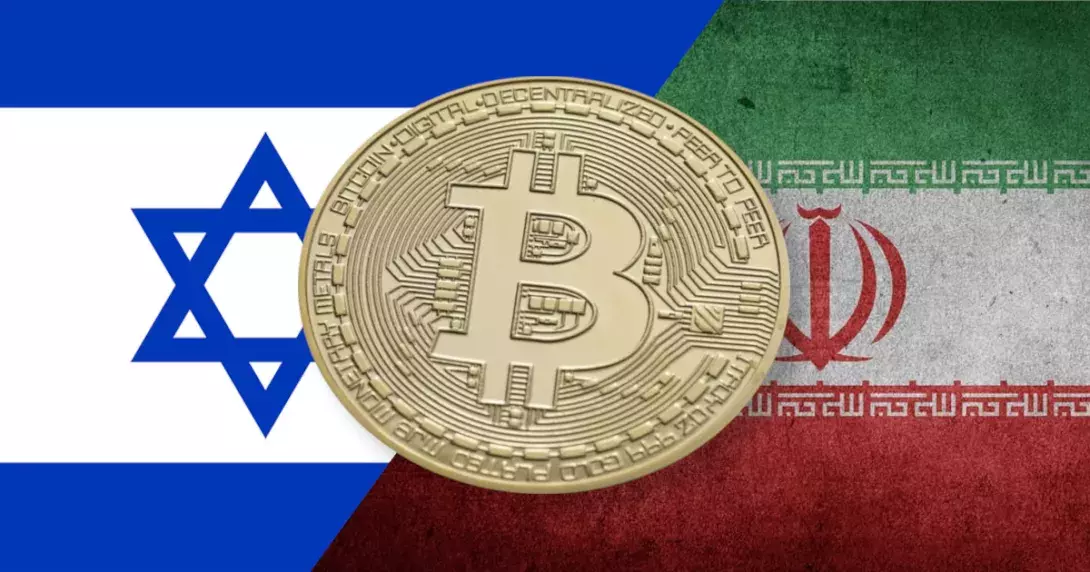
Israel’s airstrike triggers $1.15B crypto liquidation as conflict with Iran escalates—who’s leading in the regional crypto adoption race?
The broader financial markets have been roiled by the Israel-Iran conflict, particularly in the wake of the recent attack on Tunhan.
The collapse of Bitcoin and other altcoins affected the stock market and other financial markets.
Amid this turmoil between Iran and Iran, investors are questioning their approach to crypto adoption and regulation and how digital assets survive in this chaotic environment.
Let us deliberate on the essential details.
Data On Israel vs. Iran’s Crypto Adoption, Regulation, Development
The adoption of cryptocurrency is at its highest point, and countries such as Bhutan and El Salvador are setting the standard for Bitcoin purchasing and development.
Similarly, the United States follows in the footsteps of Donald Trump’s influence on the crypto sector and his assurances of new developments.
Conversely, the adoption of cryptocurrency and regulatory developments in Israel and Iran continues to be a subject of debate amid the current state of conflict.
The recent Israeli airstrike on Iran led to a significant crypto market collapse, resulting in the liquidation of $1.15B within 24 hours.
The war’s potential for escalation poses a greater threat; concurrently, investors are evaluating cryptocurrency adoption in these nations.
According to Global Legal Insights, Israel is crypto-regulated but is cautious.
Israel’s government prioritizes comprehensive crypto regulation, particularly about privacy, money trafficking, and fraud. Additionally, it encourages innovation.
Cryptocurrency is classified as an asset, not a currency, and is subject to a 25% capital gain tax.
It is intriguing that Digital Shekel, a CBDC initiative, is currently in progress but has not yet been implemented.
The approach to crypto adoption and regulation in Iran is slightly different.
In 2025, the country has strengthened its control over the crypto market, according to recent reports from Statistica, Special Eurasia, and other sources.
The government prioritizes transparency, and the CBI has unrestricted access to crypto platform data.
In January 2025, numerous platforms, including payment channels associated with Tether, were rendered inoperable due to their stringent crypto regulations.
In the same vein as Israel, they are also developing a CBC initiative known as “crypto-rial.”
According to reports from Heaven University, cryptocurrencies are subject to taxation based on trading revenues, such as income tax on mining earnings and VAT on crypto purchases (in the event of a price increase).
Who Will Adopt Cryptocurrencies First- Israel Or Iran?
Both nations are significantly influencing global crypto adoption and regulation.
Iran’s crypto policy prioritizes government control and included the prohibition of crypto in 2018, which was later lifted.
Conversely, Israel emphasizes crypto innovation but with a distinct focus on insights.
Statistica’s 2025 projection suggests that roughly 3.65 million cryptocurrency users will generate $615.7 million in revenue.
Iran is anticipated to generate $1.5 billion in revenue by 2025, with 6.73 million consumers.
Iran is the frontrunner in the Israel vs Iran crypto adoption conflict, as indicated by this information.
However, Israel is the frontrunner in infrastructure and regulation.
Nevertheless, they require an additional stimulus in comparison to other prominent nations.