

Privacy Coins & CBDCs are at the center of this ideological and technological tug-of-war; two digital currency innovations that represent opposite ends of the spectrum.
Privacy coins such as Monero, Zcash, and Dash, which prioritize user anonymity via cryptographic tools like zk-SNARKs and ring signatures.
Central Bank Digital Currencies (CBDCs), such as China’s e-CNY, Nigeria’s eNaira, and the upcoming Digital Euro, place an emphasis on state control, auditability, and programmability.
What Are Privacy Coins and CBDCs?
As the global financial system embraces digital transformation in 2025, two distinct types of digital currencies have emerged as leaders: privacy coins and central bank digital currencies (CBDCs).
While both use blockchain or distributed ledger technologies, their goals and architectures differ significantly.
What are Privacy Coins?
Privacy coins are cryptocurrencies that conceal user identity, transaction details, and balances. Unlike Bitcoin and Ethereum, which are both pseudonymous and transparent, privacy coins prioritize financial anonymity and untraceability.
Monero (XMR)

Monero (XMR): Uses ring signatures, stealth addresses, and RingCT (Ring Confidential Transactions) to hide senders, receivers, and amounts.
Zcash (ZEC)

Zcash (ZEC): Makes use of zk-SNARKs (zero-knowledge succinct non-interactive arguments of knowledge), which provide optional privacy for transactions.
Dash (DASH)

Dash (DASH): Provides a PrivateSend feature based on CoinJoin to mix transactions for added privacy.
These assets appeal to users seeking financial independence, but they are also under scrutiny from regulators due to concerns about illicit use.
What are CBDCs?
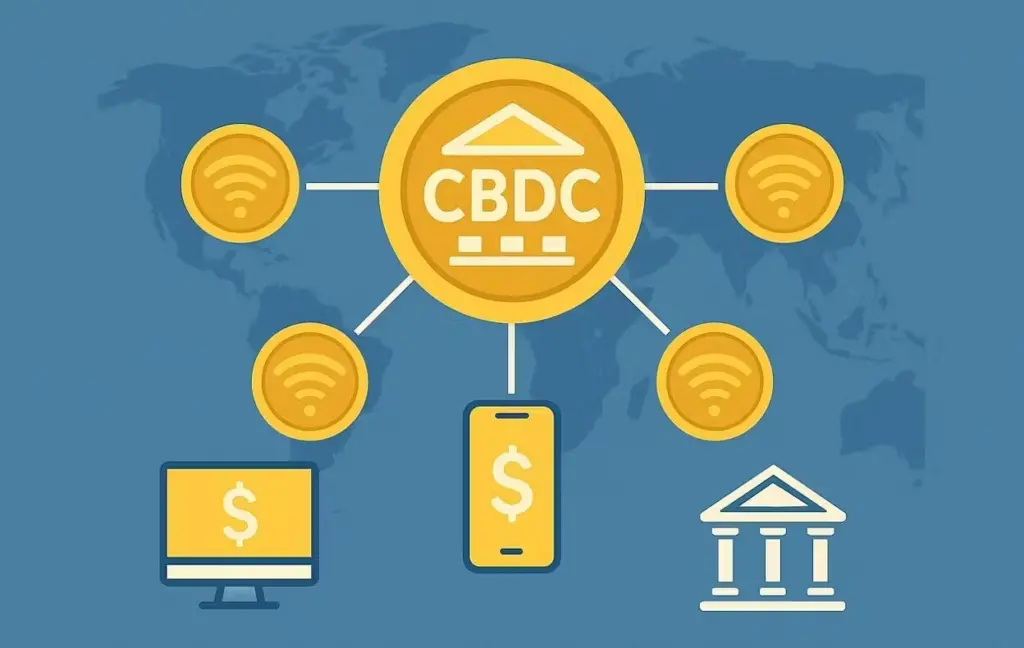
Central Bank Digital Currencies (CBDCs) are government-issued digital fiat currencies that aim to modernize payments and increase financial inclusion.
CBDCs, unlike decentralized cryptocurrencies, are centralized, fully supported by a state authority, and frequently programmable for policy implementation.
- e-CNY (China’s digital yuan): One of the most advanced CBDCs, allowing for real-time surveillance and programmable spending.
- Digital Euro: Focuses on offline transactions, financial stability, and retail access throughout the EU.
- eNaira (Nigeria): Africa’s first CBDC, aimed at streamlining banking and promoting cashless policies.
CBDCs differ from stablecoins, which are privately issued tokens tied to fiat currencies and frequently rely on reserves or algorithms. CBDCs are directly controlled by the central bank, which allows for greater monetary policy integration and regulatory oversight.
The Case for Anonymity in the Crypto Economy
As blockchain adoption increases, so does the debate over transparency and privacy. While transparency promotes auditability, financial privacy in crypto remains critical for protecting individual liberties and user security.
Why Privacy Matters
Protection Against Mass Surveillance
In a world of digital footprints, privacy coins provide protection against excessive monitoring. Without privacy layers, each blockchain transaction becomes a permanent, public record that governments, corporations, and malicious actors can access.
Personal Safety in Authoritarian Regimes
Transacting with traditional crypto in areas with strict financial controls can expose users to political persecution. Privacy coins such as Monero and Zcash allow individuals to access global finance without jeopardizing their safety.
Financial Sovereignty and Censorship Resistance
Privacy protects the right to freely transact, especially when centralized authorities can block payments, freeze assets, or monitor spending behavior.
Challenges of Transparency
While blockchain transparency is critical for trust and security, it has unintended consequences:
On-Chain Data is Public Forever
Wallet balances, transaction histories, and trading trends are all visible. Analytics tools allow anyone to link wallet addresses to real-world identities.
Risks to Businesses and High-Net-Worth Individuals
Enterprises that use DeFi or DAOs risk leaking competitive financial information. Similarly, users with large sums in public wallets may become targets for phishing or extortion.
Privacy coins answer a critical question in Web3: Should all financial transactions be visible indefinitely? While CBDCs prioritize control and traceability, privacy-preserving crypto provides a balance based on freedom, security, and human rights.
Why Governments Are Prioritizing Auditability
As BDCs move from pilot programs to full-scale implementation, auditability has emerged as a critical design feature.
CBDCs, unlike decentralized cryptocurrencies, offer governments unprecedented control and transparency, allowing for tighter alignment with regulatory and economic objectives.
CBDCs and Monetary Control
Governments are using CBDCs to enforce AML, CTF, and tax compliance through digital transactions. Every transaction made with a CBDC can be tracked, verified, and audited in real time, significantly reducing illicit financial activity.
Key programmable features further enhance control:
- Spending limits or expiration dates can encourage consumption during a downturn.
- Targeted stimulus or subsidies can be distributed directly to citizens, with usage restrictions encoded in the digital currency.
These innovations transform CBDCs into policy tools rather than just currencies.
Regulatory Alignment and Global Standards
Auditability helps CBDCs comply with global frameworks like:
- The Financial Action Task Force’s (FATF) guidelines
- G7 and G20 mandates on digital finance
- Domestic regulations for KYC, taxation, and banking oversight
This transparency ensures that CBDCs remain compliant across jurisdictions while also providing central banks with tools for more efficient monetary policy and capital flow management.
However, this level of traceability has raised CBDC surveillance concerns among privacy advocates, who warn of potential overreach and abuse.
CBDCs are redefining the lines between monetary innovation and state surveillance. While they provide effective economic governance tools, they raise legitimate concerns about government control through CBDCs and personal privacy.
Technical Tradeoffs: Privacy vs Compliance
The debate between privacy coins and CBDCs focuses on a fundamental tradeoff in modern digital finance: how to balance user privacy with regulatory compliance.
Privacy Coins: Designed for Anonymity
Monero, Zcash, and Dash are examples of privacy coins that prioritize user anonymity by employing advanced cryptographic techniques like zk-SNARKs, ring signatures, and stealth addresses.
These features keep transaction details like sender, recipient, and amount hidden from public view.
While this provides strong financial privacy in crypto, it presents major challenges for regulators. The lack of traceability makes it difficult to integrate privacy coins into compliant financial ecosystems. As a result, many exchanges delisted them due to regulatory pressure.
CBDCs: Built for Oversight and Control
In contrast, CBDCs are designed to be fully auditable. Governments can track transactions in real time, impose taxes, combat financial crimes, and even program money with smart rules (such as usage restrictions and expiration dates).
These programmable features ensure strict compliance to international standards like FATF and G7/G20 guidelines.
However, this level of control results in significant CBDC privacy trade-offs. Critics argue that CBDCs could enable state surveillance while undermining individual financial freedoms, raising concerns about government control via CBDCs.
Technologies such as zero-knowledge proofs and selective disclosure are being explored to strike a balance between privacy and transparency.
However, until scalable, compliant frameworks emerge, the tension between privacy coin regulation and CBDC traceability will remain unresolved.
This trade-off reflects a larger ideological split: freedom and anonymity vs oversight and stability. Bridging this gap is critical to the future of global digital finance.
Global Landscape: Regulation, Bans, and Adoption Trends
The global regulatory landscape is rapidly evolving, with countries taking opposing stances on privacy coins and CBDCs. As governments seek financial transparency, privacy-focused cryptos are under increasing scrutiny, whereas CBDCs are gaining traction globally.
Privacy Coin Bans and Restrictions
Several jurisdictions have moved to restrict or outright ban privacy coins due to their untraceability, which contradicts AML and CFT regulations. In 2025, significant developments include:
- South Korea and Japan have banned privacy coins such as Monero and Zcash from licensed exchanges, citing concerns about illicit finance.
- The European Union’s MiCA framework expressly prohibits the issuance of fully anonymous crypto assets, establishing a regulatory precedent for other regions.
- The US and UK have yet to outright ban privacy coins, but they do impose pressure on exchanges through compliance requirements.
These moves reflect a growing trend toward privacy coin bans in 2025, especially within jurisdictions that follow FATF travel rule enforcement.
CBDC Launches and Adoption Trends
CBDCs, on the other hand, are gaining popularity around the world, with countries testing, piloting, or scaling up national digital currencies.
- China’s e-CNY has generated over 260 million digital wallets, with use cases ranging from transit to retail shopping, indicating the most advanced large-scale deployment to date.
- Nigeria’s eNaira, despite being Africa’s first CBDC, is experiencing slow adoption due to low public trust, limited education, and banking infrastructure gaps.
- Meanwhile, the Bahamas’ Sand Dollar, the world’s first fully operational CBDC, has achieved consistent, localized success in improving financial inclusion.
Global central banks are in various stages, ranging from pilot programs in India, Brazil, and the UK to full-scale deployments in Caribbean nations.
Countries are shaping the future of digital finance through regulation and innovation. Understanding CBDC adoption statistics by country and regional stances toward privacy coins is critical for navigating this new financial landscape.
Can Privacy Coins & CBDCs Coexist?
As the digital currency ecosystem evolves, the question arises: Can privacy coins survive the CBDC era, or are they fundamentally incompatible with state-backed financial systems?
While these two technologies serve distinct purposes, anonymity versus auditability, there is room for coexistence within certain frameworks.
Scenarios of Coexistence
Privacy coins, such as Monero or Zcash, are ideal for peer-to-peer (P2P) use cases, activist fundraising, and privacy-sensitive transactions. Their appeal stems from their ability to resist censorship and maintain financial privacy, both of which are unusual and not available in CBDCs.
CBDCs, such as the e-CNY or Digital Euro, are designed for state-regulated environments, including tax payments, payroll, and public services that require transparency.
Hybrid and Emerging Approaches
To bridge the gap, hybrid models are being explored:
The Bank of England and the European Central Bank have proposed tiered anonymity, in which small CBDC payments provide limited privacy while large transactions require full KYC compliance.
Privacy coins are also evolving. zkKYC and other zk-based compliance tools enable selective disclosure, allowing users to prove compliance (e.g., over 18, not sanctioned) without revealing their entire identity.
This implies that CBDC and privacy coin integration is feasible in specialized settings where user privacy and regulatory compliance can be balanced through cryptographic innovation.
The Road Ahead: Innovation, Ethics, and Control
The future of privacy coins and CBDCs lies at the intersection of advanced cryptography, ethical decision-making, and societal control. As both technologies advance, the global crypto economy must address fundamental concerns about freedom, privacy, and trust.
Innovation Frontier
Innovative breakthroughs in privacy-preserving technologies are shaping the future of digital finance:
- Confidential computing and multi-party computation (MPC) processes sensitive data without exposing it, allowing for secure DeFi transactions without revealing identities.
- Emerging tools, such as privacy-preserving AI, are being tested to automate compliance while maintaining user confidentiality.
- Layer-2 solutions integrate zk-SNARKs to enable private transactions on public blockchains, offering new lifelines for the future of privacy coins.
These innovations seek to strike a balance: transparent enough for regulators while remaining private enough to protect users.
Ethical Dilemmas
As programmable money becomes more powerful, so do the following questions:
- Who draws the boundary between financial freedom and oversight?
- What kind of transactional privacy can citizens expect in a democratic society?
- Is anonymity a right or a risk?
Debates about the ethics of CBDC control are heating up, especially as central banks consider implementing spending limits, expiration dates, or blacklist features.
Control vs Autonomy
CBDCs introduce a shift in monetary power dynamics. Governments can use programmable controls to directly influence how, when, and where money is spent. While useful for targeted stimulus and anti-fraud efforts, it raises concerns regarding:
- Autonomy erodes in authoritarian regimes
- Surveillance creep in liberal democracies
- The importance of constitutional safeguards for digital money
In contrast, privacy coins maintain autonomy but are hindered by their incompatibility with traditional regulatory systems.
As innovation accelerates, society must consider the trade-offs between privacy and control. The way we design and govern CBDCs and privacy coins will impact not only financial security but also digital freedom.
Conclusion
As the digital asset ecosystem evolves, Privacy Coins and CBDCs represent opposite ends of a rapidly expanding spectrum: one based on anonymity and self-sovereignty, the other on compliance and centralized control.
The future of crypto should prioritize user choice, ethical governance, and transparency, whether individuals prefer privacy-focused Monero or Zcash or the programmability and oversight of CBDCs like the Digital Euro or eNaira.
Stay informed. Examine how these tools are designed and deployed. Most importantly, advocate for crypto systems that safeguard freedom and trust in the digital age.