The SEC is exploring Ethereum’s token standard to enable compliant digital securities, signaling a potential shift in crypto regulation and asset tokenization.
According to Dennis O’Connell, head of the ERC-3643 Association, the SEC showed “a noticeable shift in tone” and an openness to blockchain standards.
To facilitate the legal issue and transfer of tokenized securities, the US Securities and Exchange Commission (SEC) convened with industry participants to discuss a token standard.
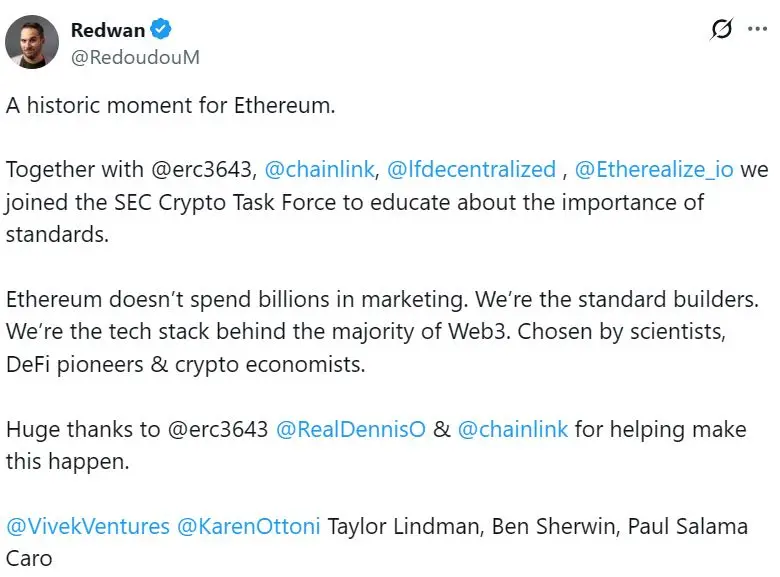
The ERC-3643 Association, Chainlink Labs, the Enterprise Ethereum Alliance, and the Linux Foundation (LF) Decentralized Trust are among the Ethereum-aligned organizations that met with the SEC’s Crypto Task Force on Thursday.
The SEC and blockchain advocates discussed how compliance frameworks like Chainlink’s Automated Compliance Engine (ACE) and open standards like ERC-3643 could assist in bridging the gap between on-chain technology and conventional regulatory frameworks.
The goal of the ERC-3643 token standard is to serve as the cornerstone of Ethereum network-compliant capital markets. Businesses like Chainlink endorse it, and the ERC-3643 Association backs it. A smart-contract-based architecture for tokenized assets, such as securities or real-world assets (RWAs), is called Chainlink ACE.
The SEC is receptive to industry norms for blockchain adherence.
In contrast to prior years, Dennis O’Connell, president of the ERC-3643 Association, said that the SEC demonstrated a discernible change in tone and strategy during the meeting.
O’Connell said, “The task force was very welcoming, engaged, and motivated to bring the US into leadership.”
O’Connell said the SEC seemed receptive to industry-led norms throughout the conference. The task team has not previously considered the significance of open standards in blockchain, he told Cointelegraph.
“We presented our argument for why standards are essential to the expansion of cryptocurrency in the United States and the on-chaining of securities, just like in other sectors, including traditional finance,” O’Connell continued.
During the discussion, industry representatives proposed all of the essential components of a regulatory framework for tokenized securities. We covered identity, compliance, registration, and control.
O’Connell said that the task group had no firm position on tokenized securities. He stated they were “interested in learning how new blockchain technologies address issues related to identity, control, and compliance.”
According to O’Connell, months of behind-the-scenes labor led to the meeting, ultimately a “major step for the industry.”
According to O’Connell, the ERC-3643 Association and its partners plan to continue engaging with the SEC Crypto Task Force and other US government organizations, hoping that the US will eventually surpass other countries in legislation and lead in adopting blockchain technology for financial markets.
SEC Chair Atkins on increasing the use of tokens
The head of the SEC made encouraging comments after the meeting, indicating support for tokenization in the US.
According to a Bloomberg story published on Friday, SEC Chair Paul Atkins is considering incorporating an innovation exemption into its framework to encourage tokenization.
According to Atkin, the SEC considered making adjustments that would encourage tokenization, such as granting new trading platforms permission to assist in creating tokenized securities.
Since transferring assets to the blockchain is unavoidable, Atkins stated, “If it can be tokenized, it will be tokenized.”