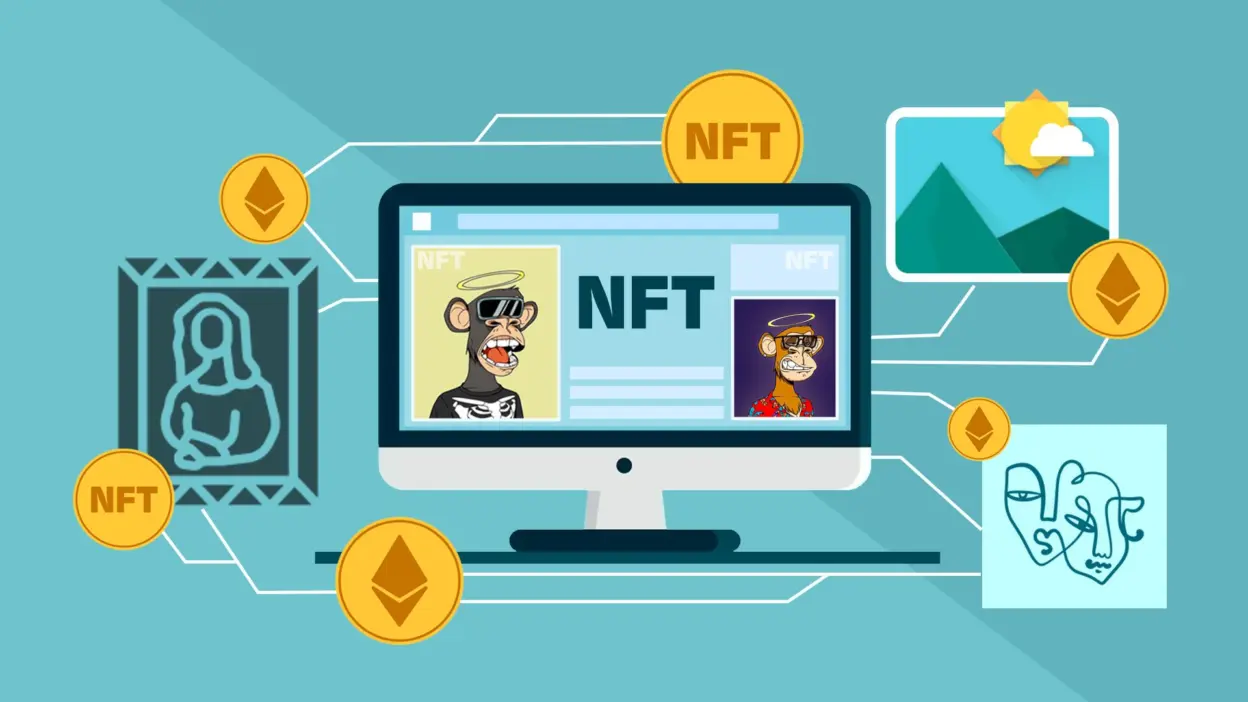
From dynamic royalties to gasless wallets and AR/VR showrooms, discover the Top 7 NFT Marketplace Features of 2025 redefining digital ownership, creator income, and NFT utility
- 1 Introduction
- 2 Dynamic, Multi‑Tier Royalty Structures
- 3 Built‑In Wallets & Seamless Payment Gateways
- 4 Multi‑Chain & Gasless Experiences
- 5 Utility‑Driven and Financialized NFTs (DeFi + Tokenization)
- 6 AI Curation & Smart NFTs
- 7 Immersive AR/VR & Metaverse Integration
- 8 Community, Social & Governance Tools
- 9 Conclusion
Introduction
The NFT landscape has come a long way—grown from speculative JPEGs into a fully matured ecosystem valued at $34.1 billion in 2025
This expansion reflects a compound annual growth rate of approximately 18.5 % since 2020 sustained by over 85 million NFTs minted in the first half of 2025 alone, and a rebounding trade volume of $8.2 billion in Q1
Today’s marketplaces go well beyond mere art speculation—more than 63 % of creators now earn more from royalties than from their initial NFT sales, highlighting a shift toward utility‑powered ecosystems
Against this backdrop, the Top 7 NFT Marketplace Features of 2025 are redefining how creators, collectors, and brands interact with digital assets. These features anchor ecosystems where identity, finance, cross‑chain operability, decentralization, sustainability, discovery, and social engagement converge to deliver real-world value.
This sets up for a deep dive into the NFT Marketplace Features of 2025, previewing seven essential elements shaping the next generation of platforms:
- Dynamic, Multi‑Tier Royalty Structures
- Built‑In Wallets & Seamless Payment Gateways
- Multi‑Chain & Gasless Experiences
- Utility‑Driven and Financialized NFTs (DeFi + Tokenization)
- AI Curation & Smart NFTs
- Immersive AR/VR & Metaverse Integration
- Community, Social & Governance Tools
Dynamic, Multi‑Tier Royalty Structures
One of the standout NFT Marketplace Features of 2025 is the rise of dynamic, multi‑tier royalty structures. Modern smart contracts now support tiered and time‑based royalties, intelligently splitting revenue among creators, collaborators, and influencers according to sale volume, resale price tiers, or duration of holding—the kind of utility that evokes real apparatus over speculative JPEGs.
Platforms like Zora and Manifold have pioneered these models: royalties can adapt dynamically based on resale price tiers or how long an NFT has been held, ensuring that early collaborators or long‑term holders are properly rewarded—shifting away from flat‑rate royalty models.
This aligns with current royalty infrastructure that empowers creators with flexible revenue mechanics and more sustainable earnings strategies.
This new flexible structure contrasts sharply with the legacy royalty controversy surrounding OpenSea. In August 2023, OpenSea discontinued its Operator Filter, the on‑chain enforcement tool that had allowed creators to blacklist marketplaces that don’t enforce resale royalties.
:max_bytes(150000):strip_icc()/GettyImages-1237650322-728c156286b240fa9ab03e7053ebaca6.jpg "Top 7 NFT Marketplace Features of 2025: Royalties, Wallets & Beyond - Protechbro: Top Stories on Bitcoin, Ethereum, Web3, & Blockchain")
As of August 31, royalty enforcement became optional for new collections, marking a shift away from perpetual creator revenue. Creators voiced intense backlash, citing threats to ongoing passive income streams.
In contrast, Yuga Labs—creator of Bored Ape Yacht Club—has taken a proactive, legally grounded approach. Starting in early 2024, Yuga Labs mandated that its collections trade only on marketplaces that enforce royalties at the protocol level.
They formally blocked trading of their NFTs on platforms that don’t enforce royalties for all creators, and launched an Ethereum marketplace in partnership with Magic Eden with built‑in, perpetual royalty guarantees.
These measures enforce creator royalties legally and technically, restoring trust in secondary‑market compensation.
This evolution is a core NFT Marketplace feature of 2025—royalties are no longer static. Instead, they adjust over time, vary by sale tiers, and bring collaborators into the earnings stream.
This reflects a maturing NFT ecosystem where over 63% of creators now earn more from royalties than from initial sales, enabling creator-first economics within the broader NFT Marketplace Features of 2025.
Built‑In Wallets & Seamless Payment Gateways
A defining NFT Marketplace Features of 2025 advancement is the integration of built‑in wallet systems and seamless payment gateways, transforming the onboarding and transaction experience for users.
On leading platforms, users can now mint NFTs, store assets securely, and capture royalty payments—all within an integrated environment—eliminating friction from wallet setup or external crypto conversions.
This evolution across NFT Marketplace Features of 2025 supports both curated creators and casual buyers by reducing technical complexity and increasing trust.
Many marketplaces now incorporate custodial or semi‑custodial wallet infrastructure (such as Mintology’s wallet), enabling users to sign up via social or email login, and begin minting immediately without seed phrases or external tools
These wallets support multi-chain asset storage and integrate with marketplace smart contracts for instant royalty settlement—a core element shaping NFT Marketplace Features of 2025.
Parallel to wallet integrations, robust support for fiat on-ramps and instant checkout has become widespread. Payment services like MoonPay Checkout, Alchemy Pay, Transak, and Switchere are embedded into platforms to allow users to buy NFTs using credit/debit cards or local payment methods without redirecting to external sites
These solutions support major chains—including Ethereum, Polygon, Solana, Arbitrum, Avalanche—enabling frictionless fiat‑crypto conversion at point of purchase.
Gasless or meta‑transaction flows on Layer‑2 networks like Polygon have also become a standard feature. These let buyers and creators transact without upfront gas fees, as gas gets sponsored by the marketplace or settled off‑chain—providing a smoother entry for newcomers, especially in regions where crypto complexity is a barrier
In non‑crypto-first regions like India and Nigeria, mobile‑first interface design paired with familiar payment rails is now common.
Many platforms support UPI or debit card payments directly, enabling users to pay in local currency via mobile wallets or banking apps—making minting and trading NFTs as easy as regular e-commerce.
With UPI’s dominance in India and growing fintech adoption in Nigeria, this localized payment approach is critical infrastructure for NFT adoption—and a hallmark among NFT Marketplace Features of 2025
Together, these capabilities—built‑in wallets, fiat on‑ramp support, gasless meta‑transactions, and region‑specific payment options—are converging to deliver a frictionless user experience. They have become defining elements of the Top 7 NFT Marketplace Features of 2025 ecosystem.
Multi‑Chain & Gasless Experiences
A centerpiece of NFT Marketplace Features of 2025 is multi‑chain access coupled with gasless transaction capabilities—making marketplaces more accessible, faster, and cost-effective.
Multi‑Chain Support
Leading marketplaces now support a wide range of networks—including Ethereum, Solana, Polygon, BNB Chain, Flow, Avalanche, Arbitrum, Base, and Optimism.
This flexibility lets users choose their preferred chain based on cost, speed, and ecosystem preference. For instance, OpenSea’s OS2 platform now supports trading across at least 19 blockchains with aggregated listings and cross-chain purchasing.
Cross-chain platforms like NFTrade enable seamless minting and trading across chains such as Ethereum, Binance Smart Chain, Avalanche, and Polygon, preserving ownership metadata while expanding interoperability.
Gasless & Bundled Transactions
Gasless or ultra-low‑fee transactions—powered by layer‑2 scaling and meta‑transaction sponsorship—are now core to the NFT experience. Layer‑2 solutions (e.g., Polygon, Immutable X, Optimism, Arbitrum) batch or offload transactions to minimize on-chain gas use, enabling cost-efficient trading.
Platforms like Element Marketplace optimize gas‑efficient minting by subsidizing gas fees and enabling near-zero-cost transactions via Ethereum L2s, supporting streamlined creation and listing flows.
Meta-transaction models allow marketplaces to sponsor gas entirely. According to Chainalysis Q2 2025 data, gasless transactions across L2s now account for approximately 37% of all NFT trades.
Why It Matters
Combining multi‑chain interoperability with gasless minting and trading lowers technical and financial barriers—opening engagement to broader audiences and inflating cross-chain liquidity. This convergence is one of the defining NFT Marketplace Features of 2025, enabling seamless, inclusive access.
Utility‑Driven and Financialized NFTs (DeFi + Tokenization)
Among the most transformative NFT Marketplace Features of 2025 is the shift toward utility‑driven and financialized NFTs, where digital assets move beyond speculative art to power real-world applications and unlock new financial mechanisms.
NFTs are no longer just collectibles; they are functional tools embedded in event ticketing, membership access, and identity verification systems.
Platforms like Tixbase and others have turned NFTs into verifiable, fraud‑resistant tickets for concerts, sports events, and conferences, linking each pass to an immutable on-chain record.
Similarly, DAOs now issue NFTs as access keys to private governance forums, while brands increasingly use them as loyalty rewards, blending blockchain technology with mainstream consumer experiences.
This evolution underscores how NFTs are transitioning into infrastructure layers for both digital and physical engagement.
The integration of DeFi capabilities into NFTs has also redefined their role in the Web3 economy. Users can now fractionalize high-value NFTs, breaking them into tradeable segments accessible to a wider pool of investors.
NFT staking platforms allow holders to lock assets in exchange for rewards, creating passive income streams tied to digital ownership. Lending markets have embraced NFTs as collateral, enabling owners to secure loans without selling their assets—an approach that combines traditional finance with the programmability of blockchain.
As of mid‑2025, average NFT-backed loans hover around $4,000, reflecting a growing but cautious market appetite for these hybridized financial instruments.
By linking NFTs to staking, lending, and yield farming mechanisms, marketplaces have made digital assets dynamic, income-generating tools rather than static representations of ownership.
Equally significant is the tokenization of real-world assets (RWAs), which has opened entirely new investor segments. Real estate, fine art, luxury goods, and even rare wines are being digitized as NFTs, allowing fractional ownership and broader market participation.
Dubai, for instance, reported over $18 billion in tokenized property transactions in May 2025 alone, signaling a shift toward blockchain-based real estate markets.
Similar initiatives have emerged globally, including a Solana-powered land tokenization project in the Central African Republic and platforms like Particle.xyz, which fractionalized ownership of high-value artworks such as Banksy pieces.
By anchoring physical assets to blockchain-secured NFTs, marketplaces have bridged the gap between digital collectibles and tangible investments, transforming NFTs into vehicles for wealth building and capital diversification.
This merging of real-world utility, DeFi integration, and asset tokenization has become one of the defining NFT Marketplace Features of 2025. It reflects a fundamental maturation of the ecosystem—away from speculative hype and toward durable, functional, and finance-linked use cases.
By embedding NFTs in everyday life and aligning them with regulated asset classes, marketplaces are paving the way for mass adoption, deeper liquidity, and institutional engagement.
AI Curation & Smart NFTs
Among the most compelling NFT Marketplace Features of 2025 is the integration of AI-driven curation and smart, adaptive NFTs—transforming how collectors discover assets, how trends emerge, and how value is maintained.
Leading-edge platforms now deploy AI-powered recommendation engines that analyze user behavior, transactional history, and trending asset traits to deliver highly personalized NFT feeds.
Services such as Colle AI harness machine learning to refine discoverability, fine-tune pricing strategies, and even flag suspicious or inauthentic assets based on pattern irregularities, improving both liquidity and trust in multichain environments
Similarly, graph-based recommender models like those described in recent academic work leverage multimodal features—images, texts, prices—to generate accurate, context-aware suggestions, boosting engagement and reducing overload amid saturated marketplaces
In tandem, the rise of smart NFTs—also known as iNFTs—signals a shift from static collectibles to evolving, behavior-responsive digital assets.
These NFTs can change form or function over time, based on owner interactions, real-world data inputs (like weather or event attendance), or pre-programmed triggers.
Powered by AI logic, decentralized oracles, and smart contracts, they serve as dynamic companions, personalized artwork, or gamified loyalty tokens
For example, a generative artwork NFT might adjust its visual traits based on a holder’s community activity; or adapt its appearance as seasons change—creating a living digital narrative tied to ownership
Beyond aesthetics, AI plays an essential role in fraud mitigation and marketplace authenticity. With nearly two-thirds of NFTs on some platforms suspected to be fake, AI analytics tools such as Optic.xyz and bitsCrunch are vital.
These systems use image recognition, metadata validation, and transaction analysis to detect copymints, wash trades, or counterfeit assets—automated at scale to protect users and preserve platform integrity
Taken together, these capabilities—intelligent curation, personalization, behavioral NFTs, and automated authentication—form a powerful suite within the broader NFT Marketplace Features of 2025 ecosystem.
They enhance user experience, support community-driven discovery, and ensure reliability and legitimacy across rapidly evolving Web3 marketplaces.
Immersive AR/VR & Metaverse Integration
Among the standout NFT Marketplace Features of 2025, immersive AR/VR and seamless metaverse integration are radically enhancing how users experience and interact with NFTs.
Virtual galleries now replicate the atmosphere of physical exhibitions; collectors can stroll through 3D showrooms, view digital artworks or wearables in life‑like scale, and participate in live auctions—all within immersive environments powered by VR and AR tech.
Platforms such as Spatial host virtual NFT shows and gallery exhibitions, while companies like Viverse, developed by HTC, combine NFT marketplaces with VR and AR content across
Beyond these static galleries, many NFT markets now maintain direct integration with metaverse platforms, allowing NFTs—like avatar wearables, virtual land parcels, or digital collectibles—to be traded on marketplaces and instantly deployed in virtual worlds.
Platforms such as Decentraland and The Sandbox enable direct marketplace links so that users can purchase virtual land or wearables and see them reflected in their metaverse environments immediately, maintaining interoperability and ownership continuity
Further enriching these experiences, real‑time social engagement features are embedded within virtual exhibits: live mint feeds scroll alongside digital walls, creator‑fan chats take place inside immersive rooms, and attendees can interact via avatars during auction events.
These social and interactive layers transform NFT marketplaces from transactional platforms into vibrant virtual communities.
This convergence of immersive display, live interaction, and metaverse linkage exemplifies the most compelling NFT Marketplace Features of 2025, redefining both the purchase and the experience of digital assets
The rise of these capabilities reflects a broader truth: the NFT ecosystem is no longer confined to flat sales screens—it now includes spatial experiences, dynamic realism, and integrated worlds where digital and social value merge.
Such developments represent a key frontier in NFT innovation and core NFT marketplace features of 2025.
Community, Social & Governance Tools
The final entry in the Top 7 NFT Marketplace Features of 2025 centers on community-first social interaction and governance mechanisms, transforming marketplaces from transactional venues into vibrant, participatory ecosystems.
At the core of this feature set are embedded social tools, enabling users to follow creators, like and comment on drops, join topic-specific forums, and message others within the platform.
These functions replicate social media behaviors directly in NFT ecosystems, reducing reliance on external apps and fostering in-platform engagement.
In a 2025 landscape where NFTs thrive on network effects, marketplaces increasingly mirror community platforms by offering intuitive feeds, curated chats, and participatory discovery experiences
Equally pivotal is the rise of DAO-based governance. Governance tokens—often issued as NFTs or ERC tokens—grant holders the power to influence marketplace direction by voting on featured drops, fee structures, and platform policies.
This shift places decision-making in the hands of active stakeholders rather than central administrators. Platforms like Rarible and the Tensor DAO, for example, give tokenholders governance rights and direct access to treasury allocations, enabling decentralized control over curation and economics
By embedding governance within smart contracts, these marketplaces uphold transparent and auditable governance, a critical advancement in NFT Marketplace Features of 2025
Additionally, many platforms now offer white-label and custom-branded marketplace solutions tailored to specific verticals like art, gaming, or music.
These bespoke platforms come with integrated social forums, messaging modules, and deep branding customization—allowing niche communities to curate engagement, shape identity, and govern activity around their shared interests
Creators and brands leveraging these tools can foster highly engaged communities with bespoke governance and built-in social architecture.
Taken together, these interactive, community-led structures—social media–style engagement tools, DAO-driven governance, and verticalized white-label platforms—form the ecosystem baseline for NFT Marketplace Features of 2025.
They empower users to shape their marketplace experience, align platform dynamics with community values, and drive collective evolution of the NFT ecosystem.
Conclusion
The Top 7 NFT Marketplace Features of 2025 collectively showcase how far the NFT ecosystem has evolved from its early speculative roots. Dynamic royalty structures ensure sustainable income streams for creators, while integrated wallets, fiat on‑ramps, and multi‑chain support reduce technical and financial friction for users worldwide.
AI-driven curation, immersive AR/VR integration, and embedded social tools elevate engagement, transforming marketplaces into experiential and interactive hubs rather than static sales platforms.
At the same time, utility-focused NFTs, DeFi integration, and real-world tokenization show that NFTs are not just for digital art anymore—they now provide real value and create new ways to invest and gain access.
These features are not standalone trends; they form an interconnected framework. Royalties secure creator monetization, wallets and multi‑chain support democratize access, and AI curation and social tools build engagement, while governance empowers communities to shape their ecosystems.
Together, they represent a holistic vision of what NFT marketplaces are becoming: user‑centric, creator‑friendly, financially sophisticated, and socially immersive.
In 2025, the marketplaces leading the pack are those that successfully blend creator-centric monetization, seamless user experience, real-world utility, and community governance into cohesive platforms.
As NFTs grow into important parts of finance, culture, and society, these key features show that the market is becoming more stable and focused on long-term value, inclusivity, and active involvement instead of just temporary excitement.
The next era of NFTs is not just about what you own; it’s about how you interact, engage, and build within these digital-first economies.