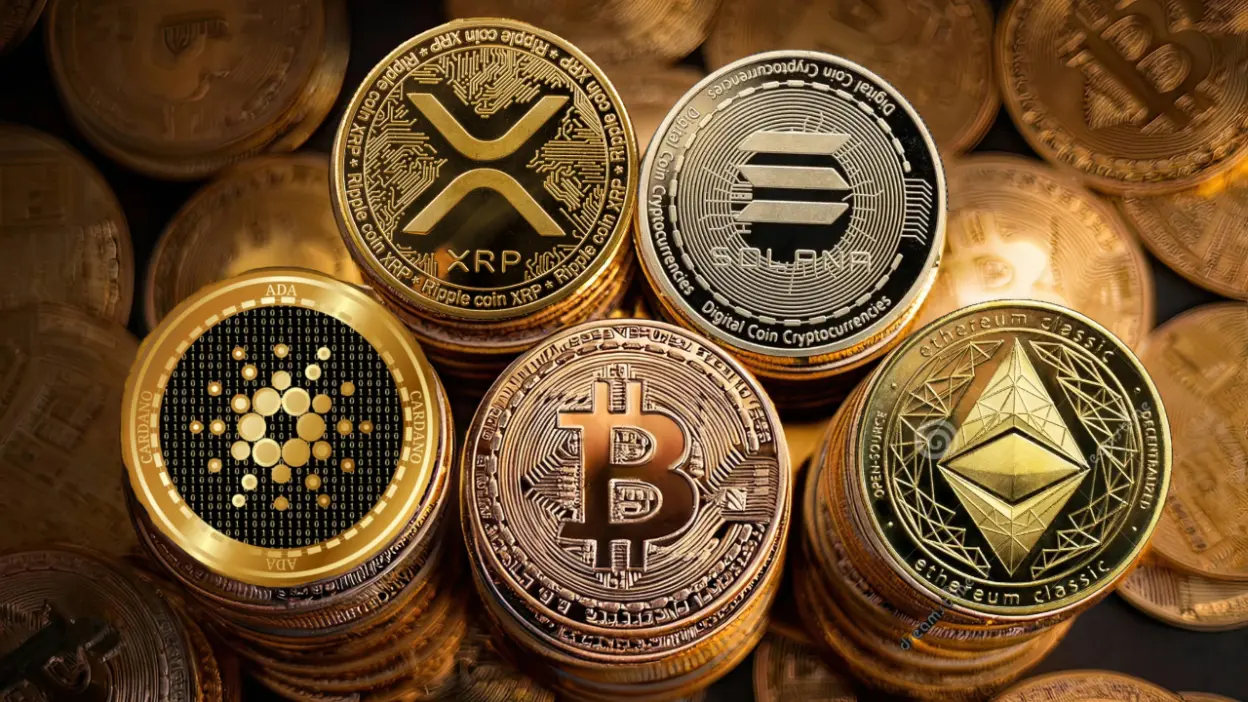
Even though the world economy is having a hard time in 2025, Bitcoin, Ethereum, XRP, and Solana are all on the rise thanks to their strong fundamentals, usefulness in the real world, and greater institutional adoption.
It has not been easy to handle the world’s money in 2025. The economy is being hurt by things like high inflation, rising interest rates, less stability around the world, and tighter rules. These all make traditional markets very unstable. But even so, some cryptocurrencies are not only still around, they’re even going up. All four cryptocurrencies, Bitcoin, Ethereum, XRP, and Solana, are strong and moving forward on their own.
Different cryptocurrencies have come and gone over the years, but these four have always been strong and useful. In 2025, Bitcoin, Ethereum, XRP, and Solana are all doing very well, even though the market as a whole is having a rough time. It also talks about why they are growing so quickly right now and why both small businesses and big banks are interested in them.
Market Resilience: How Major Coins Are Defying the Odds
As a whole, the economy is getting tighter, and regulators are paying more attention to many areas. However, big cryptocurrencies have shown a surprising amount of power. That Bitcoin, Ethereum, XRP, and Solana are so popular isn’t just a guess; it shows that they work well in the real world.
These assets are no longer seen by investors as risky bets or hedges. Instead, they see them as important parts of a bigger shift in technology. DeFi and cross-border payments, as well as decentralized apps and tokenized real-world assets, are just a few of the ways that these coins are changing the way money and technology work.
This toughness has grown as more people around the world use decentralized networks, infrastructure has gotten better, and the financial world has learned more about how these networks can help them in the long run.
Bitcoin’s Appeal as Digital Gold in Unstable Times
Gold and other safe investments have long been sought after by investors when economies show signs of being unstable. But Bitcoin has become more and more known as “digital gold” over the past few years. This means that it is seen as a safe way to store value that central banks or rising interest rates can’t change.
Inflation, war around the world, and issues in the banking industry have made people interested in real-world assets in 2025. Sovereign wealth funds, big businesses, and individual investors are all interested in Bitcoin because it is unregulated, and there are only so many of them.
Right now, Bitcoin is very popular because it’s simple to use. It doesn’t depend on government tokens, smart contracts, or hard-to-understand ways to stake. The problem is a lack of digital goods. And having a few things can be helpful when things aren’t clear.
Bitcoin is also being used by more people in places where currencies are losing value, which makes it a better global hedge. Better lightning network, Bitcoin ATMs, and tools for moving money have all made it easier and more useful to use.
But because of this, Bitcoin’s price has been steadily going up since 2025, breaking through important levels of barriers even when markets were having a hard time.
Ethereum’s Growth Through DeFi and Real-World Applications
The ETH token (Ethereum) is more than just digital cash; it plays a big part in the crypto economy. Ethereum is the leader in Web3 infrastructure because it is the base for DeFi (decentralized finance), NFTs (non-fungible tokens), and now tokenizing real-world assets.
We see a new wave of adoption in 2025 that comes from use cases built on Ethereum:
- Real-world assets on-chain: More and more tokenized real estate, bonds, and goods are being released on Ethereum.
- Stablecoin settlements: A lot of stablecoins, like USDC and DAI, work mainly on Ethereum, which increases the number of transactions that happen on the blockchain.
- Institutional DeFi: banks and fintech companies use Ethereum’s scalable Layer 2 solutions to make DeFi goods that are compliant.
- EVM compatibility: Other chains are using Ethereum Virtual Machine (EVM) standards, which makes Ethereum even more of a Web3 language.
Moving to proof-of-stake (PoS) and successfully implementing scalability changes have made Ethereum much more energy efficient and lowered gas fees, which makes it more appealing to both developers and users.
Because of these changes, Ethereum is now more than just a tech platform; it is also a foundational layer for the future of global banking.
XRP’s Role in Cross-Border Payments and Regulatory Wins
Ripple’s XRP token has been linked to changing the way cross-border payments are made for a long time. While many crypto projects try to take the place of banks, Ripple has focused on working with banks to make it easier for money to move between countries.
XRP has gotten a lot of help from two events in 2025:
- Regulatory clarity: Ripple has finally reached a good settlement with the U.S. Securities and Exchange Commission (SEC) after a long legal fight that lasted several years. The courts have ruled that XRP is a digital asset and not a bond. This makes it possible for more institutions to start using it.
- Global banking integration: RippleNet is the company’s global payments network. Hundreds of banks, including big ones in Asia, Africa, and Latin America, now use it. People use XRP as a temporary cash in places where regular banking is slow or costs a lot.
XRP is back in the holdings of both institutional and individual investors in 2025, thanks to its lightning-fast transaction speeds, low fees, and regulatory wins. Its comeback shows that the market has faith in its long-term success again.
Solana’s Speed, DeFi Expansion, and Developer Momentum
Since it began, Solana has had its fair share of ups and downs. But now, in 2025, it is going through a rebirth. Solana is becoming more and more popular among developers who are making Web3 apps because it has a high rate and lightning-fast transaction speeds.
Several trends are helping Solana gain ground:
- Explosive DeFi growth: Because they settle almost instantly and have very low fees, Solana’s DeFi systems are seeing more liquidity and users.
- NFT resurgence: After Ethereum took the lead, Solana has built a strong NFT community with markets and game integrations.
- Improved stability: Updates to the network have taken care of earlier worries about outages, which has given developers and users more faith.
- Mobile-first Web3 experiences: Solana is a leader in mobile interaction with projects like the Solana Saga phone, which is meant to make dApps easier for regular people to use.
Solana is one of the best Layer 1 chains in 2025 because its environment is growing, and it focuses on being scalable and easy to use.
Conclusion
It was not expected that Bitcoin, Ethereum, XRP, and Solana would keep going up in 2025, but they did. This was true even though the global economy was having problems, such as rising prices, interest rates, and government instability. If they keep going up, it’s not just short-term hype. It shows that their ecosystems are growing, that institutions are accepting them, and that their jobs are becoming more important in the changing digital economy.
These assets are special because they can do more than just give their opinion. They make the rules clearer, help people in the real world, and build the foundations for how banks will work in the future. Crypto is no longer just a fun experiment, as shown by its power; it’s quickly becoming an important part of future financial systems.
People will still talk about these assets when they talk about new ideas, economic security, and the spread of self-driving technologies around the world, even as the market changes. They are strong now because of a bigger change going on: digital assets aren’t just getting through tough times; they’re also shaping the future.
.